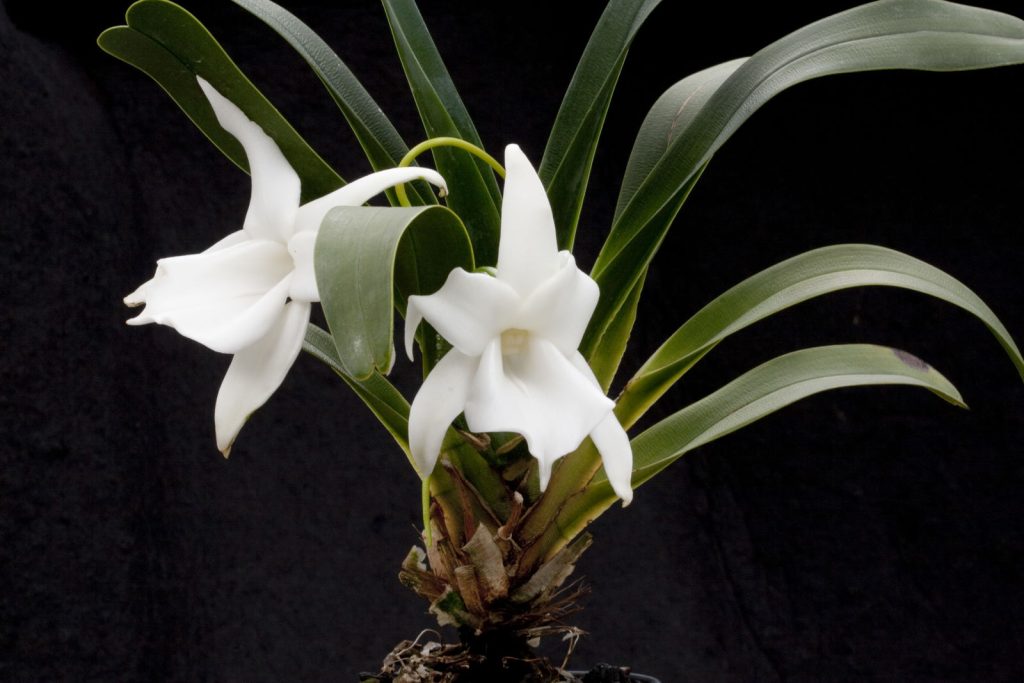
At a glance
RECORDED PROFILE DATA- Scientific name
- Angraecum magdalenae Schltr. & H.Perrier
- Name status
- Accepted
- Native region
- Madagascar
- Growth habit
- Epiphytic and lithophytic (mountain boulders, leaf litter)
- Cultivation temperature group
- Cool to intermediate (7–24 °C)
Names and Taxonomy
The accepted scientific name is Angraecum magdalenae Schltr. & H.Perrier, first published in 1925 in Repert. Spec. Nov. Regni Veg. Beih. [1]. The name is listed as accepted by Kew’s Plants of the World Online [1]. A later homotypic synonym is Rudolfangraecum magdalenae (Schltr. & H.Perrier) Szlach., Mytnik & Grochocka [3]. Two varieties are recognised: var. magdalenae (the nominal variety) and var. latiilabellum Bosser [1][8]. Common names recorded in horticultural sources include “Madeline’s Angraecum” and “Snow‑White Angraecum” [6][8].
How to Identify This Species
Growth habit: Primarily epiphytic but also lithophytic on quartzite boulders, forming a medium‑sized, monopodial plant [1][8][6].
Leaves: Six to eight short, distichous, fleshy‑coriaceous, oblong‑ligulate leaves; apices unequally bilobed [8].
Inflorescence: A short, bracteate spike 0.8–1.2 cm long arising from below the first leaf, bearing 1–5 flowers [8].
Flowers: Large, white, star‑shaped, 7.5–10 cm across; spur approximately 10 cm long; fragrance described as jasmine‑like and strongest at night [8][6][7].
Comparison: The long spur and night fragrance distinguish it from many other Angraecum species, which often have shorter spurs or different scent profiles.
Native Range and Habitat
Endemic to Madagascar, chiefly the central and eastern mountainous regions [1][2][8]. It inhabits seasonally dry tropical forest biomes, growing on quartzite boulders littered with decaying leaf material at elevations of 800–2000 m [8][6]. The species tolerates a distinct cool, dry season and receives bright but filtered light in its natural setting [11].
Species‑Specific Care
| Factor | Documented guidance | Source |
|---|---|---|
| Light | Bright, indirect light; slight shading during the hottest months mimics natural canopy exposure. | [11][8] |
| Temperature | Cool to intermediate: night lows ~7 °C (45 °F), day highs up to 24 °C (75 °F). Tolerates light frost. | [11] |
| Humidity | Moderate humidity; occasional mist to keep leaf‑litter substrate moist. | [8][11] |
| Watering | Keep the substrate (leaf litter or well‑draining bark) evenly moist but not water‑logged; reduce watering during the brief dry season. | [8][11] |
| Substrate / Mounting | Can be mounted on rock or grown in a very coarse, bark‑based mix enriched with leaf litter to replicate its lithophytic habit. | [6][8] |
| Fertiliser | Not documented for this species; a balanced orchid fertilizer applied at reduced strength during active growth is a common practice for related Angraecums. | Not documented |
| Repotting | Not documented; typically repotted when the bark medium breaks down, preferably after flowering. | Not documented |
| Seasonal care | Provide cooler night temperatures and slightly reduced watering in the winter to imitate the natural dry season. | [11][8] |
Overall, the most reliable cultivation approach is to mimic the cool, moderately humid, bright‑but‑filtered conditions of Madagascar’s mid‑altitude quartzite outcrops.
Flowering and Pollination
Flowering occurs in the later spring to early summer in its native range [8]. Individual flowers are long‑lasting (several weeks) and emit a strong jasmine‑like scent at night [6][7][8]. The long nectar spur suggests pollination by long‑tongued hawkmoths, a pattern common in the genus, but specific pollinator observations for A. magdalenae are not documented in the available sources.
Conservation and Responsible Cultivation
No formal conservation assessment (e.g., IUCN Red List category) is provided in the sources consulted. As an endemic species of Madagascar’s specialized mountain habitats, it may be susceptible to habitat loss; growers are encouraged to obtain plants from reputable, CITES‑compliant sources.
Evidence and Limitations
Key gaps include: precise population status, detailed fertilisation regimes, and confirmed pollinator records. Most horticultural recommendations derive from the species’ natural habitat description rather than controlled cultivation trials.
FOLLOW THE EVIDENCE
Sources & references
- Angraecum magdalenae Schltr. & H.Perrier | Plants of the World Online | Kew Science, https://powo.science.kew.org/taxon/urn:lsid:ipni.org:names:616244-1
- Angraecum magdalenae var. magdalenae | Plants of the World Online | Kew Science, https://powo.science.kew.org/taxon/urn:lsid:ipni.org:names:77167503-1
- Rudolfangraecum magdalenae | International Plant Names Index, https://www.ipni.org/n/77139252-1
- Angraecum magdalenae – Wikipedia, https://en.wikipedia.org/wiki/Angraecum_magdalenae
- Angraecum magdalenae (3D Digitization) – Smithsonian Gardens, https://3d.si.edu/object/3d/angraecum-magdalenae:a2450de8-106f-47c6-b018-93e56e93cb3e
- Angraecum magdalenae – Bloom (3D Digitization) – Smithsonian Gardens, https://3d.si.edu/object/3d/angraecum-magdalenae-bloom828bfad8-4ef2-453a-9aa8-e6c3015203eb
- IOSPE PHOTOS – Angraecum magdalenae, https://www.orchidspecies.com/angmagdalenae.htm
- Angraecum magdalenae Shows Herself! – Tom Kuligowski, https://orchids.herokuapp.com/articles/angraecum-magdalenae-shows-herself

