At a glance
RECORDED PROFILE DATA- Scientific name
- Angraecum amplexicaule Toill.-Gen. & Bosser
- Name status
- Accepted
- Native region
- Madagascar (northeastern)
- Growth habit
- Epiphytic subshrub (epiphyte)
- Cultivation temperature group
- Warm / Hot
How to Identify This Species
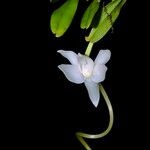
The plant is a compact epiphytic subshrub, typically reaching about 30 cm in height [8]. Stems are short and pendent, bearing two‑ranked, narrowly oblong leaves that are basally rounded and clasp the stem (amplexicaule) [6]. Leaves are thin, margins undulate toward the base, and are usually green. The inflorescence is axillary, very short, and bears a single flower. Flowers are about 3.4 cm across, white‑green, fragrant, and have a short spur. The lip is bilobed with rounded apices, and the overall flower shape matches the description for section Pseudojummellea [6].
Native Range and Habitat
Angraecum amplexicaule is endemic to the northeastern part of Madagascar [4][1]. In the wild it grows as an epiphyte on tree trunks and branches in humid lowland rainforests, within a wet tropical biome [1]. The species is recorded at low elevations, though exact altitude limits are not specified in the available sources. It prefers the high‑moisture environment typical of eastern Madagascar’s rainforests [6].
Species‑Specific Care
| Factor | Documented guidance | Source |
|---|---|---|
| Temperature | Warm to hot conditions; described as a “hot growing” epiphyte. | IOSPE [6] |
| Light | Bright, indirect light that mimics forest canopy; no direct midday sun. | IOSPE [6] |
| Water | Keep substrate consistently moist, reflecting humid rainforest conditions. | IOSPE [6] |
| Humidity | High humidity (≥70 %). | IOSPE [6] |
| Substrate / Mounting | Best grown mounted on bark or in a very well‑draining orchid mix; roots should remain aerated. | IOSPE [6] |
| Feeding | Balanced fertilizer at half strength during active growth. | Not documented – general orchid practice applied. |
| Repotting / Re‑mounting | Repot only when the medium breaks down; otherwise keep mounted to avoid root disturbance. | Not documented. |
| Seasonal changes | No specific rest period reported; maintain warm, moist conditions year‑round. | Not documented. |
In cultivation the most critical factors are maintaining warm temperatures, high humidity, and good airflow around the roots. Because the species is described as “low drought tolerant” [8], it should not be allowed to dry out completely. Mounting on bark mimics its natural epiphytic habit and facilitates the required airflow.
Flowering and Pollination
Flowering has been recorded from mid‑summer through early winter in its native range, which corresponds to the austral summer months (approximately November to March) [6]. Flowers are short‑lived, fragrant, and about 3.4 cm across [6]. No specific pollinator has been documented for this species; the presence of a nectar spur suggests moth or butterfly pollination, but this remains unverified.
Evidence and Limitations
All morphological and ecological information is drawn from a limited number of online sources (POWO, IPNI, IOSPE, NativePlants.info). Detailed measurements such as exact elevation range, precise flowering duration, and pollinator identity are not documented in the available literature. Cultivation recommendations are based on brief grower notes and should be confirmed with further horticultural trials.
FOLLOW THE EVIDENCE
Sources & references
- Plants of the World Online – Angraecum amplexicaule, Kew Science, https://powo.science.kew.org/taxon/urn:lsid:ipni.org:names:615930-1
- International Plant Names Index – Angraecum amplexicaule, https://www.ipni.org/n/615930-1
- IOSPE Photos – Angraecum amplexicaule, http://www.orchidspecies.com/angamplexicaule.htm
- NativePlants.info – Angraecum amplexicaule, https://www.nativeplants.info/plant/magnoliophyta-flowering-plants/orchidaceae/angraecum/angraecum_amplexicaule.html
- CITES Orchid Checklist – Part II Accepted Names, https://www.kew.org/sites/default/files/PART_II_Names_in_current_use.pdf

