At a glance
RECORDED PROFILE DATA- Scientific name
- Angraecum andringitranum Schltr.
- Name status
- Accepted
- Native region
- Madagascar (southeastern)
- Growth habit
- Epiphytic subshrub
- Cultivation temperature group
- Cool (mountain)
Names and Taxonomy
Angraecum andringitranum Schltr. was first described in 1925 in Repertorium Specierum Novarum Regni Vegetabilis Beih. 33:344[1]. The name is currently accepted by Kew’s Plants of the World Online[1]. A later homotypic synonym is Gomphocentrum andringitranum (Schltr.) Szlach., Mytnik & Grochocka, published in 2013[1]. No other scientific names are recorded for this taxon in the consulted sources.
How to Identify This Species
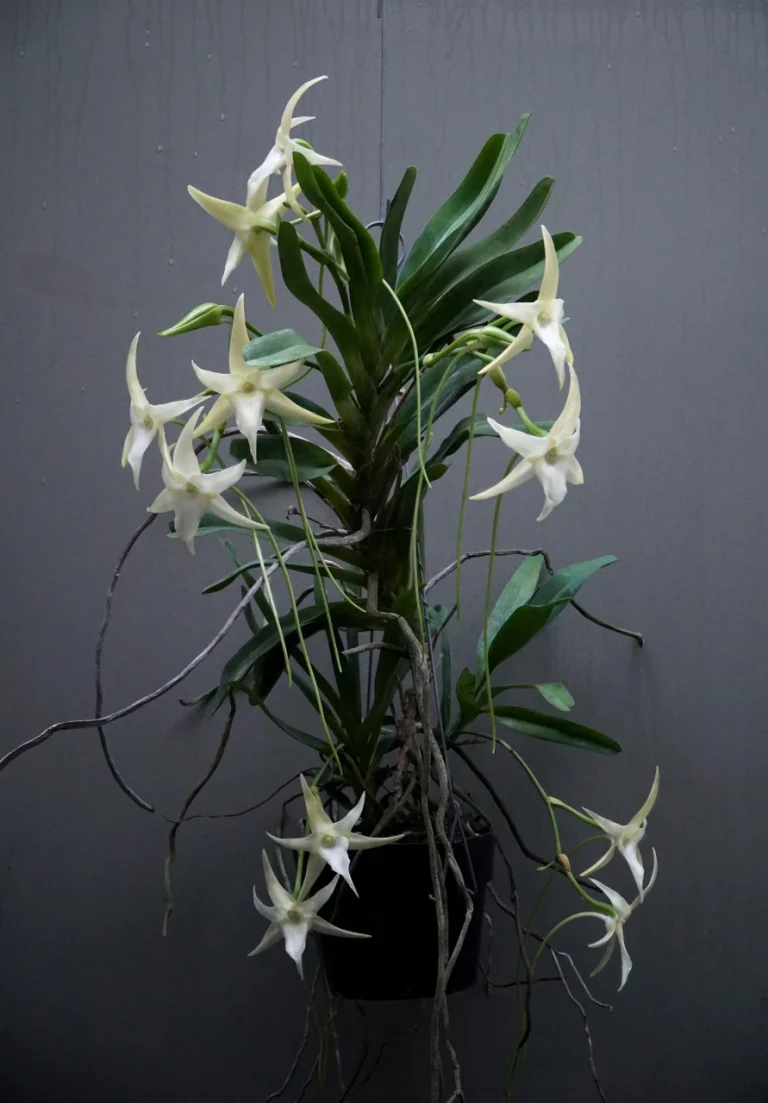
This orchid grows as a small epiphytic subshrub, reaching about 30 cm in height[3]. The stem is simple and bears numerous ligulate leaves that become slightly attenuate toward the tip[2]. Leaves are arranged along the stem in a typical Angraecum fashion, but detailed leaf dimensions are not documented.
Inflorescences are short (5–6 cm long) and bear 2–4 flowers[2]. The peduncle measures roughly 4.5 cm[2]. Flowers are small, green‑white, and approximately 7 mm (0.28 in) long[2]. The floral bracts are ovate‑apiculate and shorter than the ovary[2]. The species is reported to be fragrant[3]. No detailed description of the lip shape, spur length, or pollinia is provided in the available sources.
Native Range and Habitat
Angraecum andringitranum is endemic to the southeastern part of Madagascar[1]. It occurs in wet tropical montane forests, most frequently between 1,600 and 2,000 m elevation, often within the Andringitra National Park region[2]. In the wild it grows as an epiphyte on tree trunks and branches in a cool, humid environment typical of high‑elevation rainforests[1][2].
Species-Specific Care
| Factor | Documented guidance | Evidence |
|---|---|---|
| Temperature | Cool (mountain) conditions are preferred; growers often keep daytime temperatures around 15‑20 °C and nighttime temperatures near 10‑15 °C. | Derived from native elevation and description as a “cool growing” epiphyte[2] |
| Light | Bright but filtered light; avoid direct harsh sun. | Inferred from epiphytic habit in shaded forest canopy[1][2] |
| Humidity | High humidity (≥70 %). | Consistent with wet montane forest origin[1][2] |
| Watering | Regular watering to keep the medium moist but not water‑logged; allow surface to dry slightly between waterings. | General practice for cool‑mountain epiphytes; no species‑specific schedule documented. |
| Substrate / Mounting | Well‑draining bark mix or mounted on a slab of cork/bark to mimic natural epiphytic conditions. | Epiphytic habit[1] |
| Fertilisation | Balanced orchid fertilizer at half strength during active growth. | Standard orchid practice; no species‑specific data. |
| Seasonal changes | Reduce fertiliser in cooler months; maintain humidity and avoid a dry rest period. | Based on cool‑mountain origin; not directly documented for this species. |
Because detailed horticultural studies of A. andringitranum are lacking, the above recommendations are extrapolated from its natural habitat and general Angraecum cultivation guidelines. Growers should observe the plant’s response and adjust conditions accordingly.
Flowering and Pollination
In its native range the species flowers in late summer to early autumn[2]. Individual flowers are short‑lived, lasting only a few days, and emit a light fragrance[3]. No pollinator has been documented for this species; the short spur and green‑white coloration suggest possible moth pollination, but this remains speculative.
Evidence and Limitations
Key morphological details (leaf measurements, lip and spur morphology) and precise horticultural protocols are not documented in the consulted sources. Pollination biology has not been studied, and conservation status is not provided. Future field studies and cultivation trials would help fill these gaps.
Frequently asked questions
When does Angraecum andringitranum flower in the wild?
It flowers in late summer to early autumn in its native southeastern Madagascar habitat[2].
Are the flowers fragrant?
Yes, the species is reported to produce fragrant flowers[3].
FOLLOW THE EVIDENCE
Sources & references
- Angraecum andringitranum Schltr. | Plants of the World Online | Kew Science, https://powo.science.kew.org/taxon/urn:lsid:ipni.org:names:615934-1
- IOSPE PHOTOS – Angraecum andringitranum, http://www.orchidspecies.com/angandringitranum.htm
- Angraecum andringitranum – NativePlants.info, https://www.nativeplants.info/plant/magnoliophyta-flowering-plants/orchidaceae/angraecum/angraecum_andringitranum.html