At a glance
RECORDED PROFILE DATA- Scientific name
- Angraecum compactum Schltr.
- Name status
- Accepted (Kew POWO)
- Native region
- Madagascar
- Growth habit
- Epiphytic subshrub (miniature epiphyte)
- Cultivation temperature group
- Cool (per Milligan 2011); also cited as intermediate
Names and Taxonomy
Angraecum compactum Schltr. was first described in Beihefte zum Botanischen Centralblatt 34(2): 339 (1916) [2]. Kew’s Plants of the World Online lists the name as accepted and records its native range as Madagascar [1]. A later homotypic synonym is Perrierangraecum compactum (Schltr.) Szlach., Mytnik & Grochocka, published in 2013 [4]. No other synonyms or common names are documented in the available sources.
How to Identify This Species
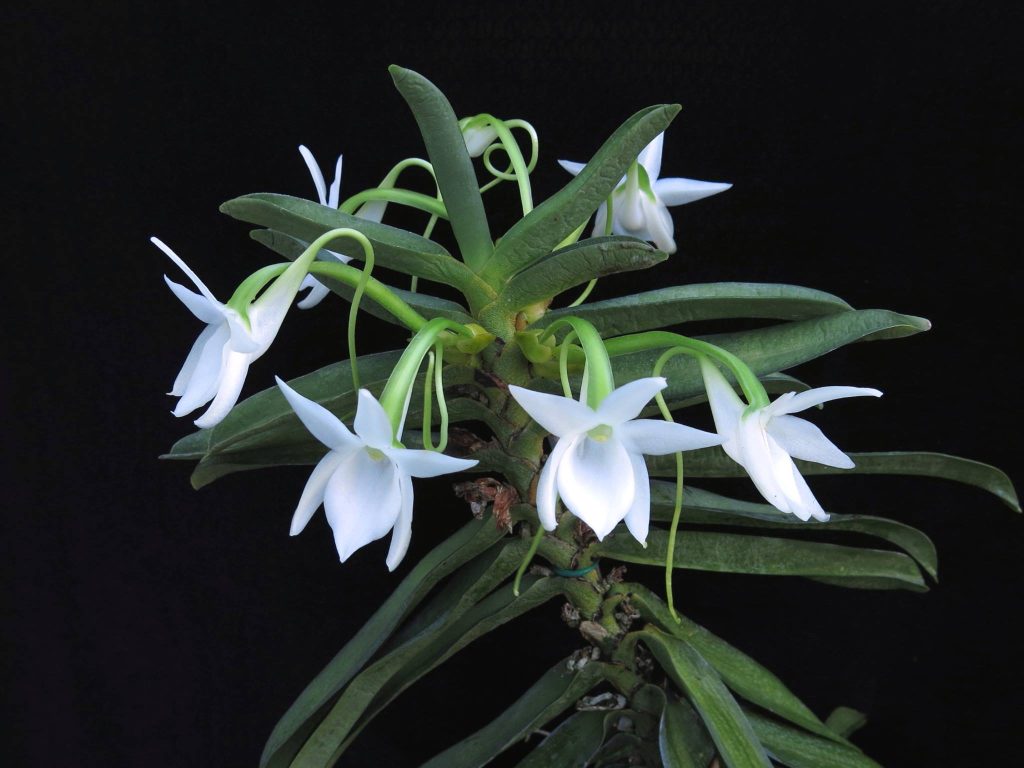
The plant is a miniature epiphytic subshrub, typically 5–15 cm tall, with a short, stout stem bearing 5–14 thick, leathery, folded leaves that are gray‑green and mottled [5][8]. Leaves are linear‑elliptic, about 35–38 mm long and 1.3–2.2 mm wide. The inflorescence is axillary, short, and bears 1–3 flowers that emerge from the leaf sheath.
The flower is white, 4–6 cm across, with a pronounced, fragrant (spicy‑to‑citrusy) nocturnal scent. The lip is modestly sized; the nectar spur is exceptionally long, about 10 cm (4 in) [5][8]. Flowering occurs in late winter through early summer in the native habitat.
Because many Angraecum species share a similar growth habit, identification should rely on the combination of leaf texture, flower size, and especially the long 10 cm spur.
Native Range and Habitat
Angraecum compactum is endemic to Madagascar, occurring in humid forest zones from 700 m to 2 000 m elevation [5][8][1]. It grows as an epiphyte on tree branches in the wet tropical biome, favoring shaded, well‑ventilated canopy positions.
Species‑Specific Care
| Factor | Documented guidance | Evidence |
|---|---|---|
| Light | 1200–2300 fc, filtered or diffused; avoid direct midday sun. | [11] |
| Temperature | Day 26–27 °C (78–80 °F) in summer; night 16 °C (60–61 °F). Diurnal range ~10 °C. | [11] |
| Humidity | 75–80 % most of the year, dropping to ~65 % briefly in spring. | [11] |
| Watering | Heavy watering during active growth (late spring–early autumn); reduce after new growth in autumn. | [11] |
| Fertilizer | ¼–½ strength balanced fertilizer weekly when growing; some growers switch to high‑N in spring‑summer and high‑P in late summer/autumn. | [11] |
| Air movement | Strong, continuous airflow is recommended. | [11] |
| Medium / Mounting | Well‑drained potting mix such as fir bark, shredded tree‑fern fiber, or a fast‑draining orchid bark blend; can also be mounted on a basket. | [11] |
| Seasonal rest | Not documented in the available sources. | Not documented |
Overall, the species prefers cool to intermediate conditions, high humidity, and bright but filtered light. The long spur and nocturnal fragrance suggest a reliance on night‑active pollinators, so maintaining a cool night temperature can help encourage flowering.
Flowering and Pollination
In the wild, flowering occurs from late winter through early summer [5][8]. Flowers are short‑lived, lasting several days, and emit a strong fragrance at night, indicating adaptation to nocturnal pollinators such as moths. The 10 cm nectar spur matches the proboscis length of large hawk moths, but specific pollinator observations for this species are not documented in the available literature.
Conservation and Responsible Cultivation
No formal conservation assessment (e.g., IUCN Red List) is cited in the supplied sources. As an endemic Madagascar orchid, habitat loss could be a concern, so growers should source plants from reputable, legally compliant nurseries.
Evidence and Limitations
Most morphological and ecological details are derived from orchid enthusiast sites (Orchid Species, IOSPE) and Kew’s taxonomic database. Cultivation data come from a single grower report (African Orchids) and may reflect conditions in a temperate greenhouse rather than the full range of possible practices. Pollinator information is inferred from flower morphology; direct field observations are lacking. Further peer‑reviewed studies would be valuable for confirming temperature group classification and conservation status.
Frequently asked questions
What light level does Angraecum compactum need?
The species prefers bright, filtered light of about 1200–2300 fc and should be protected from direct midday sun.
Can Angraecum compactum be grown on a mount?
Yes. In cultivation it is commonly grown in well‑drained pots or mounted in baskets with a fast‑draining bark or fern‑fiber medium.
Related terminology
- Epiphyte
- A plant that grows on another plant (usually a tree) but is not parasitic, obtaining moisture and nutrients from the air and rain.
- Spur (orchid)
- A tubular extension of the flower’s lip that contains nectar; length often correlates with the pollinator’s proboscis.
FOLLOW THE EVIDENCE
Sources & references
- Angraecum compactum Schltr. | Plants of the World Online | Kew Science, https://powo.science.kew.org/taxon/urn:lsid:ipni.org:names:616034-1
- Angraecum compactum | International Plant Names Index, https://www.ipni.org/n/616034-1
- Perrierangraecum compactum (Schltr.) Szlach., Mytnik & Grochocka | Plants of the World Online | Kew Science, https://powo.science.kew.org/taxon/urn:lsid:ipni.org:names:77139208-1
- Orchid Species: Angraecum compactum, https://www.orchids.org/grexes/angraecum-compactum
- IOSPE PHOTOS – Angraecum compactum, https://www.orchidspecies.com/angcompactum.htm
- Cultivation of Angraecum compactum Schltr., African Orchids, http://www.africanorchids.dk/?catid=299angraecum&id=3576cultivation-of-angraecum-compactum-schltr&view=article
- THE ORCHIDS OF MADAGASCAR by Brian Milligan – OSCOV, https://oscov.asn.au/articles/the-orchids-of-madagascar-by-brian-milligan/

