At a glance
RECORDED PROFILE DATA- Scientific name
- Angraecum urschianum Toill.-Gen. & Bosser
- Name status
- Accepted (Kew)
- Native region
- Madagascar (east‑central, ENE)
- Growth habit
- Epiphytic subshrub, miniature epiphyte
- Cultivation temperature group
- Not documented
Names and Taxonomy
The accepted name for this species is Angraecum urschianum Toill.-Gen. & Bosser, first published in Adansonia n.s., 1:101 (1961)【2】. Kew’s Plants of the World Online lists the name as accepted and records its native range as east‑northeastern Madagascar【1】. A later homotypic synonym is Perrierangraecum urschianum (Toill.-Gen. & Bosser) Szlach., Mytnik & Grochocka, published in 2013【1】. No vernacular names are documented in the available sources.
How to Identify This Species
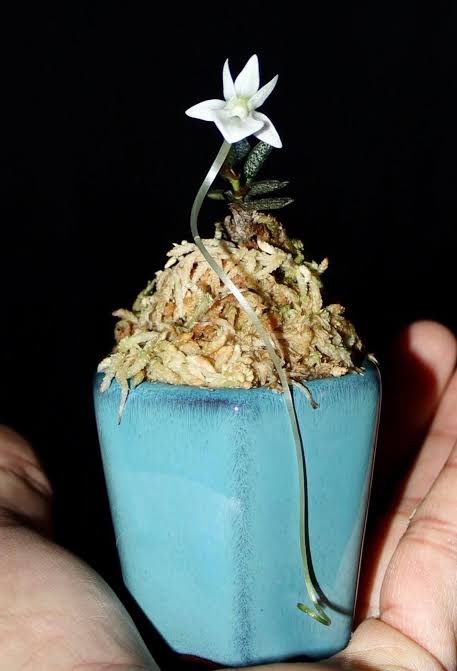
Growth habit. A very small epiphytic subshrub, typically 2–3 cm tall, with a densely leafed stem only 3–3.5 mm thick【5】. Roots are smooth, green, 1–1.5 mm in diameter.
Leaves. Leaves are thick, fleshy, 8–23 mm long and 5–8 mm wide, folded along the midrib, with denticulate margins and a surface covered by sunken dots. The leaf apex is unequally obtusely bilobed.
Inflorescence. Axillary, single‑flowered, peduncle 6–9 mm long, often half to fully concealed by 3–4 sheaths.
Flower. Flowers are medium‑sized (≈2.5 cm across). Sepals are pale green or greenish‑yellow, 10–11 mm long, 3 mm wide; lateral sepals are similar but slightly oblique. Petals are 9–9.5 mm long, 2–2.5 mm wide, five‑veined. The lip is white, 10–13 mm long by 7.5–9 mm wide, heavily veined (veins not visible on fresh flowers). A notable feature is the exceptionally long filiform spur, 11–12 cm in length【5】. The flower is not reported as fragrant.
Comparison. The combination of a very short stem, bilobed denticulate leaves, and an 11 cm spur distinguishes it from other miniature Angraecum such as A. dollii (shorter spur) and A. amplexicaule (larger plant).
Native Range and Habitat
The species is endemic to Madagascar, specifically the east‑central (ENE) region. It inhabits moss‑rich rainforests at moderate elevations of roughly 1000–1200 m above sea level【6】【5】. It grows as an epiphyte on tree trunks and branches, favouring humid, wet tropical conditions.
Species‑Specific Care
| Factor | Documented guidance | Source |
|---|---|---|
| Mounting / potting | Grown as a warm‑to‑cool epiphyte; growers report success on mounts or in very shallow, well‑draining media. | 12 |
| Light | Bright, filtered light mimicking forest canopy; avoid direct midday sun. | 12 |
| Temperature | Temperatures ranging from 10 °C night to 25 °C day are tolerated; one grower reported survival at 4 °C night in winter. | 12 |
| Watering | Keep the medium consistently moist but not waterlogged; daily watering reported during active growth. | 12 |
| Humidity | High humidity (≥70 %) replicates its rainforest origin. | 12 |
| Fertilisation | Not documented for this species; apply a balanced orchid fertilizer at half strength during growth. | Not documented |
| Rest period | Not documented; growers do not report a mandatory dry period. | Not documented |
Overall, the most critical requirements are high humidity, good air circulation, and a cool night temperature that reflects its montane forest origin. Because the plant is minute, it benefits from a shallow mounting surface that allows rapid drying of the roots between waterings.
Flowering and Pollination
In its native habitat the plant flowers in September, which corresponds to the early spring season in the southern hemisphere【5】. The flower lasts long enough for observation, but specific longevity is not documented. The long spur (11–12 cm) suggests adaptation to a sphinx moth pollinator with a proboscis of comparable length, a pattern common in many Angraecum species, though direct pollinator observations for A. urschianum are not recorded.
Evidence and Limitations
The profile draws on taxonomic data from Kew and IPNI, a detailed morphological description from African Orchids, and cultivation notes from an experienced grower on Orchid Board. Key gaps include the absence of formal studies on pollinators, precise flowering duration, and fertilisation regimes. Future field research and ex‑situ trials would help refine these aspects.
Frequently asked questions
How large does Angraecum urschianum grow?
Mature plants are only 2–3 cm tall with a stem thickness of 3–3.5 mm; leaves are up to 23 mm long.
When does Angraecum urschianum flower?
In the wild it flowers in September (early southern‑hemisphere spring); cultivated plants reported blooming in the fall.
What temperature range can this orchid tolerate?
Growers have kept it at night temperatures as low as 4 °C and day temperatures up to 25 °C, indicating a warm‑to‑cool tolerance.
FOLLOW THE EVIDENCE
Sources & references
- Plants of the World Online, Royal Botanic Gardens, Kew, 2026, https://powo.science.kew.org/taxon/urn:lsid:ipni.org:names:616467-1
- International Plant Names Index, Angraecum urschianum entry, 2026, https://www.ipni.org/n/616467-1
- African Orchids, Angraecum urschianum description, 2026, http://www.africanorchids.dk/?catid=299angraecum&id=978angraecum-urschianum&view=article
- Orchid Species: Angraecum urschianum, Orchids.org, 2026, https://www.orchids.org/grexes/angraecum-urschianum
- IOSPE PHOTOS, Angraecum urschianum page, 2026, https://www.orchidspecies.com/angurschianum.htm
- Orchid Board, Angraecum urschianum discussion, 2026, https://www.orchidboard.com/community/vanda-alliance-angraecum-aerangis/115662-angraecum-urschianum.html

