At a glance
RECORDED PROFILE DATA- Scientific name
- Angraecum stella-africae P.J.Cribb
- Name status
- Accepted
- Native region
- Malawi, Zimbabwe, South Africa (Limpopo Province)
- Growth habit
- Epiphytic herb/subshrub
- Cultivation temperature group
- Cool (montane) – documented as cool‑growing in native habitat
Names and Taxonomy
Angraecum stella-africae P.J.Cribb is the accepted name for this species according to Kew Plants of the World Online[1]. The name was first published in Malawi Orchids 1:34 (1983). A later homotypic synonym is Perrierangraecum stella-africae (P.J.Cribb) Szlach., Mytnik & Grochocka[1]. No other competing names are documented.
How to Identify This Species
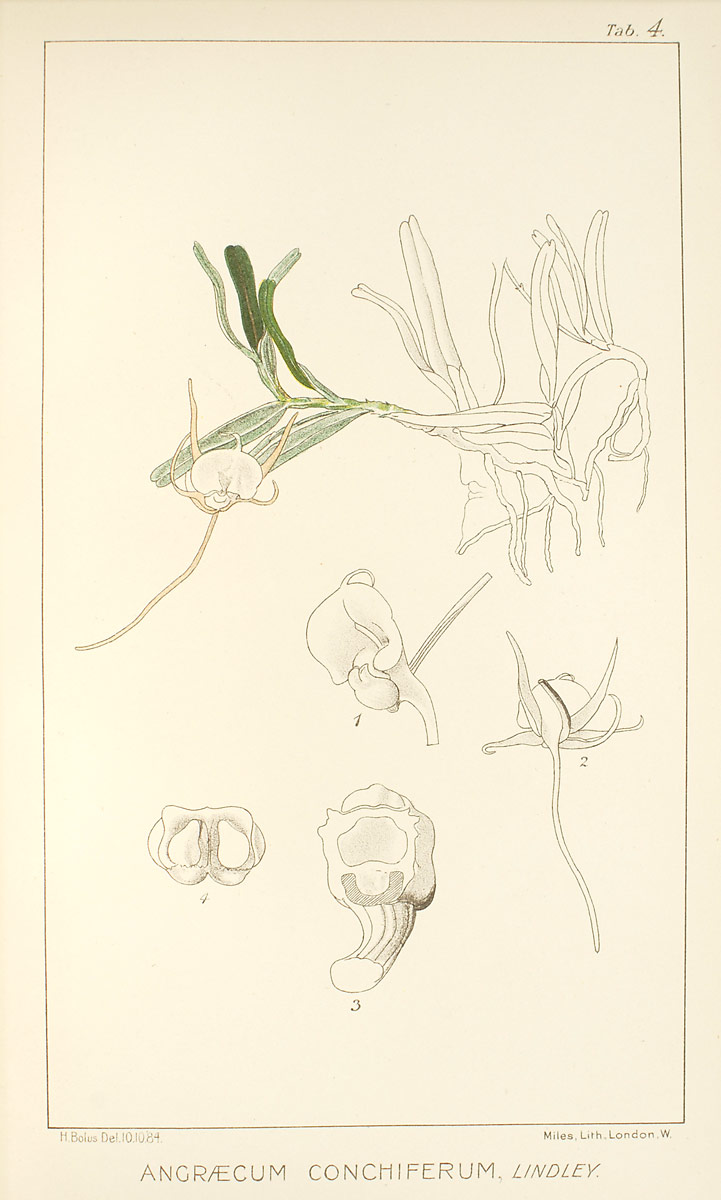
This is a very small epiphytic herb. The stem is short and the plant forms a compact, subshrubby habit. Leaves are distichous, linear, 3–5.5 cm long, 3–4 mm wide, dark gray‑green and obscurely bilobed at the apex[2]. The inflorescence arises from the base of the leaves, bears a single flower and is 1–2 cm long. The flower is white, about 5 cm (2 in) across, with a very long, initially curled spur that straightens as the flower opens[2][3]. The lip is prominent, typical of the genus, and the sepals are about 20 mm long. The plant is miniature; the entire habit is only a few centimetres tall, making the large flower especially striking. Similar small Angraecum species (e.g., A. affinis) lack the extreme spur length and differ in leaf size, but reliable identification relies on the combination of leaf dimensions, single‑flowered inflorescence, and spur morphology.
Native Range and Habitat
The species is native to three countries in southern‑central Africa: Malawi, Zimbabwe and the Limpopo Province of South Africa[1][4][5]. In the wild it grows as an epiphyte on small trees (often Brachystegia species) and on escarpments within Brachystegia woodland. It prefers mist‑frequent, seasonally dry tropical biomes at elevations of roughly 1 200–1 600 m[2][4]. The habitat is characterised by a cool, moist microclimate in summer and a drier, cooler winter.
Species-Specific Care
| Factor | Documented guidance | Source |
|---|---|---|
| Light | Bright, indirect light; semi‑shaded conditions are optimal. | [3] |
| Temperature | Cool to intermediate; the species originates from montane sites and tolerates a cooler winter. | [2][3] |
| Water / Humidity | Very high humidity (≥70 %) in summer; regular misting or soaking. Reduce watering in the cooler winter months. | [3] |
| Mounting / Potting | Best grown mounted on bark or in a very well‑draining medium that remains moist but not water‑logged. | [2] |
| Feeding | Not specifically documented for this species; a balanced half‑strength fertilizer during active growth is commonly used for Angraecum spp. | Not documented |
| Seasonal changes | Provide a drier period in winter to mimic the natural cool, less humid season. | [3] |
In practice, growers report that maintaining cool daytime temperatures (around 18–22 °C) and cooler nights (12–15 °C) together with high summer humidity produces the best growth and encourages flowering. Because the plant is miniature, it benefits from good airflow to prevent rot on the mounted bark.
Flowering and Pollination
Flowering has been recorded in December–January in Zimbabwe[4] and described as occurring in late spring to early summer in other observations[2]. Individual flowers are long‑lived, remaining in prime condition for more than a week[5]. The flower’s long spur contains nectar; however, capsule development in wild specimens is normal, indicating that the species readily self‑pollinates[5]. No specific pollinator has been documented.
Conservation and Responsible Cultivation
The South African Red List (2009) classifies the species as “Rare”[5]. In Zimbabwe the Red Data listing describes it as “Critically Endangered” due to its extremely small and localized populations[4]. All known South African sites lie within protected wilderness areas, but the overall rarity and limited distribution make wild collection a serious threat. Cultivation from seed or tissue culture is encouraged to reduce pressure on natural populations.
Evidence and Limitations
Most morphological data come from field photographs and brief descriptions; detailed measurements of flower parts, exact temperature ranges, and fertilisation regimes are not documented in the available sources. Pollination observations are limited to capsule development, and no pollinator has been recorded. Future field studies and controlled cultivation trials would help fill these gaps.
Frequently asked questions
What light conditions does Angraecum stella-africae need?
The species prefers bright, indirect light in a semi‑shaded setting, mimicking the dappled canopy of its native woodland habitat. (Source: Pumpkin Beth)
Does Angraecum stella-africae self‑pollinate?
Capsule development in wild plants indicates that the orchid readily self‑pollinates, although no specific pollinator has been recorded. (Source: SANBI Red List)
When does this orchid flower in the wild?
Flowering has been observed in December–January in Zimbabwe and described as occurring in late spring to early summer in other parts of its range. (Sources: Flora of Zimbabwe; IOSPE)
FOLLOW THE EVIDENCE
Sources & references
- Angraecum stella-africae P.J.Cribb | Plants of the World Online | Kew Science, 2026, https://powo.science.kew.org/taxon/urn:lsid:ipni.org:names:901458-1
- IOSPE PHOTOS – Angraecum stella-africae, P.J.Cribb 1983, https://orchidspecies.com/angstela-africae.htm
- Pumpkin Beth – Angraecum stella-africae, 2020, https://www.pumpkinbeth.com/plants/angraecum-stella-africae/
- Flora of Zimbabwe – Angraecum stella-africae, https://www.zimbabweflora.co.zw/speciesdata/species.php?species_id=118630
- SANBI Red List of South African Plants – Angraecum stella-africae, 2009 assessment, https://redlist.sanbi.org/species.php?species=2762-7
- Flora of Malawi – Angraecum stella-africae, https://www.malawiflora.com/speciesdata/species.php?species_id=118630