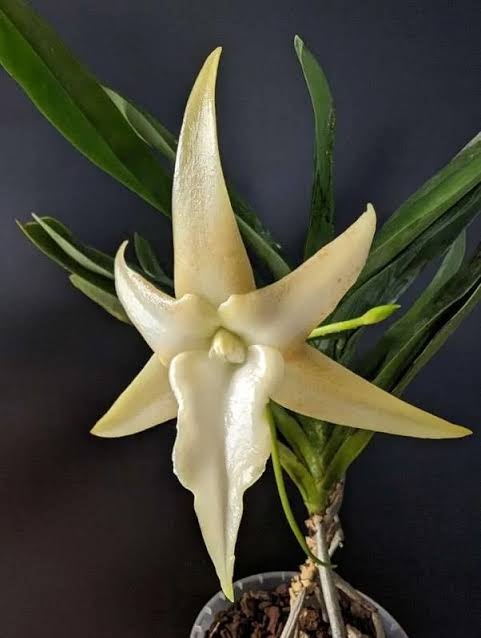
At a glance
RECORDED PROFILE DATA- Scientific name
- Angraecum sesquipedale var. angustifolium Bosser & Morat
- Name status
- Accepted
- Native region
- Madagascar (south‑east, reported also from south‑west)
- Growth habit
- Terrestrial subshrub
- Cultivation temperature group
- Not documented
Names and Taxonomy
The accepted scientific name is Angraecum sesquipedale var. angustifolium Bosser & Morat, first published in Adansonia 12: 77 (1972) and listed as an accepted infraspecific taxon by Kew Plants of the World Online[1]. It is a variety of the species Angraecum sesquipedale Thouars, which comprises two accepted varieties: var. sesquipedale and var. angustifolium[2].
A homotypic synonym recorded by POWO is Angraecum bosseri Senghas (1973)[1]. The variety is occasionally referred to by the common name “Narrow Leafed Angraecum sesquipedale” in the IOSPE database[5].
How to Identify This Species
Field reports describe the plant as a terrestrial subshrub with a comparatively narrow leaf set and a reduced overall size relative to the typical epiphytic form of the species[1][5]. Key diagnostic features include:
- Growth habit: terrestrial, often on sandy substrates.
- Leaves: narrower and shorter than those of var. sesquipedale (exact measurements not documented).
- Inflorescence: short, bearing only one to two flowers per spike[5].
- Flower morphology: similar overall shape to the species, but smaller; no specific dimensions are published.
Because quantitative leaf and flower measurements are not available in the cited sources, identification should be confirmed by comparing the plant’s habit and flower count with the typical form of A. sesquipedale.
Native Range and Habitat
POWO records the native range of the variety as south‑east Madagascar, occurring in the seasonally dry tropical biome[1]. IOSPE notes occurrences in south‑west Madagascar, describing the plant as “often in sand” and emphasizing its terrestrial habit[5]. The habitat is therefore understood to be dry forest or scrubland on sandy soils, at unknown elevation (not documented).
Species-Specific Care
| Factor | Documented guidance | Evidence |
|---|---|---|
| Growth substrate | Terrestrial; prefers sandy, well‑draining medium | IOSPE observation[5] |
| Light | Not documented | – |
| Temperature | Not documented | – |
| Watering | Not documented | – |
| Humidity | Not documented | – |
| Fertilisation | Not documented | – |
| Repotting / mounting | Not documented | – |
| Seasonal changes | Not documented | – |
Because detailed horticultural data for this variety are lacking, growers are advised to treat it as a terrestrial Angraecum, using a well‑draining orchid mix (e.g., bark and coarse sand) and providing moderate shade. Monitoring the plant’s response and adjusting water and temperature to mimic the dry seasonal climate of south‑east Madagascar will help achieve healthy growth.
Flowering and Pollination
Specific flowering time and pollinator information for var. angustifolium have not been published[1][5]. The parent species, A. sesquipedale, is famously pollinated by the hawk moth Xanthopan morganii due to its long nectar spur, but whether the narrower‑spurred variety shares the same pollination ecology remains unverified.
Evidence and Limitations
The profile relies on a limited set of taxonomic and horticultural sources. Quantitative morphological data (leaf length, flower dimensions, spur length) and detailed cultivation guidelines are absent. Native‑range reports differ between south‑east and south‑west Madagascar, reflecting a need for further field verification. Until more comprehensive studies are available, the information above represents the current documented knowledge.
FOLLOW THE EVIDENCE
Sources & references
- Angraecum sesquipedale var. angustifolium Bosser & Morat | Plants of the World Online | Kew Science, https://powo.science.kew.org/taxon/urn:lsid:ipni.org:names:887238-1
- Angraecum sesquipedale var. angustifolium Bosser & Morat 1972 | IOSPE PHOTOS, http://www.orchidspecies.com/angsesvarangustifolia.htm
- Angraecum sesquipedale var. angustifolium – orchidroots, https://orchidroots.com/display/summary/orchidaceae/9686/
- Angraecum sesquipedale Thouars | Plants of the World Online | Kew Science, https://powo.science.kew.org/taxon/urn:lsid:ipni.org:names:616416-1

