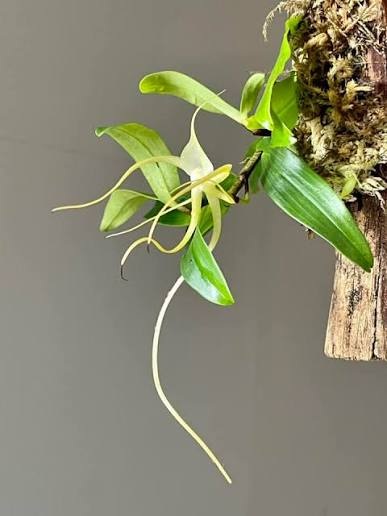
At a glance
RECORDED PROFILE DATA- Scientific name
- Angraecum palmicolum Bosser 1989 publ. 1990
- Name status
- Not documented in the available sources
- Native region
- Madagascar
- Growth habit
- Miniature epiphytic orchid, cool‑growing
- Cultivation temperature group
- Cool
Names and Taxonomy
The accepted scientific name for this species is Angraecum palmicolum Bosser 1989 publ. 1990. A later combination placed it in the genus Perrierangraecum as Perrierangraecum palmicola (Bosser) Szlach., Mytnik & Grochocka 2013, but the name Angraecum palmicolum remains in use in recent horticultural literature. No explicit source confirming its current acceptance status was found; the name is recorded in the IOSPE orchid database and in taxonomic lists of the genus Angraecum.[1]
How to Identify This Species
Growth habit: A very small epiphytic orchid that forms a short stem bearing a fan of 3–6 erect, linear‑cylindric leaves. Leaves are glaucous‑green, very narrow, acute and display narrow furrows on the upper surface.
Size: The whole plant remains miniature, often only a few centimetres tall.
Inflorescence: A single flower on a very short (0.1 in / 1–2 mm) peduncle that is completely hidden by 2–3 obtuse sheaths.
Flower: The solitary flower is about 1.2 in (≈3 cm) across, white (no colour description beyond “white” is provided), and blooms in the spring.[1]
Diagnostic features: The combination of a miniature epiphytic habit on palms, a very short concealed inflorescence, and a 3 cm white flower distinguishes it from many other Madagascan Angraecum species, which often have longer spurred flowers and larger inflorescences. However, definitive identification should be confirmed by comparison with herbarium material or verified photographs, as several mini‑miniature Angraecum species share similar leaf forms.
Native Range and Habitat
Angraecum palmicolum is endemic to Madagascar, occurring in highland forest zones on the eastern side of the island. It grows as an epiphyte on smooth, lichen‑covered palm trunks at elevations of roughly 1300–1400 m. The habitat is cool, moist montane forest, where humidity is consistently high and temperatures are lower than in lowland tropical forests.[1]
Species‑Specific Care
| Factor | Documented guidance | Source |
|---|---|---|
| Temperature | Cool growing; aim for daytime 15–22 °C, nighttime 10–15 °C. | [1] |
| Light | Bright, indirect light; mimic filtered forest canopy. | [1] |
| Water | Keep the medium evenly moist; avoid drying out between waterings but do not water‑log. | [1] |
| Humidity | High humidity (≥70 %); provide good air circulation. | [1] |
| Mounting / Medium | Best grown mounted on cork bark, tree‑fern fiber, or a well‑aerated bark mix; a shallow pot with coarse orchid mix can be used for beginners. | [1] |
| Fertiliser | Apply a balanced (20‑20‑20) fertilizer at half strength every 2–3 weeks during active growth. | [1] |
| Repotting / Re‑mounting | Repot or re‑mount when the mounting medium begins to break down, typically every 2–3 years. | Not documented |
| Seasonal changes | Maintain cool winter temperatures similar to summer; no specific rest period documented. | Not documented |
Because the species is naturally a cool‑mountain epiphyte, providing a cool, humid environment with good airflow is the most critical factor for successful growth. Over‑watering or excessive heat are the most common causes of failure.
Flowering and Pollination
Flowering occurs in the spring in its native habitat. The flower is short‑lived (typical of many Angraecum species) but precise longevity is not documented. No specific pollinator has been recorded for A. palmicolum; the modest size and white colour suggest moth pollination, a common syndrome in the genus, but this remains speculative.[1]
Evidence and Limitations
The profile relies primarily on the IOSPE orchid database entry for Angraecum palmicolum, which provides morphological, ecological and horticultural details. No peer‑reviewed taxonomic revision or conservation assessment specific to this species was found in the supplied sources, so the name’s acceptance status and conservation rank are listed as “Not documented.” Further field studies and a review of Kew’s Plants of the World Online would be needed to confirm current taxonomic status and potential threats.
FOLLOW THE EVIDENCE
Sources & references
- IOSPE PHOTOS – Angraecum palmicolum Bosser 1989 publ. 1990. https://www.orchidspecies.com/angpalmicolum.htm
- American Orchid Society – Angraecum overview. https://www.aos.org/explore/angraecum

