At a glance
RECORDED PROFILE DATA- Scientific name
- Angraecum sanfordii P.J.Cribb & B.J.Pollard
- Name status
- Accepted
- Native region
- West-Central Tropical Africa (Cameroon)
- Growth habit
- Epiphytic subshrub
- Cultivation temperature group
- Not documented
Names and Taxonomy
The accepted scientific name is Angraecum sanfordii P.J.Cribb & B.J.Pollard, first published in Kew Bulletin 57: 653 (2002) [2]. Kew Plants of the World Online lists this name as accepted [1]. A later homotypic synonym is Conchograecum sanfordii (P.J.Cribb & B.J.Pollard) Szlach., Grochocka, Oledrz. & Mytnik (2018) [1]. No common name is recorded in the available sources.
How to Identify This Species
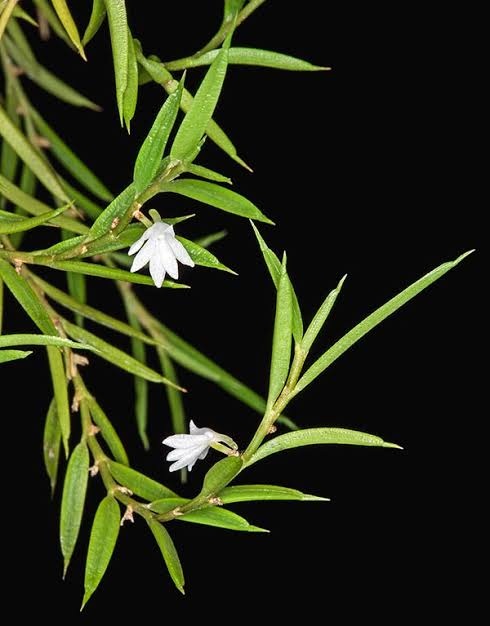
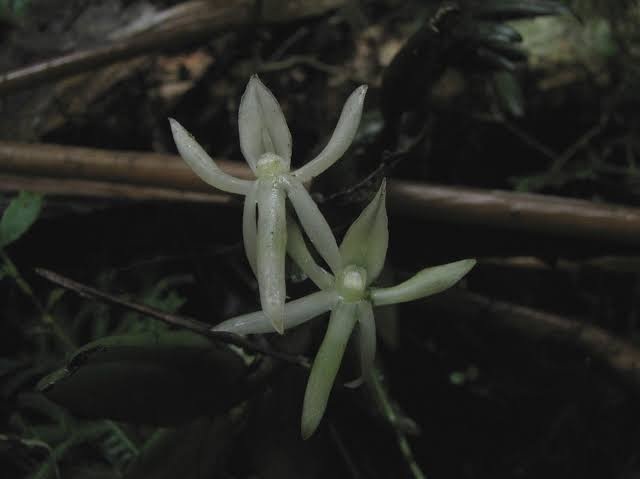
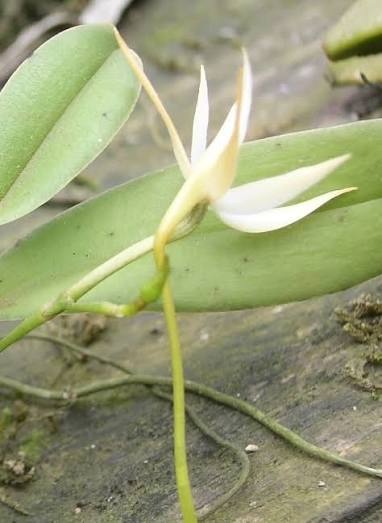
Angraecum sanfordii is an epiphytic subshrub that typically reaches about 30 cm in height [4]. Leaves are arranged along a short, branching stem and are leathery, a common trait in many Angraecum species, but the species is distinguished by its white‑green flowers that are reported as fragrant [4]. The flowers possess the characteristic long nectar spur of the genus, though exact spur length for this species is not documented in the sources consulted. Blooming has been observed throughout the year in its native range [4]. Because detailed morphometric data (e.g., flower size, lip shape) are lacking, identification should be confirmed with a herbarium specimen or by comparison with the original description.
Native Range and Habitat
The orchid is endemic to the southwest region of Cameroon, specifically recorded from Mount Kupe and Mount Cameroon [3]. It inhabits submontane and montane forest zones, growing as an epiphyte on tree trunks and large branches within the wet tropical biome [1]. Elevational data are not provided in the sources, but the reference to “mount” habitats suggests an occurrence above 1,000 m. The species is confined to humid, shaded canopy environments where it receives filtered light and high ambient humidity.
Species-Specific Care
| Factor | Documented guidance | Evidence |
|---|---|---|
| Growth habit | Epiphytic; mount on bark or place in a well‑aerated orchid mix containing coarse bark and sphagnum. | POWO, NativePlants.info [1][4] |
| Light | Not documented; recommend bright, indirect light based on typical Angraecum requirements, but specific data are absent. | Not documented |
| Temperature | Not documented; native montane habitat suggests cool to intermediate temperatures, but precise ranges are not published. | Not documented |
| Watering | Not documented; epiphytic habit implies regular watering to keep the substrate moist but not water‑logged. | Not documented |
| Humidity | Not documented; native wet tropical forest indicates high humidity (>70%). | Not documented |
| Feeding | Not documented; typical orchid fertilizer regimes may be applied, but no species‑specific study. | Not documented |
| Propagation | Seed germination requires symbiotic mycorrhizal fungi or sterile asymbiotic agar medium; conventional cold stratification is not applicable. | NativePlants.info [4] |
Because detailed horticultural trials are lacking, growers should treat this species as a specialist epiphyte, providing ample air flow, high humidity, and a mounting substrate that mimics tree bark. Monitor for signs of desiccation, which the species is reported to tolerate poorly.
Flowering and Pollination
Flowering has been reported throughout the year in its native habitat [4]. The flowers emit a fragrance, a trait that often signals moth pollination in the Angraecum genus, but no direct pollinator observations have been recorded for A. sanfordii. Consequently, the pollination biology remains undocumented.
Conservation and Responsible Cultivation
The International Union for Conservation of Nature (IUCN) classifies Angraecum sanfordii as Endangered (EN) [5]. Threats include habitat loss due to forest clearing and agricultural expansion on the mountains of Cameroon. Cultivation from seed or tissue culture, when done under appropriate permits, can reduce pressure on wild populations.
Evidence and Limitations
Key aspects such as precise flower dimensions, elevation range, temperature tolerances, and pollinator identity are not documented in the available sources. The care recommendations are therefore based on general epiphytic orchid principles rather than species‑specific trials. Further field studies and horticultural experiments are needed to fill these gaps.
Frequently asked questions
What is the conservation status of Angraecum sanfordii?
It is listed as Endangered (EN) on the IUCN Red List, reflecting a high risk of extinction in the wild.
What type of substrate does Angraecum sanfordii require?
The species is epiphytic; in cultivation it should be mounted on bark or grown in a coarse, well‑aerated orchid mix that mimics tree bark.
When does Angraecum sanfordii flower?
Flowering has been reported throughout the year in its native habitat.
Related terminology
- Epiphyte
- A plant that grows upon another plant (such as a tree) non‑parasitically, deriving its moisture and nutrients from the air, rain, and debris accumulating around it.
- Endangered (EN)
- IUCN Red List category indicating a species faces a very high risk of extinction in the wild.
FOLLOW THE EVIDENCE
Sources & references
- Plants of the World Online – Angraecum sanfordii, Kew Science, https://powo.science.kew.org/taxon/urn:lsid:ipni.org:names:20007991-1
- International Plant Names Index – Angraecum sanfordii, https://www.ipni.org/n/20007991-1
- Wikipedia – Angraecum sanfordii, https://en.wikipedia.org/wiki/Angraecum_sanfordii
- NativePlants.info – Angraecum sanfordii, https://www.nativeplants.info/plant/magnoliophyta-flowering-plants/orchidaceae/angraecum/angraecum_sanfordii.html
- IUCN Red List – Angraecum sanfordii (2004 assessment), https://doi.org/10.2305/iucn.uk.2004.rlts.t46351a11051072.en