At a glance
RECORDED PROFILE DATA- Scientific name
- Angraecum atlanticum Stévart & Droissart
- Name status
- Synonym of Afropectinariella atlantica (accepted by Kew)
- Native region
- Equatorial Guinea, Gabon (West‑Central Tropical Africa)
- Growth habit
- Epiphytic subshrub with pendant stems
- Cultivation temperature group
- Warm (22–32 °C day, ≥16 °C night)
Names and Taxonomy
The name Angraecum atlanticum Stévart & Droissart was published in Systematic Botany 35(2): 253 (2010) [2]. Kew’s Plants of the World Online records this name as a synonym of Afropectinariella atlantica (Droissart & Stévart) M.Simo & Stévart, which is the currently accepted name in that database [1][3]. Some taxonomic authorities, however, continue to accept Angraecum atlanticum (e.g., Govaerts 2011) [1]. No widely used common name is documented for this species.
How to Identify This Species
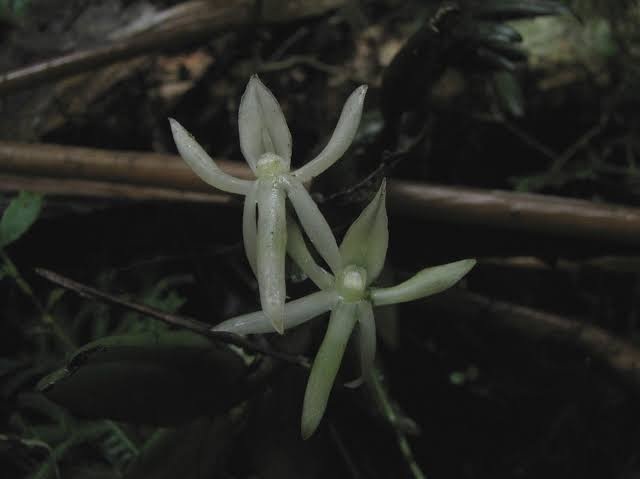
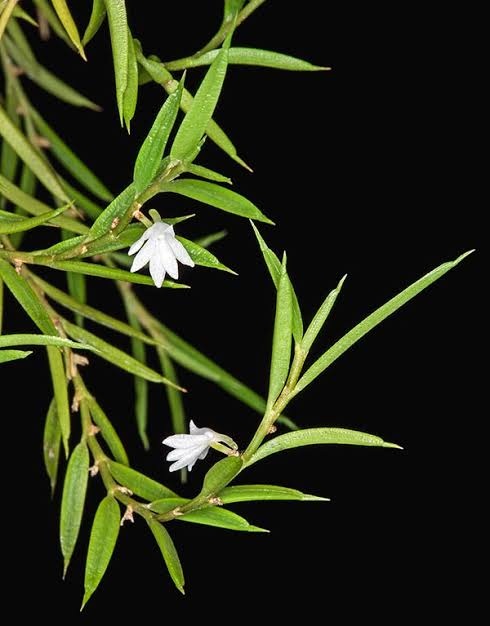
Plants are epiphytic subshrubs with pendant, branched stems up to 25–35 cm long and about 0.8–1 mm in diameter [5][4]. Leaves are distichous, fleshy, elliptic‑oblong, 10–16 mm long and 1.8–2.2 mm wide, folded along the mid‑vein to form a channel [5]. Roots are succulent, up to 0.5 mm thick, and form a dense mat on the host bark.
Inflorescences are usually solitary, arising opposite a leaf or along the stem, bearing a single white, fragrant flower on a short pedicel (4–6 mm) [4][5]. Sepals are almost equal, ovate‑elliptic, 4–5.5 mm long and 1–1.7 mm wide; petals are similar in length but slightly narrower. The labellum is ovate‑triangular, 2.5–4 mm long, with an acute apex, and bears a short spur 2.5–4 mm long that is slightly inflated in the middle [5][4]. Flower size is modest; the whole flower is only a few millimetres across.
The combination of a very narrow leaf (≈2 mm wide), a slightly inflated spur, and a single small white flower distinguishes it from the closely related Angraecum gabonense, which has broader leaves and longer sepals [5].
Native Range and Habitat
The species is known from two countries in the Atlantic Central African region: Equatorial Guinea (Monte Alén National Park, Engong inselnberg) and Gabon (Moukalaba‑Doudou and Ivindo National Parks) [2][5]. It occurs in sub‑montane forest and forest‑edge thickets between 600 m and 1 200 m elevation, often on moss‑covered trunks in humid, semi‑shaded conditions rich in epiphytes [5][4]. The distribution follows the Atlantic sector of the Lower Guinea phytogeographic domain.
Species‑Specific Care
| Factor | Documented guidance | Source |
|---|---|---|
| Temperature | Day 22–32 °C; night not below 16 °C | [4] |
| Light | Intermediate, semi‑shaded; avoid direct harsh sun | [4] |
| Humidity | 75–85 % relative humidity; good airflow | [4] |
| Mounting | Best grown mounted on tree‑fern fibre or bark slabs; roots should remain airy | [5][4] |
| Watering | Keep substrate moist but not water‑logged; mist frequently in the morning | [4] |
| Fertilisation | Regular balanced orchid fertilizer at half strength during active growth | Not documented |
| Repotting / Re‑mounting | Refresh mounting material every 2–3 years or when roots become overly thick | Not documented |
| Seasonal changes | No distinct rest period reported; maintain warm, humid conditions year‑round | Not documented |
In practice growers have successfully cultivated the species in greenhouse conditions that mimic its native sub‑montane environment: a warm, humid house with moderate light, frequent morning mist, and a well‑ventilated mount. Using rain water or de‑mineralised water is recommended to avoid mineral buildup.
Flowering and Pollination
Flowering time in the wild has not been recorded in the available sources; the species is noted as producing a single white, fragrant flower, suggesting nocturnal scent emission typical of many Angraecum species, but specific pollinator observations are lacking [5][4].
Conservation and Responsible Cultivation
The IUCN Red List assesses Angraecum atlanticum as Near Threatened (2014) due to its limited known sub‑populations and habitat specificity [6]. Cultivation from seed or division in botanical institutions can reduce collection pressure on wild populations.
Evidence and Limitations
This profile is based on a limited set of published descriptions, herbarium data, and a single cultivation report. Key gaps include precise flowering phenology, detailed pollinator information, and long‑term cultivation trials. Future field studies and ex‑situ observations would help refine care recommendations and conservation status.
Frequently asked questions
Is Angraecum atlanticum the same as Afropectinariella atlantica?
Yes. According to Kew’s Plants of the World Online, Angraecum atlanticum is treated as a synonym of Afropectinariella atlantica, the accepted name for this taxon.
What temperature range does Angraecum atlanticum need in cultivation?
Growers report a warm range of 22–32 °C during the day and night temperatures that do not fall below 16 °C, matching the conditions of its sub‑montane forest habitat.
Is this species endangered?
The IUCN Red List classifies it as Near Threatened (2014) because it is known from only three sub‑populations in protected areas.
FOLLOW THE EVIDENCE
Sources & references
- Angraecum atlanticum Stévart & Droissart | Plants of the World Online | Kew Science, http://powo.science.kew.org/taxon/urn:lsid:ipni.org:names:77107560-1
- Angraecum atlanticum | International Plant Names Index, https://www.ipni.org/n/77107560-1
- Afropectinariella atlantica (Droissart & Stévart) M.Simo & Stévart | Plants of the World Online | Kew Science, https://powo.science.kew.org/taxon/urn:lsid:ipni.org:names:60476171-2
- Angraecum atlanticum – Monaco Nature Encyclopedia, https://www.monaconatureencyclopedia.com/angraecum-atlanticum-2/?lang=en
- Angraecum atlanticum prot.pdf, https://epidendra.com/taxones/Angraecum/Angraecumatlanticum/angraecum_atlanticum_prot.pdf
- Angraecum atlanticum | Wikipedia, https://en.wikipedia.org/wiki/Angraecum_atlanticum