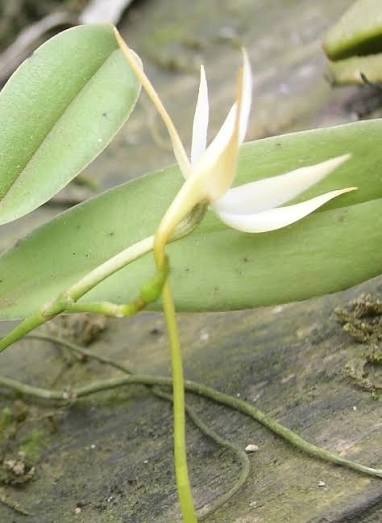
At a glance
RECORDED PROFILE DATA- Scientific name
- Angraecum crassifolium (Cordem.) Schltr.
- Name status
- Accepted
- Native region
- Madagascar; Réunion
- Growth habit
- Epiphytic subshrub
- Cultivation temperature group
- Not documented
Names and Taxonomy
Angraecum crassifolium (Cordem.) Schltr. is accepted as a distinct species by Kew’s Plants of the World Online[1]. The name was first published in Beih. Bot. Centralbl., Abt. 2 33: 433 (1915). Several synonyms have been recorded, including Mystacidium crassifolium Cordem. (the basionym) and Angraecum cordemoyi Schltr., which is treated as a heterotypic synonym in the same database[2]. Additional homotypic synonyms listed by POWO are Gomphocentrum crassifolium and Gomphocentrum acutipetalum.[1] No vernacular (common) name is documented in the available sources.
How to Identify This Species
The plant is an epiphytic subshrub that typically reaches about 30 cm in height[4]. Leaves are arranged along a short stem; detailed leaf morphology is not documented in the sources consulted. The inflorescence bears white to greenish‑white flowers that are reported to be fragrant[4]. Blooming may occur in any month, suggesting a prolonged or continuous flowering period[4]. No quantitative data on flower size, spur length, or lip shape are available in the cited material, so identification should be corroborated with herbarium specimens or expert confirmation.
Native Range and Habitat
Angraecum crassifolium occurs naturally on the islands of Madagascar and Réunion[1][4][9]. In the wild it is an epiphyte growing on tree branches within wet tropical forest biomes[1]. Specific elevation limits have not been recorded, nor are particular host tree species noted. The species is therefore associated with humid, shaded canopy environments typical of montane and lowland rainforests on these islands.
Species-Specific Care
| Factor | Documented Guidance | Evidence / Context |
|---|---|---|
| Growth habit | Epiphytic; mount on bark or grow in a very well‑draining medium | Native epiphytic habit[1] |
| Light | Not documented | — |
| Temperature | Not documented | — |
| Watering | Not documented | — |
| Humidity | High humidity, similar to wet tropical forest | Inferred from native habitat[1] |
| Fertilisation | Not documented | — |
| Seasonal rest | Not documented | — |
Because the only reliable information concerns the species’ natural epiphytic habit and its occurrence in consistently moist, humid forests, growers should aim to provide high air humidity (≥70 %) and a mounting substrate that remains moist but well‑aerated. Light, temperature, and fertilisation regimes have not been published for this taxon; growers are advised to follow general Angraecum guidelines and adjust based on plant response.
Flowering and Pollination
Flowers are reported to be fragrant and to appear throughout the year in their native range[4]. No detailed description of flower longevity, nectar spur dimensions, or specific pollinator observations is available in the cited literature. Consequently, pollination mechanisms remain undocumented for this species.
Evidence and Limitations
The profile is based on data from Kew’s Plants of the World Online, NativePlants.info, a generic Angraecum compendium, and the CITES Orchid Checklist. Key aspects such as precise flower morphology, elevation range, detailed cultural requirements, and pollinator identities are not documented in the accessed sources. Further field studies or horticultural reports would be needed to fill these gaps.
Frequently asked questions
Is Angraecum crassifolium fragrant?
Yes. The species is reported to produce fragrant white‑green flowers in its native habitat.
When does Angraecum crassifolium flower?
Blooming has been recorded throughout the year, indicating a potentially continuous flowering period.
Can Angraecum crassifolium be grown in a pot?
Specific potting recommendations are not documented; the plant is naturally epiphytic, so mounting on bark or using a very well‑draining medium is advisable.
FOLLOW THE EVIDENCE
Sources & references
- Angraecum crassifolium (Cordem.) Schltr. | Plants of the World Online | Kew Science, https://powo.science.kew.org/taxon/urn:lsid:ipni.org:names:616052-1
- Angraecum cordemoyi Schltr. | Plants of the World Online | Kew Science, https://powo.science.kew.org/taxon/urn:lsid:ipni.org:names:616041-1
- Angraecum crassifolium | NativePlants.info, https://www.nativeplants.info/plant/magnoliophyta-flowering-plants/orchidaceae/angraecum/angraecum_crassifolium.html
- Angraecum Orchids, Orchid Care, Orchid Compendium, http://www.clanorchids.com/compendium/page3a.html
- CITES Orchid Checklist (Part II: Accepted names in current use), https://www.kew.org/sites/default/files/PART_II_Names_in_current_use.pdf