At a glance
RECORDED PROFILE DATA- Scientific name
- Angraecum sambiranoense Schltr.
- Name status
- Accepted
- Native region
- Madagascar
- Growth habit
- Epiphytic pendant subshrub
- Cultivation temperature group
- Not documented
Names and Taxonomy
The accepted scientific name is Angraecum sambiranoense Schltr.[1]. It was first described in Repert. Spec. Nov. Regni Veg. Beih. 33: 329 (1925). A later homotypic synonym is Perrierangraecum sambiranoense (Schltr.) Szlach., Mytnik & Grochocka (2013)[1]. No other synonyms or varieties are recorded in the consulted sources. The name is accepted by Kew’s Plants of the World Online.
How to Identify This Species
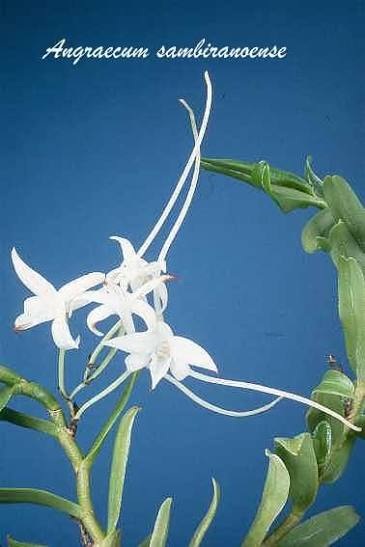
Growth habit: A pendant, epiphytic subshrub that forms long, slender, hanging stems. Mature plants reach about 40 cm in height[5].
Leaves: Leathery, oblong‑ligulate leaves that are spreading and unequally bilobed at the tip. Leaves are arranged along the upper part of the stem.
Inflorescence: A short, 7–10 mm long, 2–3‑folded sheathed raceme that bears a single flower.
Flower: The solitary flower is about 3 cm across, white to green‑white, and emits a fragrance. The lip is typical of Angraecum, and a slender nectar spur extends from the base (exact length not documented). Flowering occurs in mid‑summer[3].
Comparison: It may resemble other north‑western Madagascan Angraecum species such as A. ambrense, but the combination of a pendant habit, single short inflorescence, and the specific leaf shape helps separate it.
Native Range and Habitat
Endemic to northern and central Madagascar[1]. It inhabits humid evergreen forests of the Sambirano region, typically at elevations of 700–800 m[3]. The species grows as an epiphyte on tree branches within a wet tropical biome, indicating a preference for high humidity and consistent moisture.
Species‑Specific Care
| Factor | Documented guidance | Source |
|---|---|---|
| Growth medium | Mount on well‑draining bark or grow in a coarse orchid mix that retains some moisture but allows airflow. | Habitat inference from epiphytic habit[1] |
| Light | Bright indirect light, mimicking forest canopy; direct sun should be avoided. | Not documented – inferred from native forest shade[1] |
| Watering | Keep the medium consistently moist but not water‑logged; increase watering during active growth. | Habitat humidity (wet tropical biome) indicates high water availability[1] |
| Humidity | Maintain high humidity (70 % or higher) to reflect the humid evergreen forest. | Wet tropical biome description[1] |
| Temperature | Warm conditions are preferred; specific temperature range not documented. | Not documented |
| Fertilisation | Apply a balanced, water‑soluble orchid fertilizer at half strength during the growth period. | Not documented; standard orchid practice. |
| Airflow | Good air movement is important to prevent fungal problems on hanging stems. | Epiphytic habit in humid forest[1] |
| Seasonal rest | Not documented. | Not documented |
In practice, growers mount the plant on cork or tree‑fern fiber, mist daily, and keep the pot in a well‑ventilated greenhouse that stays above 18 °C year‑round. Because the species is native to a consistently moist environment, it does not tolerate prolonged drying.
Flowering and Pollination
The plant produces a single fragrant flower in mid‑summer[3]. The flower lasts several weeks, but exact longevity is not documented. The long, narrow spur suggests pollination by a hawk‑moth with a proboscis matching the spur length, a common pattern in Angraecum, yet no specific pollinator has been recorded for this species.
Evidence and Limitations
Information on this species is limited to taxonomic databases, a horticultural description, and a general plant‑information site. Detailed measurements of the nectar spur, precise temperature tolerances, and confirmed pollinator observations are not documented in the available sources. Cultivation recommendations are therefore based on habitat inference rather than controlled trials.
Frequently asked questions
How tall does Angraecum sambiranoense grow?
Mature plants reach about 40 cm in height in cultivation, matching observations from native habitats.
Is the flower of Angraecum sambiranoense fragrant?
Yes, the single flower is described as fragrant in horticultural accounts.
When does this orchid flower?
It blooms in mid‑summer, producing a single flower on a short inflorescence.
FOLLOW THE EVIDENCE
Sources & references
- Angraecum sambiranoense Schltr. | Plants of the World Online | Kew Science, https://powo.science.kew.org/taxon/urn:lsid:ipni.org:names:616394-1
- IOSPE PHOTOS – Angraecum sambiranoense, https://www.orchidspecies.com/angsamborinense.htm
- Angraecum sambiranoense – NativePlants.info, https://www.nativeplants.info/plant/magnoliophyta-flowering-plants/orchidaceae/angraecum/angraecum_sambiranoense.html

