At a glance
RECORDED PROFILE DATA- Scientific name
- Angraecum expansum Thouars
- Name status
- Accepted
- Native region
- Réunion, Mauritius
- Growth habit
- Epiphytic subshrub
- Cultivation temperature group
- Not documented
Names and Taxonomy
The accepted scientific name for this species is Angraecum expansum Thouars (published 1822) [1][3]. Kew’s Plants of the World Online lists the name as accepted and places it in the family Orchidaceae, subfamily Epidendroideae, tribe Vandeae [1]. Several historical synonyms exist, including Aeranthes expansa (Thouars) S.Moore, Aerobion expansum (Thouars) Spreng., Epidorkis expansa (Thouars) Kuntze, and Angorkis expangis Thouars [1][12].
Local French‑Creole names recorded for the species are “Petit faham” and “Ti‑faham” [6][11].
How to Identify This Species
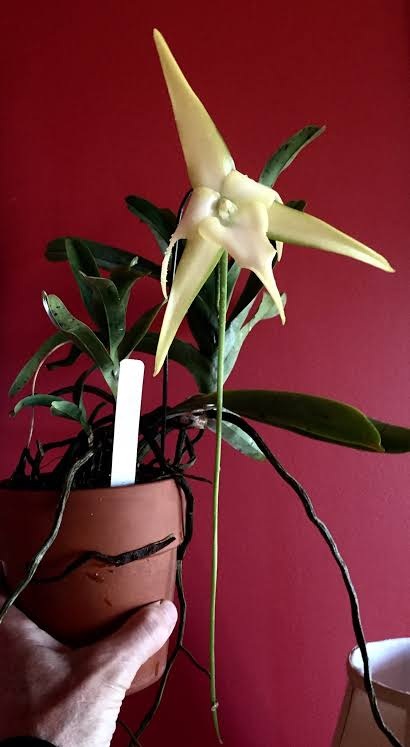
Growth habit: A pendulous, epiphytic subshrub whose stems reach about 30–40 cm in length and often curve horizontally before drooping [11].
Leaves and roots: Typical of many Angraecum, the plant bears several leathery, opposite leaves along the stem and a dense mat of aerial roots that attach to host branches. Detailed leaf measurements are not documented in the available sources.
Flower characteristics: Flowers are produced singly in the leaf axils, usually between November and February in the wild [11]. Each flower measures roughly 5–6 cm across, with sepals and petals that are pale green to green‑yellowish. The labellum (lip) is white and positioned atop the flower, while a long, downward‑curving spur extends from the lip’s base. The fragrance is reported as strong and sweet, typical of many night‑pollinated Angraecum species [11].
Because several Angraecum species share a similar pendulous habit and greenish flowers, identification should be confirmed by the combination of flower size, the distinctive white lip, and the long curved spur.
Native Range and Habitat
Angraecum expansum is native to the Mascarene Islands, specifically Réunion and Mauritius [1][7]. It is an epiphyte of humid forest, most often found on large horizontal branches within mature woodland. Observations on Réunion record the species across the whole island, typically at elevations of 1 000–2 000 m, within a mesothermic climate zone [6][11]. The habitat is characterized by high humidity, frequent cloud cover, and moderate temperatures relative to sea‑level conditions.
Species‑Specific Care
| Factor | Documented guidance | Source |
|---|---|---|
| Growth habit | Epiphytic; can be mounted on cork bark or grown in a well‑draining bark mix. | [10] |
| Temperature | Not documented; native elevation suggests preference for cool‑to‑moderate conditions. | Not documented |
| Light | Not documented; in the wild it receives dappled forest light. | Not documented |
| Watering | Medium drought tolerance reported; avoid prolonged dryness. | [10] |
| Humidity | Not documented; native humid forest implies high humidity is beneficial. | Not documented |
| Feeding | Not documented. | Not documented |
| Repotting / mounting | Not documented; typical practice for epiphytic Angraecum is to refresh bark medium every 2–3 years. | Not documented |
| Seasonal changes | Not documented; wild flowering occurs in the southern summer (Nov–Feb). | [11] |
Because detailed horticultural guidelines are scarce, growers should aim to replicate the cool, moist forest conditions of the species’ native range: moderate temperatures, bright indirect light, high humidity, and a well‑aerated bark substrate. Monitor the plant for signs of stress and adjust watering accordingly.
Flowering and Pollination
In its natural habitat, A. expansum flowers from November through February, producing solitary, long‑lasting blooms that emit a sweet fragrance at night [11]. The flower’s long, curved spur suggests adaptation to sphingid (hawkmoth) pollinators, a common pollination syndrome in the genus, but direct observations of pollinators for this species are not documented in the sources consulted.
Conservation and Responsible Cultivation
The species is listed as “LC – taxon de préoccupation mineure” (Least Concern) in the regional assessment for Réunion [7]. While it is not considered threatened, it remains endemic to a limited island range, so responsible sourcing and cultivation from propagated material are recommended.
Evidence and Limitations
Most morphological and ecological information derives from regional flora observations and herbarium records. Precise horticultural parameters (temperature ranges, light intensity, fertilizer regimes) are not documented in the available literature, and pollinator identities have not been recorded. Future field studies and cultivation trials would help fill these gaps.
FOLLOW THE EVIDENCE
Sources & references
- Angraecum expansum Thouars | Plants of the World Online | Kew Science, https://powo.science.kew.org/taxon/urn:lsid:ipni.org:names:616114-1
- Angraecum expansum | International Plant Names Index, https://www.ipni.org/n/616114-1
- Petit faham - Angraecum expansum | atlas - SINP de La Réunion, https://geonature.borbonica.re/atlas/espece/705833
- index F005 | http://orchidees-run.vandes.com/fiche-ind-angraecum-expansum.html
- Angraecum expansum (NativePlants.info), https://www.nativeplants.info/plant/magnoliophyta-flowering-plants/orchidaceae/angraecum/angraecum_expansum.html
- WFO Plant List snapshot for Angraecum expansum, https://wfoplantlist.org/taxon/wfo-0000976873-2023-12
- Index de la flore – Angraecum expansum entry, https://mascarine.cbnm.org/index.php/flore/index-de-la-flore/nom?code_taxref=705833