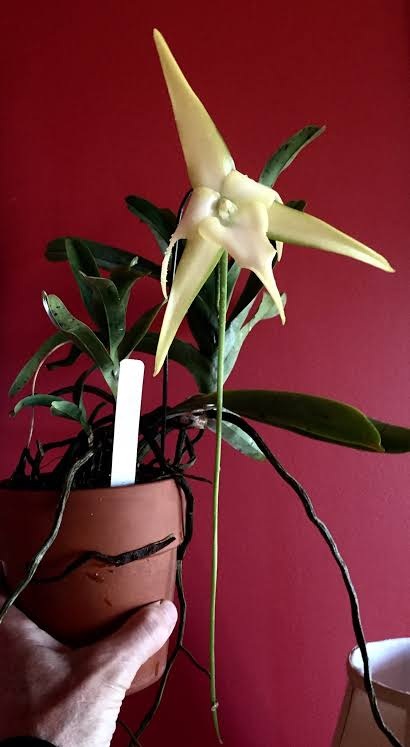
At a glance
RECORDED PROFILE DATA- Scientific name
- Angraecum parvulum Ayres ex S.Moore
- Name status
- Synonym of Angraecum parvulum (accepted)
- Native region
- Mauritius, Réunion (Mascarene Islands)
- Growth habit
- Miniature epiphytic orchid
- Cultivation temperature group
- Cool (mountain)
Names and Taxonomy
The name Angraecum nanum Frapp. ex Cordem. was published in 1895. Current taxonomic consensus lists it as a heterotypic synonym of Angraecum parvulum Ayres ex S.Moore, which is the accepted species name according to Kew’s Plants of the World Online[1]. Synonyms recorded for the taxon include:
- Lesliegraecum nanum (Frapp. ex Cordem.) Szlach., Mytnik & Grochocka (2013)
- Mystacidium nanum (Frapp. ex Cordem.) Cordem. (1899)
No widely used common name is documented; the horticultural source IOSPE refers to it as “The Little Angraecum”[2].
How to Identify This Species
Plants are minute epiphytic subshrubs with a short, compact stem that bears a fan of dark‑green, linear leaves. Leaves are canaliculate (grooved) and unequally bilobed at the apex. The inflorescence is axillary, short (about 1.5 cm long), and carries only a few flowers. Individual flowers are extremely small, approximately 3 mm (0.12 in) across. Floral colour, spur length, and detailed lip morphology are not documented in the available sources.[2]
Because the species is diminutive and shares many traits with other miniature Angraecum taxa, identification should be confirmed by comparison with herbarium material or expert‑verified photographs.
Native Range and Habitat
Angraecum nanum occurs naturally on the Mascarene islands of Mauritius and Réunion[2]. It inhabits shady, humid forest interiors at elevations around 2000 m, where temperatures are cool to cold. The orchid grows as an epiphyte on tree branches, favouring well‑drained bark or mossy substrates.
Species‑Specific Care
| Factor | Documented guidance | Evidence |
|---|---|---|
| Temperature | Cool conditions, roughly 10‑18 °C (50‑64 °F) | Inferred from native montane habitat[2] |
| Light | Low to medium light; mimic deep forest shade | Inferred from “shady humid forest” description[2] |
| Humidity | High humidity (≥70 %); maintain moist air | Inferred from humid forest habitat[2] |
| Watering | Regular watering to keep roots moist but not water‑logged; allow surface to dry slightly between waterings | General epiphytic practice aligned with humid environment[2] |
| Mounting / Medium | Best grown mounted on bark, tree‑fern fibre or in a very coarse, well‑aerated orchid mix | Epiphytic habit in nature[2] |
| Fertilisation | Not documented for this species; a balanced, diluted fertilizer applied during active growth is typical for miniature Angraecums | General orchid cultivation guidance (no species‑specific source) |
| Repotting / Re‑mounting | Only when roots become overly dense; handle with care due to small size | General practice for small epiphytes |
All cultivation recommendations are extrapolated from the species’ natural habitat because specific horticultural studies for Angraecum nanum are not available.
Flowering and Pollination
Flowering occurs in late spring in the native range[2]. Individual flowers are very small (≈3 mm) and are borne on short axillary spikes about 1.5 cm long. No information on fragrance, nectar spur length, or pollinator identity is documented for this taxon.
Evidence and Limitations
The taxonomic status relies on Kew’s Plants of the World Online, which treats Angraecum nanum as a synonym of Angraecum parvulum. Morphological and ecological details come from the IOSPE horticultural entry; no peer‑reviewed field studies were found. Consequently, cultivation advice is inferred from habitat description rather than experimentally verified. Further field observations and horticultural trials would improve the completeness of this profile.
Frequently asked questions
Is Angraecum nanum a distinct species?
Current taxonomic consensus treats Angraecum nanum as a heterotypic synonym of Angraecum parvulum, which is the accepted name according to Kew's Plants of the World Online.
What size are the flowers of Angraecum nanum?
The flowers are very small, about 3 mm (0.12 in) across, and are borne on short axillary spikes roughly 1.5 cm long.
Can I grow Angraecum nanum in a home collection?
Specific cultivation protocols are not documented, but because it naturally occurs in cool, humid, shaded montane forests, growers should provide low light, high humidity, and cool temperatures, ideally mounting the plant on bark.
FOLLOW THE EVIDENCE
Sources & references
- Angraecum parvulum Ayres ex S.Moore | Plants of the World Online | Kew Science, https://powo.science.kew.org/taxon/urn:lsid:ipni.org:names:616322-1
- IOSPE PHOTOS – Angraecum nanum Frapp. ex Cordem. 1895, https://www.orchidspecies.com/angnanum.htm

