At a glance
RECORDED PROFILE DATA- Scientific name
- Angraecum multinominatum Rendle
- Name status
- Accepted
- Native region
- West Tropical Africa to Gabon
- Growth habit
- Epiphytic subshrub
- Cultivation temperature group
- Not documented
Names and Taxonomy
The accepted scientific name of this orchid is Angraecum multinominatum Rendle. Kew’s Plants of the World Online lists the name as accepted and records the original publication in Catalogue des Plantes d’Oban 107 (1913) [1]. Several homotypic synonyms have been applied, including Listrostachys clavata Rendle (1895), Angraecum clavatum (Rendle) Schltr., and the recent combination Conchograecum multinominatum (Rendle) Szlachetko et al. (2018) [2]. No common names are documented in the available sources.
How to Identify This Species
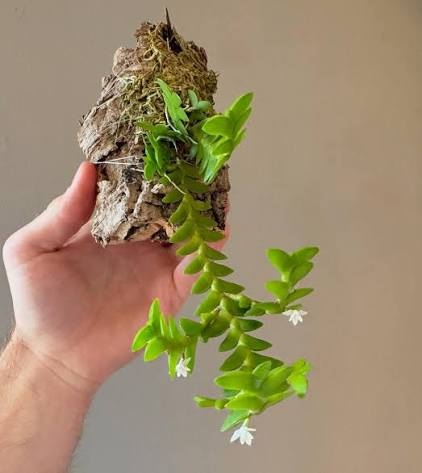
Angraecum multinominatum is an epiphytic subshrub that forms short, slightly compressed stems bearing oblanceolate to oblong leaves that are unequally bilobed at the apex. The plant reaches roughly 30 cm in height in the wild [4]. The inflorescence is erect, slender, usually single‑flowered, and appears in late winter to spring [3]. Flowers are small, about 2 cm long (‰0.8″), with a whitish‑green coloration and occasional yellow tones [3]. Key floral measurements (from Limodore) are:
- Spur length: 11–14 mm
- Dorsal sepal: 8–12 mm × 3–6 mm
- Lateral sepals: 8–10 mm × 3–4 mm
- Labellum (lip): 7–9 mm × 4–6 mm, ovate to rhombic
These dimensions, together with the single‑flowered inflorescence and the short spur, help separate it from similar West African species such as Angraecum affine, which typically bears larger, multiple flowers.
Native Range and Habitat
The species is native to West Tropical Africa, extending from Ghana and Côte d’Ivoire eastward through Nigeria, Cameroon, Equatorial Guinea to Gabon [1][4]. It grows as an epiphyte on trees in semi‑deciduous woodlands, usually at elevations of 200–300 m above sea level [3]. The native biome is classified as wet tropical forest, with high humidity and a warm temperature regime.
Species‑Specific Care
| Factor | Documented guidance | Source |
|---|---|---|
| Temperature | Not documented | |
| Light | Not documented | |
| Watering | Not documented | |
| Humidity | Not documented | |
| Mounting / Potting | Not documented | |
| Feeding | Not documented | |
| Repotting / Re‑mounting | Not documented | |
| Seasonal changes | Not documented |
Specific horticultural recommendations for A. multinominatum have not been published in the sources consulted. Growers should therefore emulate the warm, humid, low‑light conditions of its native lowland forest, using well‑aerated epiphytic media (e.g., fine bark) and maintaining steady moisture without waterlogging. Observations from related Angraecum species suggest a preference for high humidity (>70 %) and bright‑indirect light, but these are not documented for this species.
Flowering and Pollination
In the wild the plant blooms in late winter through spring, producing a single flower per inflorescence [3]. Flower longevity and fragrance are not recorded in the available literature. The short spur (11–14 mm) suggests pollination by small moths, a common pattern in many Angraecum species, but no pollinator has been observed for A. multinominatum specifically.
Evidence and Limitations
The profile relies on taxonomic and distribution data from Kew’s Plants of the World Online and supplementary country listings from NativePlants.info. Morphological details come from a French orchid site (Limodore) and the IOSPE photo database. No peer‑reviewed monograph or field study provides comprehensive cultivation or pollination information; consequently many horticultural fields remain undocumented. Future field observations and controlled cultivation trials would be needed to refine care recommendations and confirm pollinator relationships.
Frequently asked questions
How tall does Angraecum multinominatum grow in the wild?
Plants reach about 30 cm in height in their natural habitat.
Does Angraecum multinominatum have a noticeable fragrance?
Fragrance has not been documented for this species.
When does Angraecum multinominatum typically flower?
Flowering occurs in late winter to spring in its native range.
FOLLOW THE EVIDENCE
Sources & references
- Angraecum multinominatum Rendle. Plants of the World Online, Kew Science. https://powo.science.kew.org/taxon/urn:lsid:ipni.org:names:616286-1
- Limodore – Auteur Angraecum multinominatum. https://limodore.france-orchidees.org/angraecum/angraecum-multinominatum/angraecum-multinominatum.html
- IOSPE PHOTOS – Angraecum multinominatum. http://www.orchidspecies.com/angmultinominatum.htm
- Angraecum multinominatum | NativePlants.info. https://www.nativeplants.info/plant/magnoliophyta-flowering-plants/orchidaceae/angraecum/angraecum_multinominatum.html