At a glance
RECORDED PROFILE DATA- Scientific name
- Angraecum aporoides Summerh.
- Name status
- Accepted
- Native region
- Nigeria to West‑Central Tropical Africa
- Growth habit
- Epiphytic subshrub
- Cultivation temperature group
- Not documented
Names and Taxonomy
The accepted scientific name is Angraecum aporoides Summerh.[1][2] The name was first published in Kew Bulletin 17: 560 (1964). Kew Plants of the World Online lists the name as accepted and places it in the family Orchidaceae, subfamily Epidendroideae, tribe Vandeae, subtribe Angraecinae.[1]
Synonyms recorded in the Catalogue of Life and GBIF include:
- Angraecum distichum var. grandifolium (De Wild.) Summerh.
- Mystacidium distichum var. grandifolium De Wild.
- Dolabrifolia aporoides (Summerh.) Szlach. & Romowicz
No common names were found in the cited sources.
How to Identify This Species
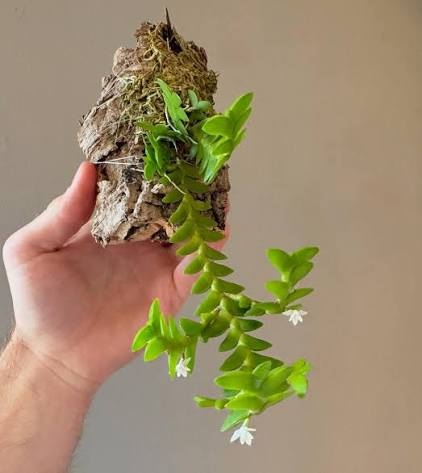
Growth habit: Small to medium‑sized epiphytic subshrub forming tightly clustered pseudobulbs on short, often pendant stems.[1][3]
Leaves: Distichous, fleshy, bright‑green, conduplicate (folded lengthwise), obtuse‑tipped; typical leaf length about 2 cm, width 0.8 cm (SITF measurement).[3]
Inflorescence: Axillary, single‑flowered, short (≈8.5 cm long) with a peduncle bearing a solitary bloom.[3]
Flower: White, gardenia‑scented, with a narrow cylindrical spur 0.7 cm long – the longest among the four species in its section (Dolabrifolia). The ovary is terete, chartreuse, 0.7–0.8 cm long, ribbed, and 0.1 cm wide.[3][6] Sepals are about 0.5 cm long; the lip is white and the column is also white with a yellow anther cap.[3]
These characters, especially the long straight spur (0.7 cm) and the ovary dimensions, separate A. aporoides from close relatives such as A. bancoense, A. distichum and A. podochiloides, which have shorter spurs (0.25–0.6 cm).[3]
Native Range and Habitat
The species occurs from Nigeria eastward through Cameroon, Gabon, the Republic of the Congo (formerly Zaire), and into the Gulf of Guinea Islands (São Tomé & Principe). Additional records list Burundi, Rwanda, the Democratic Republic of the Congo and Equatorial Guinea.[2][6][9] The native range is therefore best described as “Nigeria to West‑Central Tropical Africa”.
It grows as an epiphyte on trees such as Gilbertiodendron dewevrei in dense lowland forest, from near sea level up to about 1 300 m elevation (some sources extend the upper limit to 2 400 m). The habitat is a wet tropical biome with high humidity and abundant rainfall.[1][6][9]
Species‑Specific Care
| Factor | Documented guidance | Evidence |
|---|---|---|
| Growth habit | Epiphytic; can be mounted on bark or grown in a very well‑draining medium such as fine orchid bark. | Observed habit in the wild[1][3] |
| Temperature | Reported as a “hot to cool” growing epiphyte; tolerates conditions from lowland warmth to cooler montane temperatures (sea level to 1 300 m). | IOSPE description[6] |
| Light | Not documented in the cited sources. | — |
| Watering | Not documented. | — |
| Humidity | Not documented, but native forest is humid. | — |
| Fertilisation | Not documented. | — |
| Repotting / mounting | Epiphytic habit suggests minimal disturbance of roots; mounting on bark is common for Angraecum species. | General Angraecum guidance (implicit from habit)[1] |
| Seasonal changes | Not documented. | — |
Because specific cultural parameters are scarce, growers should emulate the humid, shaded forest canopy: bright‑filtered light, warm days (≈24–28 °C) with cooler nights (≈18–20 °C) when possible, and consistent moisture without waterlogging. Monitor the plant for signs of stress and adjust based on growth response.
Flowering and Pollination
Flowering is reported in the spring in cultivation, producing a single white, fragrant flower per inflorescence.[6] The flower’s nectar spur (0.7 cm) suggests pollination by a moth with a proboscis of comparable length, a pattern common in many Angraecum species, although direct pollinator observations for A. aporoides are not documented.[3]
The flower’s fragrance is described as “gardenia‑like”, which typically peaks in the evening, a trait that aligns with moth pollination syndromes.
Conservation and Responsible Cultivation
The IUCN Red List classifies Angraecum aporoides as Least Concern (LC) as of the 2014 assessment.[2]
Although not currently threatened, the species inhabits lowland forests that face ongoing deforestation. Collectors should obtain plants from reputable, legal sources and avoid wild collection.
Evidence and Limitations
Most morphological data come from a 2025 SITF submission and the IOSPE database; detailed horticultural guidance is limited to general statements of “hot to cool” growth. Precise light, watering, and humidity regimes have not been published for this species, and pollinator identity remains inferred rather than observed. Future field studies and cultivation trials would fill these gaps.
Frequently asked questions
What colour are the flowers of Angraecum aporoides?
The flowers are white and emit a gardenia‑like fragrance.[2][6]
What is the conservation status of this species?
It is listed as Least Concern (LC) on the IUCN Red List (2014 assessment).[2]
At what elevations does Angraecum aporoides grow in the wild?
It occurs from sea level up to about 1 300 m, with some reports extending to 2 400 m.[6][9]
FOLLOW THE EVIDENCE
Sources & references
- Angraecum aporoides Summerh. | Plants of the World Online | Kew Science, https://powo.science.kew.org/taxon/urn:lsid:ipni.org:names:615945-1
- Angraecum aporoides Summerh. | Plants of the World Online – General information, https://powo.science.kew.org/taxon/urn:lsid:ipni.org:names:615945-1/general-information
- Angraecum aporoides 'M & B' CBR 2025-04-27 | SITF Findings, https://www.aos.org/awards-judging/sitf-findings/Angraecum-aporoides-MB-CBR-2025-04-27
- IOSPE PHOTOS – Angraecum aporoides, https://www.orchidspecies.com/angaporioides.htm
- Wikipedia – Angraecum aporoides, https://en.wikipedia.org/wiki/Angraecum_aporoides
- GBIF – Angraecum aporoides, https://www.gbif.org/taxon/DZRB
