At a glance
RECORDED PROFILE DATA- Scientific name
- Angraecum sesquipedale var. sesquipedale Thouars
- Name status
- Accepted
- Native region
- Madagascar (eastern and southeastern)
- Growth habit
- Lithophytic subshrub
- Cultivation temperature group
- Warm (20‑27 °C day, 15‑20 °C night)
Names and Taxonomy
The accepted name for this plant is Angraecum sesquipedale var. sesquipedale Thouars. The variety is the autonym of the species and is accepted by Kew’s Plants of the World Online (POWO) [1]. A heterotypic synonym recorded by POWO is Angorkis dolichangis Thouars [1]. Common names documented in horticultural sources include “Christmas orchid”, “Darwin’s orchid”, and “Comet orchid” [5][6][8].
How to Identify This Species
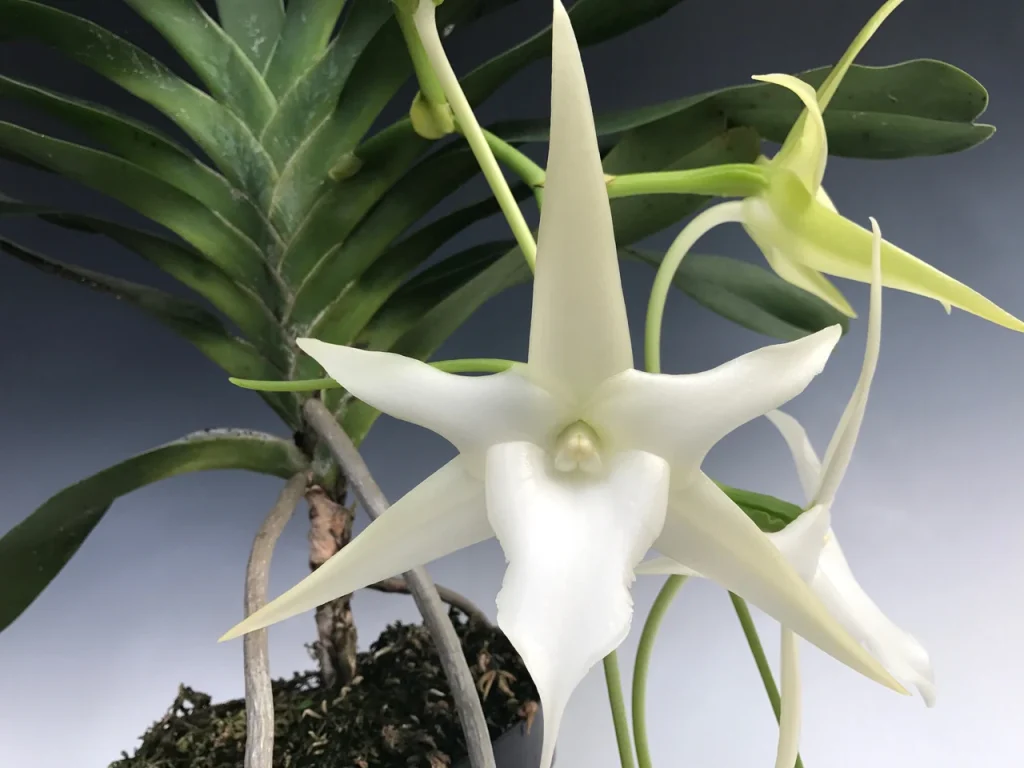
In the wild the plant grows as a lithophytic or semi‑terrestrial subshrub up to about 60 cm tall [7]. The stem is slightly flattened, covered by tightly clasping leaf sheaths. Leaves are coriaceous, dark‑green, bilobed at the tip, measuring 10–30 cm long and 1.4–2.7 cm wide [7]. Roots are thick, glabrous, and arise from the lower stem nodes.
Inflorescences are laterally produced from the upper leaf sheaths, arching to pendent, 25–30 cm long, bearing one to six creamy‑white, star‑shaped flowers [7]. Individual flowers are 15–20 cm across; the labellum bears a tubular nectar spur 30–45 cm long (often quoted as ~35 cm) that narrows toward the tip [6][8]. The flowers are fragrant at night, emitting a jasmine‑like scent [6][8].
Similar species such as Angraecum sesquipedale var. angustifolium differ in leaf width and spur length, but reliable identification should combine leaf size, growth habit (lithophytic vs. strictly epiphytic), and spur measurement [2].
Native Range and Habitat
The variety is native to eastern and southeastern Madagascar [1][2]. It occurs in the seasonally dry tropical biome, often on lithophytic substrates (rocky outcrops) and occasionally as a semi‑terrestrial plant on low trees [1]. Habitat descriptions from cultivated collections note that in the wild it is found near the edge of coastal forests with heavy, year‑round rainfall, at low elevations (0–100 m) [9][10].
Species‑Specific Care
| Factor | Documented guidance | Source |
|---|---|---|
| Light | Bright, filtered shade; avoid direct midday sun. | [8] |
| Temperature | Day 20–27 °C, night 15–20 °C. | [8] |
| Humidity | Maintain ≥60 % relative humidity; good airflow. | [8] |
| Medium | Well‑draining bark mix or sphagnum moss; can be grown in a basket or pot. | [8] |
| Watering | Frequent watering in the growing season; reduce in cooler months but do not let the plant dry out completely. | [8] |
| Fertiliser | Weekly feeding with quarter‑strength liquid fertilizer during active growth. | [8] |
| Repotting | Repot when the medium breaks down, typically every 2–3 years, using fresh bark mix. | Not documented |
| Seasonal change | No mandatory rest period; a slightly cooler, less‑wet period after flowering is beneficial. | [8] |
In practice, growers report that the plant thrives when mounted on cork or tree fern slabs, provided the roots remain moist but not waterlogged. Over‑watering or exposure to strong, direct sun can cause leaf scorch and root rot.
Flowering and Pollination
In its native range the orchid typically flowers from June to September [3]. Cultivated plants often display blooms from November to May in the northern hemisphere [6]. Flowers last several weeks; the fragrance is strongest in the evening, attracting nocturnal pollinators.
The long nectar spur is pollinated by the hawk moth Xanthopan morganii var. praedicta, a moth with a proboscis matching the spur length [6][9]. This classic example of co‑evolution was first hypothesised by Charles Darwin in 1862 and later confirmed when the moth was discovered in 1903 [6].
Conservation and Responsible Cultivation
The IUCN Red List status for this taxon is “Not Evaluated” [6]. Habitat loss due to deforestation in eastern Madagascar is a general concern for many endemic orchids, so sourcing plants from reputable, CITES‑compliant nurseries is recommended.
Evidence and Limitations
Key data such as precise elevation limits, long‑term field studies of population size, and detailed soil chemistry are not documented in the available sources. Cultivation advice is based on a single horticultural article (OSCOV) and may not represent the full range of successful practices. Further field observations would help refine habitat preferences and conservation status.
Frequently asked questions
What temperature range does Angraecum sesquipedale var. sesquipedale prefer?
Warm conditions are recommended: day temperatures of 20–27 °C and night temperatures of 15–20 °C, as reported by horticultural guidance from OSCOV [8].
Can this orchid be grown on a mount instead of in a pot?
Yes. Growers successfully mount the plant on cork, tree‑fern slabs, or similar media, provided the roots stay moist and the medium is well‑draining [8].
What pollinator is responsible for fertilising the flowers?
The long‑tongued hawk moth Xanthopan morganii var. praedicta is the documented natural pollinator, matching the 30‑45 cm nectar spur [6][9].
Related terminology
- Lithophyte
- A plant that grows on rocks or stone substrates, obtaining nutrients from rainwater and accumulated debris.
- Nectar spur
- A tubular extension of a flower’s lip that contains nectar, often adapted to specific pollinator morphology.
- Epiphyte
- A plant that grows upon another plant (such as a tree) but is not parasitic, obtaining moisture and nutrients from the air.
FOLLOW THE EVIDENCE
Sources & references
- Angraecum sesquipedale var. sesquipedale | Plants of the World Online | Kew Science, https://powo.science.kew.org/taxon/urn:lsid:ipni.org:names:77167471-1
- Angraecum sesquipedale Thouars | Plants of the World Online | Kew Science, https://powo.science.kew.org/taxon/urn:lsid:ipni.org:names:616416-1
- Darwin’s orchid | Kew, https://www.kew.org/plants/darwins-orchid
- Angraecum sesquipedale by Hans Proebsting – OSCOV, https://oscov.asn.au/articles/angraecum-sesquipedale-by-hans-proebsting/
- Angraecum sesquipedale – Smithsonian Gardens, https://si.gardenexplorer.org/taxon-19788.aspx
- NParks – Angraecum sesquipedale, https://www.nparks.gov.sg/florafaunaweb/flora/5/9/5986
- The Wild Records for Angraecum Sesquipedale Point to a Hot, Wet Lowland Plant | Orchid Society, https://orchidsociety.com/the-wild-records-for-angraecum-sesquipedale-point-to-a-hot-wet-lowland-plant/
- Pupulin, Franco (2019). Angraecum sesquipedale. New Refugium Botanicum, NRB 49, PDF, https://www.kerwa.ucr.ac.cr/items/e243ea2a-60c5-48ab-ae2a-029e5fb6b57c

