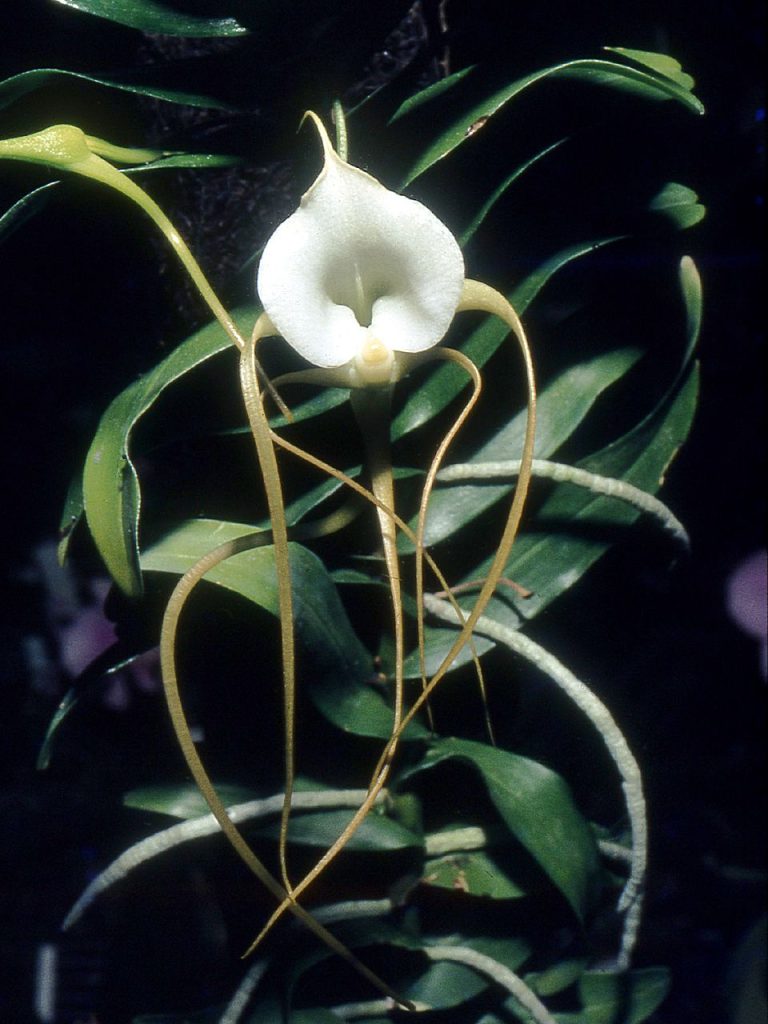
At a glance
RECORDED PROFILE DATA- Scientific name
- Angraecum ramosum Thouars
- Name status
- Accepted (POWO)
- Native region
- Madagascar, Mauritius, Réunion
- Growth habit
- Epiphytic subshrub; also lithophytic or terrestrial
- Cultivation temperature group
- Not documented
Names and Taxonomy
Angraecum ramosum Thouars is the accepted name for this species according to Kew Plants of the World Online (POWO) [1]. The name was first published in Hist. Orchid. t. 59 (1822) [2]. Synonyms recorded in major databases include:
- Angorkis ramosa (Thouars) Kuntze [9]
- Arachnangraecum ramosum (Thouars) Szlach., Mytnik & Grochocka [9]
- Macroplectrum ramosum (Thouars) Finet [9]
- Angraecum verruculosum Frapp. ex Cordem. (heterotypic) [1]
- Angraecum ramosum subsp. bidentatum H.Perrier (heterotypic) [1]
No widely used common name is documented for this species.
How to Identify This Species
In the wild A. ramosum is a small‑to‑medium‑sized, caulescent orchid that forms a long, branching, scandent stem which may be pendant, horizontal or erect [10]. The stem bears widely spaced, two‑ranked, lanceolate leaves that are linear, broadest near the base and taper to a slightly bilobed apex. Leaves are typically grey‑green and up to several centimetres long (exact length not documented). Mature plants reach about 30 cm in height [7].
Flowering is usually on a short, axillary inflorescence opposite a leaf base, bearing a single flower. The flower is about 3 cm across, initially white and becoming yellowish with age, and is strongly fragrant [10]. The lip is modestly sized, and a short nectar spur is present, typical of many Angraecum species. Blooming in the wild has been reported in the summer months of the Southern Hemisphere (December–February) and into early autumn [10].
Because several Angraecum species share a white, fragrant flower, identification should rely on the combination of a branched, scandent stem, the two‑ranked lanceolate leaves, and the single‑flowered axillary inflorescence described above. Photographs with verified provenance are essential for reliable identification.
Native Range and Habitat
Angraecum ramosum is native to the western Indian Ocean islands of Madagascar, Mauritius and Réunion [1][8]. It occurs in wet tropical forest biomes, growing as an epiphyte on tree trunks, as a lithophyte on rocks, or occasionally on the forest floor. Elevations range from sea level up to about 1 500 m [10]. The species prefers humid, shaded conditions typical of rainforest canopies.
Species‑Specific Care
| Factor | Documented guidance | Evidence |
|---|---|---|
| Growth medium / substrate | Can be mounted on bark or grown in a well‑draining orchid mix; also tolerates lithophytic conditions. | Observed growth habit as epiphyte, lithophyte or terrestrial in the wild [10] |
| Light | Bright, filtered light (similar to rainforest canopy). | Not documented in the available sources. |
| Watering | Regular watering; low drought tolerance indicates the plant should remain consistently moist. | Low drought tolerance noted in horticultural description [7] |
| Humidity | High humidity (70 % +), reflecting its native humid forest. | Not documented in the available sources. |
| Temperature | Warm to intermediate temperatures; no specific limits documented. | Not documented in the available sources. |
| Fertilisation | Balanced orchid fertilizer applied at regular intervals during active growth. | Not documented in the available sources. |
| Repotting / re‑mounting | When mounted, replace the bark annually; in pots, refresh orchid mix every 2–3 years. | Not documented in the available sources. |
| Seasonal rest | Not documented; growers should observe the plant’s growth cycle. | Not documented in the available sources. |
Because specific cultural data are sparse, growers should monitor the plant for signs of stress (leaf yellowing, loss of turgor) and adjust light, water and humidity to mimic its humid forest environment.
Flowering and Pollination
In cultivation the species produces a single, fragrant flower on a short axillary stalk. Flowers open in summer and early autumn, are about 3 cm across, and change from white to a yellowish hue as they age [10]. The scent is reported as pleasant and noticeable, especially in the evening, a trait common among moth‑pollinated Angraecum orchids. No specific pollinator has been documented for A. ramosum, and pollination biology remains unstudied.
Evidence and Limitations
Key aspects such as precise temperature ranges, light intensity, humidity requirements, and pollinator identity are not documented in the sources consulted. The care table therefore contains several “Not documented” entries. Further field studies and horticultural trials would be valuable to refine cultivation protocols and to assess conservation status.
FOLLOW THE EVIDENCE
Sources & references
- Angraecum ramosum Thouars | Plants of the World Online | Kew Science – https://powo.science.kew.org/taxon/urn:lsid:ipni.org:names:616366-1
- Angraecum ramosum | International Plant Names Index – https://ipni.org/n/616366-1
- IOSPE PHOTOS – Angraecum ramosum – https://www.orchidspecies.com/angramosum.htm
- Angraecum ramosum (NativePlants.info) – https://www.nativeplants.info/plant/magnoliophyta-flowering-plants/orchidaceae/angraecum/angraecum_ramosum.html
- Angraecum ramosum – Wikipedia – https://en.wikipedia.org/wiki/Angraecum_ramosum
- WFO Plant List – Angraecum ramosum – https://wfoplantlist.org/taxon/wfo-0000979414-2023-12

