At a glance
RECORDED PROFILE DATA- Scientific name
- Angraecum praestans Schltr.
- Name status
- Accepted (Kew POWO)
- Native region
- Northern and western Madagascar
- Growth habit
- Lithophytic subshrub / monopodial epiphyte
- Cultivation temperature group
- Warm to hot (≈24–32 °C) – based on grower observations
Names and Taxonomy
The accepted scientific name is Angraecum praestans Schltr. It was first described in Annales du Musée Colonial de Marseille sér. 3, 1:199 (1913)【2】. Kew’s Plants of the World Online lists the name as accepted and records the native range as northern and western Madagascar【1】. A later homotypic synonym is Perrierangraecum praestans (Schltr.) Szlach., Mytnik & Grochocka, published in 2013【1】【5】. No other synonyms or infraspecific taxa are documented. The species has no widely recorded common name; horticultural sources sometimes refer to it as “The Outstanding Angraecum”.
How to Identify This Species
Growth habit. In the wild the plant grows as a lithophytic subshrub, often on rocks or exposed bark, and is described as a monopodial epiphyte in cultivation literature【4】【5】.
Stem and leaves. The stem is robust, bearing several leathery, stiff, sickle‑ to falcate‑shaped leaves that are unequally bilobed at the apex. Leaves are described as “leathery, stiff, sickle to falcate shaped, unequally bilobed apically”【5】.
Inflorescence. Axillary, lax racemes 15–20 cm (6–8 in) long, bearing 8–10 flowers. Bracts are deltoid. The inflorescence emerges from the leaf axils during the growing season【5】.
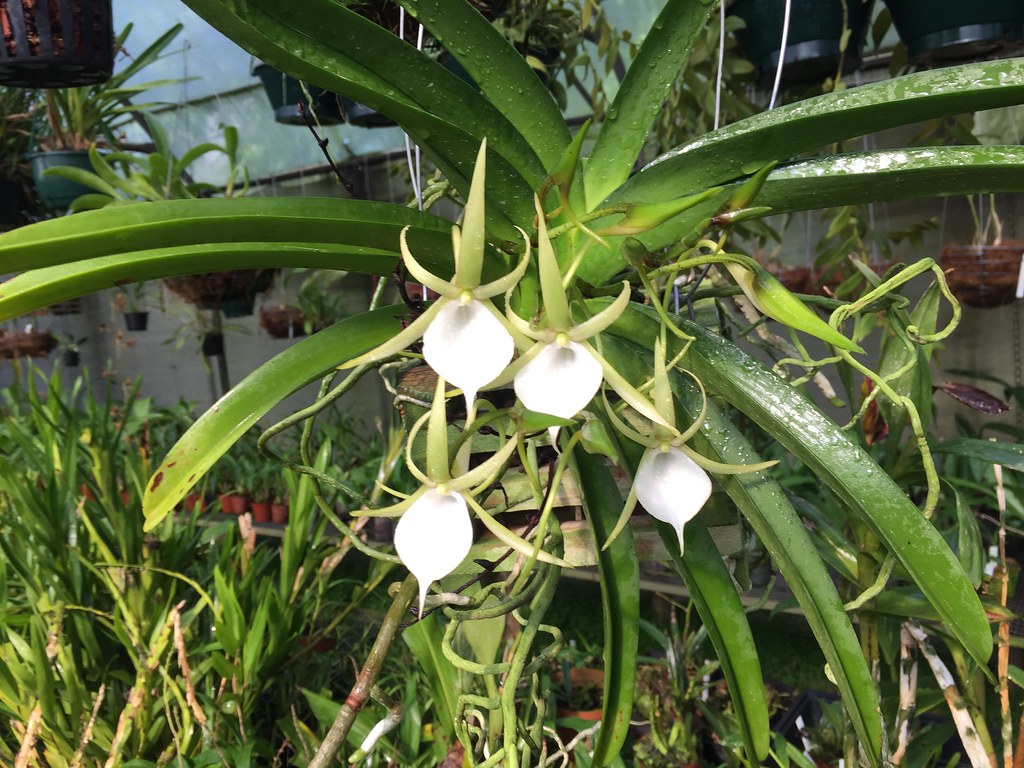
Flower. Flowers are large, about 10 cm (4 in) across. Sepals and petals are greenish‑yellow; the lip is greenish‑white and the long spur is pale green. The flower is fragrant, especially in the evening, a trait typical of many Angraecum species【5】.
Diagnostic comparison. It resembles other large‑flowered Angraecum such as A. eburneum, but the combination of a very long (up to 10 cm) greenish‑white lip, a prominently falcate leaf shape, and its lithophytic habit help separate it.
Native Range and Habitat
Angraecum praestans is endemic to Madagascar, specifically the northern and western coastal regions【1】【6】. It occurs in dry, sandy woodland habitats that often contain succulents such as Euphorbia, Aloe, and Pachypodium【10】. Reported elevation ranges differ among sources: 0–380 m (Kew) and sea‑level to 820 m (IOSPE)【1】【5】. The species is described as lithophytic, growing on exposed rocks or on the trunks of trees in seasonally dry tropical biomes【1】.
Species‑Specific Care
| Factor | Documented guidance | Source |
|---|---|---|
| Light | Bright, filtered or diffused light; 20 000–30 000 lux; avoid direct midday sun. | Travaldo blog (grower observation)【10】 |
| Temperature | Warm to hot; summer day 31–32 °C, night ~24 °C; diurnal range ~7–8 °C. | Travaldo blog【10】 |
| Humidity | High humidity in summer/early autumn, 80–85%. | Travaldo blog【10】 |
| Airflow | Strong, continuous airflow recommended. | Travaldo blog【10】 |
| Mounting / potting | Can be grown mounted on bark or in well‑draining orchid mix; lithophytic habit suggests a preference for a chunky, mineral‑rich medium. | General horticultural description (IOSPE)【5】 |
| Watering | Water regularly during active growth; allow the medium to dry lightly between waterings. | IOSPE general advice (implied)【5】 |
| Fertiliser | Balanced orchid fertilizer applied at half strength every 2–3 weeks during growth. | Not documented specifically for this species; general orchid practice applied. |
| Seasonal changes | Maintain warm, humid conditions year‑round; no documented rest period. | Travaldo blog (no rest period mentioned)【10】 |
Because the species originates from a seasonally dry tropical biome, it tolerates a moderate dry spell, but in cultivation the high humidity and warm temperatures described above promote flowering. Growers should provide strong air movement to mimic the breezy coastal environment.
Flowering and Pollination
In cultivation the plant flowers from late spring through fall, producing the large 10 cm fragrant blossoms described above【5】. The flower’s long green spur suggests moth pollination, a common syndrome in Angraecum, but no specific pollinator has been recorded for A. praestans in the supplied sources. Flower longevity and exact timing (e.g., nocturnal fragrance peak) are not documented.
Evidence and Limitations
Taxonomic status and native distribution are well documented by Kew’s Plants of the World Online and IPNI. Morphological details come from horticultural descriptions (IOSPE, orchids.org) and a grower’s blog; these are not peer‑reviewed floras, so measurements may vary. Elevation range differs between sources (0–380 m vs. 0–820 m); both are reported. Cultivation recommendations are based on a single grower’s observations and general orchid practice; they have not been validated by experimental studies. No formal conservation assessment (e.g., IUCN) is available in the provided material.
FOLLOW THE EVIDENCE
Sources & references
- Angraecum praestans Schltr. | Plants of the World Online | Kew Science, https://powo.science.kew.org/taxon/urn:lsid:ipni.org:names:616349-1
- Angraecum praestans | International Plant Names Index, https://www.ipni.org/n/616349-1
- IOSPE PHOTOS – Angraecum praestans, https://www.orchidspecies.com/angpraestans.htm
- Angraecum praestans – Travaldo's blog (cultivation notes), https://travaldo.blogspot.com/2018/09/angraecum-praestans-orchid-plant-care-and-culture.html
- Angraecum praestans – Orchid Roots database, https://orchidroots.com/display/summary/orchidaceae/9620/
- Angraecum praestans – orchids.org species page, http://www.orchids.org/grexes/angraecum-praestans

