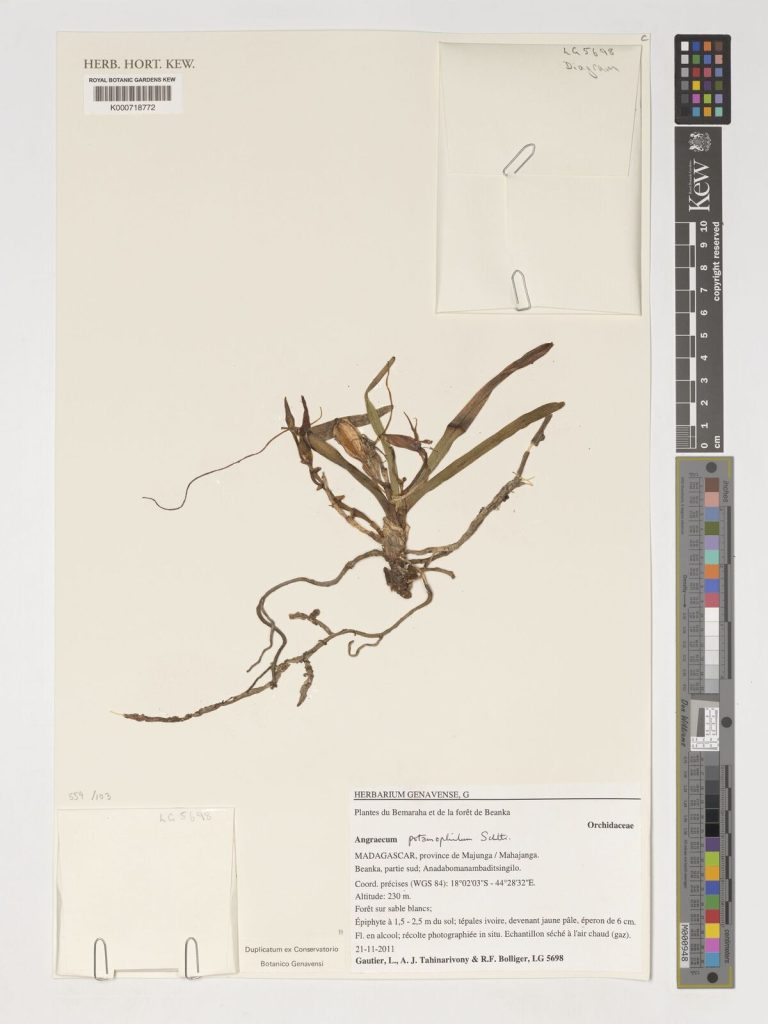
At a glance
RECORDED PROFILE DATA- Scientific name
- Angraecum potamophilum Schltr.
- Name status
- Accepted
- Native region
- Madagascar (north‑central)
- Growth habit
- Epiphytic subshrub
- Cultivation temperature group
- Not documented
Names and Taxonomy
The accepted scientific name is Angraecum potamophilum Schltr. According to Kew’s Plants of the World Online the name is accepted and was first published in Ann. Mus. Colon. Marseille 3(1):199 in 1913[1]. Two later homotypic synonyms are recorded:
- Aerangis potamophila (Schltr.) Schltr., published 1915.
- Humblotiangraecum potamophilum (Schltr.) Szlach., Mytnik & Grochocka, published 2013.
No widely used common name appears in the primary taxonomic sources; IOSPE lists the informal name “River Loving Angraecum”[3].
How to Identify This Species
Angraecum potamophilum is a miniature to small epiphytic subshrub. Key diagnostic features documented in the IOSPE description include:
- Short, erect stem bearing 4–6 stiff, thick, linear leaves.
- Inflorescence: a pendent peduncle about 5 cm (2 in) long, bearing 3–5 flowers; the base is sheathed by 3–4 short bracts.
- Flowers: very small, pure white, approx. 2 cm (0.8 in) across; each flower is borne on a short, thick floral bract.
- Growth habit: epiphytic on tree trunks, especially near rivers.
Plant height in cultivation has been recorded up to roughly 30 cm[5]. Without flowering material, vegetative characters alone can be ambiguous, so the combination of leaf form, short bract‑enclosed peduncle and minute white flowers is the most reliable field identifier.
Native Range and Habitat
The species is endemic to north‑central Madagascar. POWO lists its native range as “N. Central Madagascar” and notes it occurs in the seasonally dry tropical biome[1]. IOSPE adds a more precise ecological note: it grows on tree trunks near rivers, indicating a preference for humid micro‑habitats within an overall dry forest matrix[3]. Elevation and precise forest type are not documented in the available sources.
Species‑Specific Care
| Factor | Documented guidance | Source |
|---|---|---|
| Growth habit | Epiphytic; can be mounted on cork bark or grown in a very well‑draining medium such as fine orchid bark. | [5] |
| Light | Not documented for this species; general Angraecum epiphytes prefer bright, filtered light. | Not documented |
| Temperature | Not documented; native habitat is lowland to sub‑montane, suggesting warm to intermediate conditions. | Not documented |
| Watering | Not documented; epiphytes typically require regular moisture with good airflow to avoid rot. | Not documented |
| Humidity | Not documented; native riverine setting implies a preference for moderate to high humidity. | Not documented |
| Fertiliser | Not documented; a balanced half‑strength orchid fertilizer applied during active growth is commonly used for Angraecum. | Not documented |
| Seasonal rest | Not documented; no specific rest period reported. | Not documented |
In the absence of species‑specific horticultural studies, growers should treat A. potamophilum as a typical low‑light, moisture‑moderate Angraecum epiphyte, monitoring for signs of dehydration or rot.
Flowering and Pollination
Flowering is reported to occur in the spring in its native range[3]. Flowers are small, white, and reportedly fragrant (source: NativePlants.info lists “Fragrant: Yes”)[5]. No pollinator observations are recorded in the cited literature; the short spur length and white coloration are consistent with moth pollination in many Angraecum species, but this remains a hypothesis pending field study.
Evidence and Limitations
Most morphological and ecological information comes from brief online summaries (IOSPE, Kew POWO, NativePlants.info). Detailed measurements, elevation range, exact humidity and temperature requirements, and pollinator data are not documented in the accessible sources. Further field research and cultivation trials are needed to refine care recommendations and to confirm pollination biology.
FOLLOW THE EVIDENCE
Sources & references
- Angraecum potamophilum Schltr. | Plants of the World Online | Kew Science, https://powo.science.kew.org/taxon/urn:lsid:ipni.org:names:616348-1
- IOSPE PHOTOS – Angraecum potamophilum, https://www.orchidspecies.com/angpotamophilum.htm
- Angraecum potamophilum – NativePlants.info, https://www.nativeplants.info/plant/magnoliophyta-flowering-plants/orchidaceae/angraecum/angraecum_potamophilum.html
- Angraecum – Clan Orchids Compendium (potamophilum entry), http://www.clanorchids.com/compendium/page3a.html

