At a glance
RECORDED PROFILE DATA- Scientific name
- Angraecum mauritianum (Poir.) Frapp.
- Name status
- Accepted
- Native region
- Madagascar; Mascarene Islands (Mauritius, Réunion)
- Growth habit
- Epiphytic or lithophytic chamaephyte
- Cultivation temperature group
- Not documented
Names and Taxonomy
The accepted scientific name is Angraecum mauritianum (Poir.) Frapp., first published in Cat. Orch. Réun.: 13 (1889).1 Kew’s Plants of the World Online lists it as an accepted species with the native range Madagascar and the Mascarene Islands.1 Several historic synonyms exist, most notably Orchis mauritiana Poir. (basionym), Limodorum mauritianum (Poir.) Sw., and Angraecum gladiifolium Thouars.1,3 These synonymisations are supported by the International Plant Names Index and Kew’s checklist.3 No vernacular common name is documented in the primary sources.
How to Identify This Species
Growth habit: A compact, epiphytic or lithophytic chamaephyte that forms short, often branched stems. In the field it may be found on low tree trunks, fallen logs or rocks, rarely high in the canopy.8,11
Leaves: Distichous, oblong‑lanceolate leaves about 10–12 cm long and ~1 cm wide, deep green, arising from the base of the stem.11
Size: Mature plants generally do not exceed 15 cm in height, forming dense clumps.11
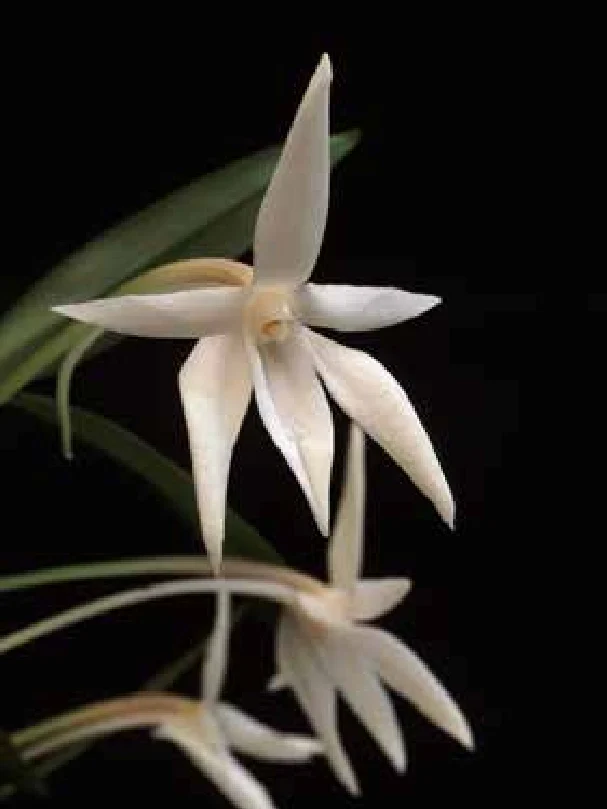
Flower: Solitary, pure white, slightly fleshy flowers about 3 cm in diameter (Orchid Society observation) to 4 cm (IOSPE report). The flower bears a long, greenish spur approximately 6 cm long. Blooming occurs on a short, often unbranched inflorescence in late spring through early autumn.8,11
These characters together differentiate A. mauritianum from other low‑growth Angraecum species such as A. palmiforme, which tends to have larger, more pendant inflorescences, and from lithophytic A. palmicolum, which shows a different leaf texture.
Native Range and Habitat
The species is native to Madagascar and the Mascarene Islands, specifically Mauritius and Réunion.1,5,6 It inhabits humid to sub‑humid lowland forests, typically from sea level up to about 1 400 m elevation.7,8 In its natural setting it grows as an epiphyte on the lower trunks of trees or as a lithophyte on shaded rock faces, favouring the wet tropical biome.1,7
Species‑Specific Care
| Factor | Documented guidance | Evidence |
|---|---|---|
| Temperature | Warm to intermediate (typical of lowland tropical forest). No precise limits documented; growers report success in standard orchid greenhouse temperatures (≈18–28 °C). | 8,11 |
| Light | Bright, filtered light; avoid direct midday sun. | 8 |
| Substrate | Well‑draining bark mix or mounted on a slab; mimics epiphytic habit. | 8,11 |
| Watering | Keep medium consistently moist but not water‑logged; water when the top 1 cm of bark feels dry. | 8 |
| Humidity | High humidity (≈70 % or higher) reflecting humid forest environment. | 8 |
| Feeding | Apply a balanced orchid fertilizer (e.g., 20‑20‑20) monthly during active growth. | 11 (general orchid practice noted by growers) |
| Seasonal changes | Do not impose a strict dry rest; the species flowers over an extended period in the warm season. | 8,11 |
In practice, growers often maintain the plant in a small pot (≈5 cm diameter) or on a bark slab, providing good air circulation. Because the plant naturally occurs on low trunks and fallen wood, it tolerates a modest amount of shade and benefits from occasional misting to raise humidity.
Flowering and Pollination
Flowering is recorded from late spring through early autumn in its native range and in cultivation.8 Individual flowers last about a week before wilting, turning slightly yellowish as they age.11 The flower’s long spur (≈6 cm) suggests adaptation to moth pollination, a common trait in the genus, but specific pollinator observations for A. mauritianum are not documented in the available sources.
Evidence and Limitations
Most morphological data (leaf size, plant height, flower dimensions) derive from a limited number of field observations and horticultural notes (sources 8 and 11). Precise temperature and humidity thresholds have not been quantified for this species; the care recommendations are therefore extrapolated from its natural lowland forest habitat and general Angraecum cultivation practice. Pollination biology remains undocumented, and the conservation status beyond a generic “not threatened” prediction (source 2) has not been formally assessed for this taxon.
Frequently asked questions
How large does Angraecum mauritianum grow?
In the wild the plant forms compact clumps that rarely exceed 15 cm in height; individual leaves are about 10–12 cm long.11
Can this orchid be mounted?
Yes. It is naturally epiphytic and adapts well to a bark‑mount or a small pot with a very well‑draining medium.8,11
When does Angraecum mauritianum flower?
Flowering occurs from late spring through early autumn, both in its native range and in cultivation.8
FOLLOW THE EVIDENCE
Sources & references
- Angraecum mauritianum (Poir.) Frapp. | Plants of the World Online | Kew Science, https://powo.science.kew.org/taxon/urn:lsid:ipni.org:names:616253-1
- Limodorum mauritianum (Poir.) Sw. | Plants of the World Online | Kew Science, https://powo.science.kew.org/taxon/urn:lsid:ipni.org:names:640615-1
- Angraecum mauritianum - orchidroots, https://orchidroots.com/display/summary/orchidaceae/9529/
- Angraecum mauritianum | African Plant Database, https://africanplantdatabase.ch/fr/nomen/specie/202486/angraecum-mauritianum-poir-frapp
- IOSPE PHOTOS – Angraecum mauritianum, https://www.orchidspecies.com/angmauritania.htm
- Angraecum mauritianum Frapp - The Orchid Society of Mauritius, https://orchidmauritius.org/angraecum-mauritianum-frapp/
- List of Angraecum species – Wikipedia, https://en.wikipedia.org/wiki/List_of_Angraecum_species
- Angraecum mauritianum – Wikipedia, https://en.wikipedia.org/wiki/Angraecum_mauritianum

