At a glance
RECORDED PROFILE DATA- Scientific name
- Angraecum mahavavense H.Perrier
- Name status
- Accepted (Kew POWO)
- Native region
- Madagascar (north‑western)
- Growth habit
- Epiphytic subshrub; often mounted on slab or raft
- Cultivation temperature group
- Temperate (15‑22 °C)
Names and Taxonomy
Angraecum mahavavense H.Perrier is the accepted scientific name for this species. The name was first published in Notulae Systematicae (Paris) 7:131 in 1938 by Henri Perrier de la Bâthie.[1] Kew’s Plants of the World Online lists the name as accepted and records its native range as northern Madagascar.[1] No synonyms or alternative spellings are documented in the consulted sources.
How to Identify This Species
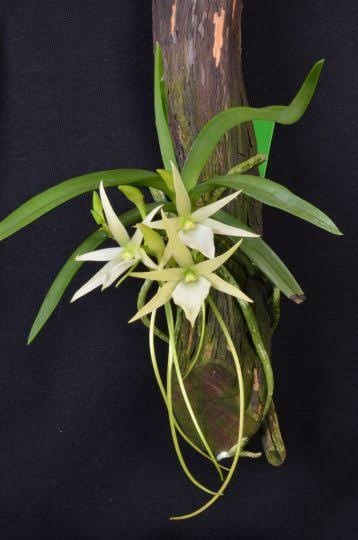
This orchid is a miniature to small epiphytic subshrub with an almost stemless appearance. Leaves are 5–6 per plant, broadly linear, leathery, rigid, keeled in the middle, V‑shaped below, and shortly bilobed at the apex.[2] Roots are noted for having an uneven surface, a characteristic mentioned in horticultural notes.[3]
Flowering stems (inflorescences) are very short, 2–5 cm long, bearing three to five flowers that arise alternately from a groove on each side of the rachis.[2] Individual flowers are white, crystalline, about 1.2 in (3 cm) across, and the plant typically blooms in the spring.[2][3] The nectar spur length is not documented, and fragrance is described as faintly scented in some grower notes, but no formal scent description is available.
In cultivation the species is often mounted on cork slabs or grown in a basket (raft) to mimic its natural epiphytic habit.[3][5]
Native Range and Habitat
Angraecum mahavavense is endemic to the north‑western part of Madagascar, specifically the humid, shady forests of the Sambirano region.[2][3] It grows as an epiphyte on tree trunks within a wet tropical biome.[1] Elevational range and precise host tree preferences are not documented in the available sources.
Species‑Specific Care
[3][5][5][4][4][5][4]Not documented[4]Not documentedNot documented
| Factor | Documented guidance | Evidence |
|---|---|---|
| Mounting / Substrate | Mount on cork slab, cork‑bound basket (raft), or grow in a well‑draining pot. | |
| Light | Bright, indirect light; half‑shade is acceptable. | |
| Temperature | Temperate: night 15‑18 °C, day 20‑28 °C (commercial growers use 16‑22 °C). | |
| Watering | Water thoroughly about once a week; avoid standing water. | |
| Humidity | Not documented; maintain moderate humidity typical of humid tropical forests. | |
| Fertilisation | Apply balanced orchid fertilizer every two weeks from May to September. | |
| Airflow | Provide good air movement to prevent fungal issues. | |
| Repotting / Re‑mounting | Refresh mounting material or potting medium every 2–3 years as roots expand. |
Because the species is naturally an epiphyte, mounting on a slab or using a very coarse bark mix helps replicate its arboreal substrate. Consistent weekly watering and a temperate temperature regime have been reported to produce regular flowering in cultivation.[4][5]
Flowering and Pollination
In the wild the plant flowers in the spring season, producing a short inflorescence with three to five white flowers each about 3 cm across.[2][3] Detailed pollinator observations for this species are not available in the consulted literature; pollination mechanisms remain undocumented.
Conservation and Responsible Cultivation
No formal conservation assessment (e.g., IUCN Red List category) is provided in the sources consulted. Given its limited distribution in north‑western Madagascar, growers are encouraged to obtain material from reputable, legally compliant sources and to support in‑situ conservation efforts where possible.
Evidence and Limitations
Key aspects such as exact elevation range, precise nectar spur length, humidity requirements, and natural pollinators are not documented in the available sources. Cultivation recommendations are based on a limited number of grower observations and may not reflect the full variability of the species in different settings.
Frequently asked questions
What light conditions does Angraecum mahavavense need?
Bright, indirect light is recommended; the species tolerates half‑shade when mounted on a slab or grown in a basket.[5][4]
How large does the plant grow in cultivation?
Mature plants reach about 12–18 cm (5–7 in) across, with older specimens producing multiple short inflorescences.[3]
When does this orchid flower?
In the wild it flowers in the spring; cultivated plants often flower under temperate conditions when provided weekly water and regular feeding.[2][4]
FOLLOW THE EVIDENCE
Sources & references
- Angraecum mahavavense H.Perrier | Plants of the World Online | Kew Science, https://powo.science.kew.org/taxon/urn:lsid:ipni.org:names:616245-1
- IOSPE PHOTOS – Angraecum mahavavense, http://www.orchidspecies.com/angmahavense.htm
- Angraecum mahavavense – AOS Bulletin (Oct 2018) by Brenda Oviatt & Bill Nerison, https://botanicaltd.com/wp-content/uploads/2022/12/aos-angraecum-mahavavense-oct2018-oviatt-nerison.pdf
- Angraecum mahavavense – Schwerter Orchideenzucht sales page, https://shop.schwerter-orchideenzucht.de/product_info.php?language=en&products_id=8780&reviews_id=3048
- Clan Orchids – Angraecum care table, http://www.clanorchids.com/compendium/page3a.html

