At a glance
RECORDED PROFILE DATA- Scientific name
- Angraecum madagascariense (Finet) Schltr.
- Name status
- Accepted
- Native region
- Madagascar
- Growth habit
- Epiphytic subshrub
- Cultivation temperature group
- Not documented
Names and Taxonomy
The accepted scientific name is Angraecum madagascariense (Finet) Schltr.[1]. The name was first published in Beih. Bot. Centralbl. 36:162 (1918). Two homotypic synonyms are recorded: Macroplectrum madagascariense Finet (1907) and Lemurangis madagascariensis (Finet) Szlach., Mytnik & Grochocka (2013)[1]. No common name is documented in the consulted sources.
How to Identify This Species
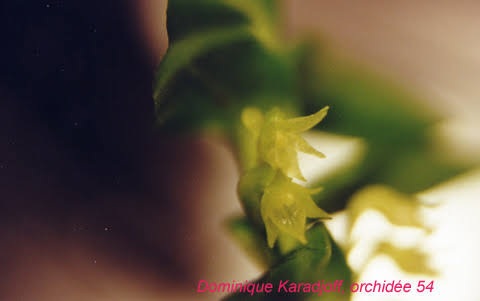
Angraecum madagascariense is a very small epiphytic subshrub. Mature plants reach about 6–10 cm in overall size[3]. Stems are short and bear a few short, oval, amplexicaul leaves that are closely spaced. Leaves are obtuse‑tipped and clasp the stem.[3]
The inflorescence is a short, pendant to slightly curved raceme 5–6 cm long, bearing three to four flowers[2][3]. Flowers are small, white, and lack a prominent fragrance in the descriptions. Sepals are triangular, measuring roughly 0.2 mm × 0.1 mm; the lip is concave and oval. The nectar spur is extremely short, 0–1 mm in length[3]. These minute dimensions help distinguish the species from larger, more robust Angraecum taxa.
Native Range and Habitat
The species is endemic to Madagascar, with a distribution centred in the central and eastern high‑plateau regions[1][2]. It grows as an epiphyte on tree trunks and branches in wet tropical forest, typically at elevations between 600 and 1500 m above sea level[2]. The habitat is characterised by high humidity and consistent moisture, typical of Madagascar’s montane rainforest belt.
Species‑Specific Care
| Factor | Documented guidance | Evidence |
|---|---|---|
| Growth medium | Not documented | — |
| Light level | Not documented | — |
| Temperature | Not documented | — |
| Watering | Not documented | — |
| Humidity | Not documented | — |
| Fertilisation | Not documented | — |
| Repotting / mounting | Not documented | — |
Published horticultural information specific to Angraecum madagascariense was not found in the available sources. Growers are advised to consult general Angraecum culture references and to mimic the species’ natural humid, montane forest conditions, but any such recommendations are not directly documented for this taxon.
Flowering and Pollination
Details on flowering time, flower longevity, fragrance pattern, or pollinator interactions are not documented for this species in the consulted literature.[2][3]
Evidence and Limitations
The profile is based on three online references: the Kew Plants of the World Online entry, the IOSPE orchid species page, and a French orchid database (Limodore). Morphological measurements are limited to the brief descriptions available; no peer‑reviewed monographs or field studies were accessed. Cultivation, phenology, and pollination data are absent, and any care recommendations are therefore generalised from related Angraecum species rather than species‑specific evidence.
FOLLOW THE EVIDENCE
Sources & references
- Plants of the World Online – Angraecum madagascariense (Finet) Schltr., Kew Science, 2026, https://powo.science.kew.org/taxon/urn:lsid:ipni.org:names:616243-1
- IOSPE PHOTOS – Angraecum madagascariense (Finet) Schltr., 1918, http://www.orchidspecies.com/angmadagascariense.htm
- Limodore – Angraecum madagascariense (Finet) Schltr., French Orchid Database, 2026, https://limodore.france-orchidees.org/angraecum/angraecum-madagascariense/angraecum-madagascariense.html

