At a glance
RECORDED PROFILE DATA- Scientific name
- Angraecum linearifolium Garay
- Name status
- Accepted
- Native region
- Madagascar (north & east‑central)
- Growth habit
- Epiphytic subshrub (pendent)
- Cultivation temperature group
- Intermediate
Names and Taxonomy
Angraecum linearifolium Garay is the accepted name for this species according to Kew’s Plants of the World Online.[1] The name was first published in Botanical Museum Leaflets 23:160 (1972). Synonyms include Angraecum palmiforme H.Perrier (illegitimate homonym) and Arachnangraecum linearifolium (Garay) Szlach., Mytnik & Grochocka.[1][2] No vernacular (common) name is documented in the consulted sources.
How to Identify This Species
Key diagnostic features reported for A. linearifolium are:
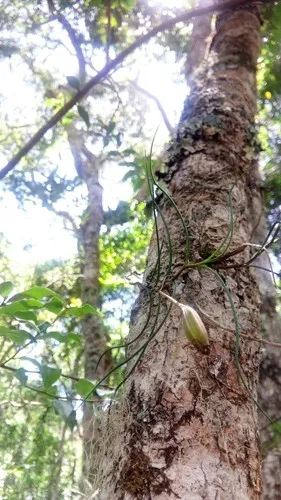
- Growth habit: Slender, pendent epiphytic subshrub with an elongate stem bearing 6–12 leaves arranged in two rows.[3]
- Leaves: Linear, 50–110 mm long, 0.6–0.9 mm wide, narrowly furrowed on the upper surface.[3]
- Inflorescence: Axillary, short, bearing a single flower; the flower emerges from the leaf axil on a slender pedicel.[2]
- Flower size: Approximately 10 cm (4 in) long.[2]
- Colour: Salmon‑pink to rose‑tinged sepals and petals; lip narrowly lanceolate, white‑cream at the base with a pinkish hue.[3]
- Spur: Long, curved, 90–100 mm in length (about 9–10 cm). Some growers report a spur up to 5 in (≈127 mm), confirming a very elongated structure.[3][4]
The species is frequently confused with Angraecum teretifolium; the latter has terete (cylindrical) leaves, whereas A. linearifolium has distinctly flattened linear leaves.[2]
Native Range and Habitat
Angraecum linearifolium is endemic to Madagascar, recorded from the northern and east‑central parts of the island.[1][3] It inhabits humid, moss‑rich evergreen forests, growing epiphytically on tree branches at elevations between 500 and 2500 m (≈1600–8200 ft). The species prefers the wet tropical biome and is most often found on trees in mist‑laden canopy zones.[1][3]
Flowering in the wild occurs from October through February, spanning the Malagasy spring and early summer.[3]
Species‑Specific Care
| Factor | Documented guidance | Evidence |
|---|---|---|
| Light | Moderate, bright indirect light; avoid direct midday sun. | [4] |
| Temperature | Intermediate temperatures; growers report success with day‑night ranges typical of mid‑elevation Madagascan forests. Exact numerical limits not documented. | [4] |
| Humidity | Not documented; high humidity is typical for epiphytic orchids but no specific data for this species. | Not documented |
| Watering | Maintain year‑round moisture; water when the mounting medium or potting mix begins to dry. Use a good soak rather than mist‑only. | [4] |
| Feeding | Dilute balanced fertilizer (e.g., ½ strength) weekly during active growth; reduce to a lower strength in winter. | [4] |
| Substrate / Mounting | Can be cultivated mounted on cork or tree fern, or grown in a well‑draining orchid mix in a hanging basket. | [4] |
| Repotting | Not documented. | Not documented |
| Airflow | Not documented. | Not documented |
Growers report that providing a stable, moderately warm environment with good air circulation and regular feeding encourages robust growth and promotes flowering. Because the species originates from elevations up to 2500 m, it tolerates cooler night temperatures compared with lowland Angraecums, but extreme cold should be avoided.
Flowering and Pollination
In situ, the plant flowers from October to February, producing a single, long‑spurred flower that remains on the plant for several weeks. The spur length (≈90–100 mm) suggests adaptation to a pollinator with a long proboscis, but no specific pollinator has been recorded for this species; pollination biology remains undocumented.
Similar Species
The most frequently mentioned look‑alike is Angraecum teretifolium. While both have pendant stems and a single flower, A. teretifolium bears cylindrical (terete) leaves and generally a shorter spur. Careful examination of leaf cross‑section and spur length helps separate the two.[2]
Conservation and Responsible Cultivation
All orchid species, including A. linearifolium, are listed under CITES, which regulates international trade to prevent over‑exploitation.[9] The species is endemic to Madagascar, a biodiversity hotspot facing habitat loss; however, a formal IUCN Red List assessment was not found in the available sources.
Evidence and Limitations
The profile relies on a limited set of online sources. Morphological measurements (leaf size, spur length) are taken from the Czech botany site and the IOSPE database; these are not from a peer‑reviewed monograph. Cultivation advice derives from a single horticultural grower’s notes and may not represent the full range of successful practices. Data on humidity requirements, precise temperature ranges, pollinator identity, and conservation status are not documented in the consulted material.
FOLLOW THE EVIDENCE
Sources & references
- Angraecum linearifolium Garay | Plants of the World Online | Kew Science, https://powo.science.kew.org/taxon/urn:lsid:ipni.org:names:616232-1
- IOSPE PHOTOS – Angraecum linearifolium Garay 1972, https://www.orchidspecies.com/anglinearifolium.htm
- ANGRAECUM LINEARIFOLIUM Garay – botan.cz, https://botany.cz/cs/angraecum-linearifolium/
- Angraecum linearifolium #74 outcross – grower notes, http://marniturkel.com/mostlyspecies/f.ang.linear.74.html

