At a glance
RECORDED PROFILE DATA- Scientific name
- Angraecum humile Summerh.
- Name status
- Accepted (Kew Plants of the World Online)
- Native region
- Ethiopia, Kenya, Rwanda, Sudan‑South Sudan, Tanzania, Zimbabwe
- Growth habit
- Dwarf epiphytic subshrub
- Cultivation temperature group
- Cool‑to‑cold (mountain) – not formally coded
Names and Taxonomy
The accepted scientific name is Angraecum humile Summerh.[1]. The name was first published in Kew Bulletin 13:269 (1958). Kew’s Plants of the World Online lists it as an accepted species and records a homotypic synonym Lemurangis humilis (Summerh.) Szlach., Mytnik & Grochocka (2013). No other synonyms or infraspecific taxa are documented for this species in the consulted sources.
How to Identify This Species
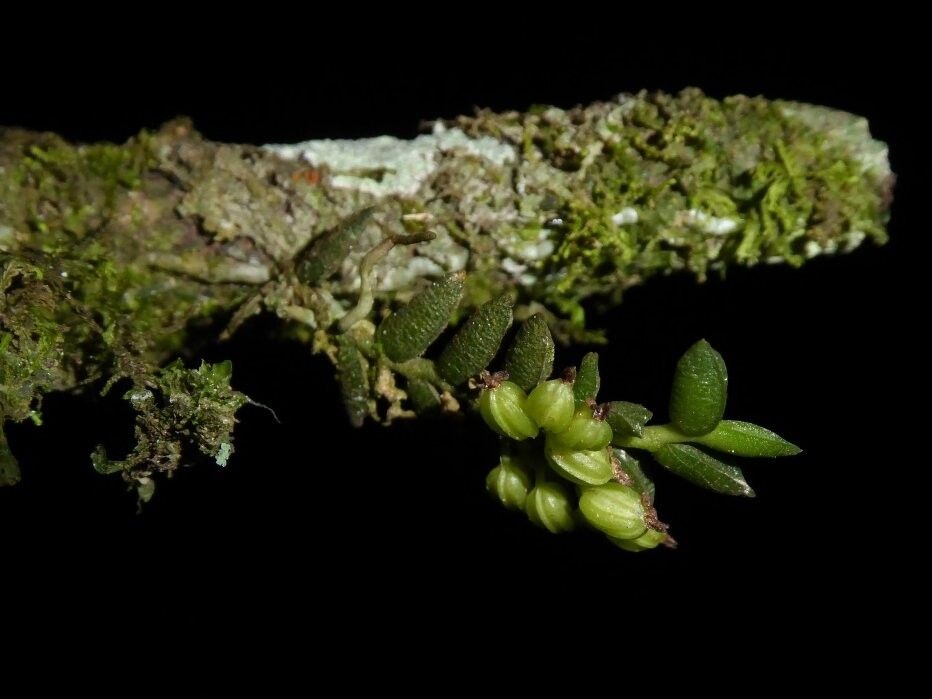
Angraecum humile is a miniature, dwarf epiphytic subshrub. Stems are short, rarely branching, and bear a single rosette of distichous, equitant leaves that are narrowly elliptic, light‑green, fleshy and grooved on the upper surface. Leaves are typically 5–10 cm long (exact measurements not given in the sources). The plant produces an axillary inflorescence 2–5 mm long that bears 2–5 flowers.[2] Flowers are among the smallest in the genus, each only 2–3 mm across. The lip is bilaterally flattened; a short nectar spur is present but very reduced, consistent with the tiny flower size. No fragrance is recorded in the available literature.[2] Because the flowers are minute and the plant habit is compact, the species can be confused with other low‑growing Angraecum such as A. affinis or A. humblotianum, but the combination of dwarf stature, leaf morphology, and especially the 2–3 mm flower size is distinctive.
Native Range and Habitat
The species occurs in East and South Tropical Africa, specifically in Ethiopia, Kenya, Rwanda, Sudan‑South Sudan, Tanzania, and Zimbabwe.[1] Field records from Rwanda and Zimbabwe note its presence in evergreen montane forest, usually growing as an epiphyte on tree trunks and large branches.[3][4] Elevations are reported between 1 200 and 2 500 m above sea level, indicating a preference for cool, moist montane environments.[2] The habitat is characterised by high humidity, frequent mist, and a pronounced dry season, but the orchid remains active throughout the year.
Species‑Specific Care
| Factor | Documented guidance | Evidence |
|---|---|---|
| Temperature | Cool to cold (mountain) – precise °C not documented | Based on native elevation and IOSPE description of “cool to cold growing”[2] |
| Light | Not documented | — |
| Water | Not documented | — |
| Humidity | Not documented | — |
| Substrate / Mounting | Epiphytic – best mounted on bark or grown in a very coarse, well‑aerated medium | Habitat description as epiphyte in montane forest[3][4] |
| Fertilisation | Not documented | — |
| Repotting / Refreshing | Not documented | — |
| Seasonal changes | Not documented | — |
Because the orchid is a miniature epiphyte from cool, humid forests, growers should aim to replicate a cool environment (roughly 10–18 °C) with high air movement and ample humidity. Mounting on cork bark or a block of tree fern fiber allows the roots to stay dry between waterings, reducing the risk of rot. Watering should be sufficient to keep the medium moist but not water‑logged; however, exact watering frequency is not recorded for this species.
Flowering and Pollination
Flowering has been reported from late spring through mid‑fall, with individual blooms lasting only a few days.[2] The flowers are minute (2–3 mm) and lack any documented fragrance. No specific pollinator has been recorded for A. humile; the reduced spur suggests that pollination may be performed by tiny insects such as gnats, but this remains speculative.
Evidence and Limitations
The profile relies on a limited set of sources: Kew’s Plants of the World Online for taxonomy and distribution, the IOSPE species page for morphological details and general habitat, and national flora portals for locality records. Quantitative data on plant size, flower dimensions beyond the brief range, exact temperature and humidity requirements, and pollinator observations are not documented in the available literature. Growers are therefore encouraged to treat the care guidelines as provisional and adjust based on plant response.
FOLLOW THE EVIDENCE
Sources & references
- Angraecum humile Summerh. | Plants of the World Online | Kew Science, https://powo.science.kew.org/taxon/urn:lsid:ipni.org:names:616183-1
- IOSPE PHOTOS – Angraecum humile, https://www.orchidspecies.com/anghumile.htm
- Flora of Zimbabwe: Species information: Angraecum humile, https://www.zimbabweflora.co.zw/speciesdata/species.php?species_id=118590
- Flora of Rwanda: Species information: Angraecum humile, https://www.rwandaflora.com/speciesdata/species.php?species_id=118590