At a glance
RECORDED PROFILE DATA- Scientific name
- Angraecum chimanimaniense G.Will.
- Name status
- Accepted
- Native region
- Zimbabwe (Chimanimani Mountains)
- Growth habit
- Epiphytic (occasionally lithophytic) subshrub
- Cultivation temperature group
- Not documented
Names and Taxonomy
The accepted scientific name is Angraecum chimanimaniense G.Will. The name was first published in Kew Bulletin 51:557 (1996) and is listed as accepted by Kew’s Plants of the World Online.[1] A later homotypic synonym is Perrierangraecum chimanimaniense (G.Will.) Szlach., Mytnik & Grochocka (2013). The species is occasionally referred to by the common name “Chimanimani Mountains Angraecum” in horticultural listings.[3]
How to Identify This Species
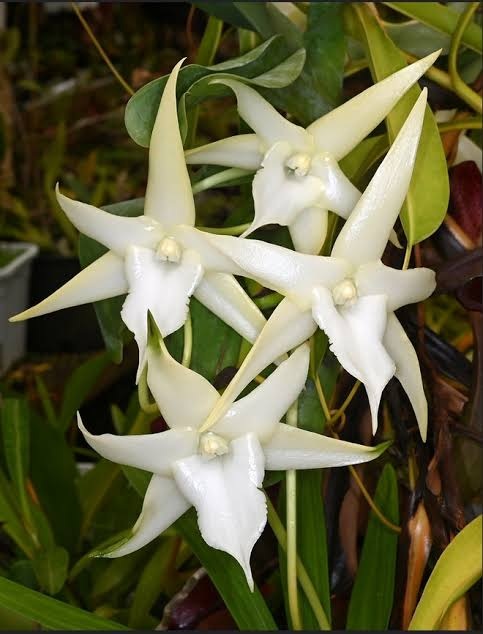
In the wild the plant is a miniature epiphytic or lithophytic subshrub reaching about 30 cm in height.[5] Stems are elongated, sometimes branched, with roots arising near the base. Leaves are distichous, linear, dark‑green, and punctate on the upper surface.[3] Each inflorescence bears a single resupinate flower that is white with a faint green‑straw tint. The flower measures roughly 7 cm (2.8 in) in length, with a spurred lip typical of the genus.[3][8] The plant is fragrant, a trait noted in horticultural references.[5] Because the species produces only one flower per stem and occurs at high elevation, these characters together help separate it from other Zimbabwean Angraecum such as A. humile or A. conchiferum, which differ in flower number and size.
Native Range and Habitat
Angraecum chimanimaniense is endemic to Zimbabwe, known only from the Chimanimani Mountains.[1][4] It inhabits riverine forests at elevations around 1800 m, growing on tree trunks (epiphyte) or on rocks (lithophyte) in a seasonally dry tropical biome.[1][3] The habitat is characterised by moderate to high humidity and cooler temperatures compared with lowland tropical forests.
Species‑Specific Care
| Factor | Documented guidance | Evidence |
|---|---|---|
| Light | Bright, filtered light (mimicking forest canopy) | Inferred from riverine forest habitat[3] |
| Temperature | Cool conditions; approx. 15‑22 °C (59‑72 °F) | Described as a “cool‑growing” species[3] |
| Humidity | Moderate to high humidity | Inferred from riverine forest environment[3] |
| Substrate | Well‑draining bark mix or mounted on cork/bark | Epiphytic habit documented[2] |
| Watering | Regular watering with good drainage; allow brief drying between waterings | Not documented – general practice for epiphytic orchids |
| Fertilisation | Balanced orchid fertilizer applied during active growth | Not documented for this species |
| Rest period | Not documented | — |
Growers should aim to replicate the cool, humid conditions of the Chimanimani forest. Because specific horticultural trials are scarce, observations remain limited; the above recommendations are derived from the plant’s natural ecology.
Flowering and Pollination
In its native range the orchid flowers in late spring to early summer. Individual flowers last several weeks and emit a faint fragrance.[5][8] The flower’s long spurred lip suggests moth pollination, a common syndrome in the genus, but no pollinator has been recorded for this species.Not documented
Conservation and Responsible Cultivation
The Flora of Zimbabwe lists Angraecum chimanimaniense as an endemic species with an IUCN‑style status of Endangered (EN).[4] Habitat loss in the Chimanimani Mountains is the primary threat. The species does not appear on the CITES Orchid Checklist, but growers should verify current regulations before trade.
Evidence and Limitations
Most information derives from herbarium‑based floras (POWO, Flora of Zimbabwe) and a horticultural description on IOSPE. Detailed cultivation trials, precise temperature ranges, and pollinator observations are lacking. Future field studies and ex‑situ propagation experiments are needed to refine care recommendations and assess conservation status.
Frequently asked questions
Is Angraecum chimanimaniense cultivated by orchid enthusiasts?
The species is very rare in cultivation; only a few growers have reported successful culture, typically mounting the plant on bark and keeping it cool and humid to imitate its natural forest habitat.
What time of year does this orchid flower in the wild?
In the Chimanimani Mountains it flowers in late spring to early summer, producing a single fragrant white flower that can last several weeks.
FOLLOW THE EVIDENCE
Sources & references
- Angraecum chimanimaniense G.Will. | Plants of the World Online | Kew Science, 2026. https://powo.science.kew.org/taxon/urn:lsid:ipni.org:names:990439-1
- Flora of Zimbabwe: Species information: Angraecum chimanimaniense. 2026. https://www.zimbabweflora.co.zw/speciesdata/species.php?species_id=118560
- IOSPE PHOTOS – Angraecum chimanimaniense. 2026. https://www.orchidspecies.com/angchimanimaniense.htm
- Flora of Zimbabwe: List of endemic species. 2026. https://www.zimbabweflora.co.zw/speciesdata/utilities/utility-display-endemics.php
- Angraecum chimanimaniense | NativePlants.info. 2026. https://www.nativeplants.info/plant/magnoliophyta-flowering-plants/orchidaceae/angraecum/angraecum_chimanimaniense.html