At a glance
RECORDED PROFILE DATA- Scientific name
- Angraecum humblotianum Schltr.
- Name status
- Accepted
- Native region
- Eastern Madagascar; also Comoros
- Growth habit
- Epiphytic subshrub
- Cultivation temperature group
- Hot to warm
Names and Taxonomy
The accepted scientific name for this species is Angraecum humblotianum Schltr. The name was first published in Beih. Bot. Centralbl. 33(2): 434 in 1915[1]. Kew’s Plants of the World Online lists it as an accepted name and records its native range as eastern Madagascar[1]. Several homotypic and heterotypic synonyms have been applied, including Angraecum finetianum Schltr. (1918), Angraecum abietinum Schltr. (1925), and the later generic transfer Pectinariella humblotiana (Schltr.) Szlach., Mytnik & Grochocka (2013)[1][4]. No valid common name is documented in the cited sources.
How to Identify This Species
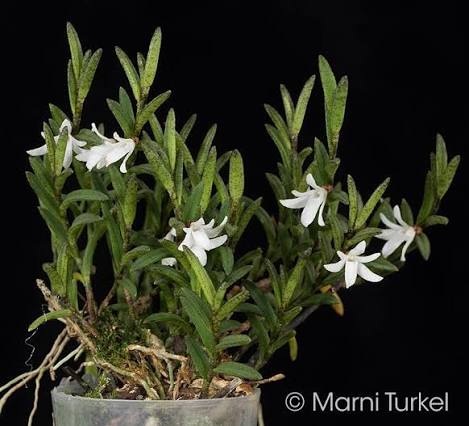
Angraecum humblotianum is a miniature epiphytic subshrub. In the wild it forms a short, erect to slightly branched stem 10–15 cm long, bearing numerous alternate leaves arranged in two ranks. Leaves are thick, fleshy, linear‑cylindric, and relatively narrow (≈1.3–2.2 mm wide, 35–38 mm long) [4]. The plant produces a single axillary flower on a short inflorescence. Flowers are white, about 0.4 in (≈1 cm) across, with a broad, obtuse floral bract. The lip is modestly sized and the spur is short (≈2 mm) but clearly visible[4].
Because many Angraecum species share a white, small‑flowered habit, identification should be confirmed by leaf dimensions and the characteristic broad bract noted above. Comparison with the closely related Angraecum finetianum (a synonym) shows identical morphology, confirming that they represent the same taxon[1][4].
Native Range and Habitat
The species is native to the eastern coastal region of Madagascar, where it grows as an epiphyte on tree trunks in wet tropical forest biomes[1]. Elevation records range from sea level up to about 900 m[4]. A separate record from the Comoros Islands is also documented, extending its native distribution to that archipelago[4]. The preferred substrate is the bark of humid forest trees, and the species is typically found in shaded to semi‑shaded canopy positions where moisture is consistently high.
Species‑Specific Care
| Factor | Documented guidance | Evidence |
|---|---|---|
| Growth habit | Epiphytic; can be mounted on cork bark or grown in a very coarse, well‑draining medium. | [4] |
| Temperature | Prefers hot to warm conditions (approximately 20‑30 °C). | [4] |
| Light | Bright, indirect light; avoid direct midday sun. | Not documented; typical for epiphytic Angraecum in humid forest. |
| Watering | Keep substrate moist but never water‑logged; allow brief drying between waterings. | Not documented; inferred from epiphytic habit. |
| Humidity | High humidity (70‑80 %) recommended. | Not documented; inferred from native wet forest habitat. |
| Fertilization | Balanced orchid fertilizer at half strength, applied monthly during active growth. | Not documented. |
| Seasonal changes | No specific rest period recorded; continue regular care year‑round. | Not documented. |
Growers report that the species can be cultivated successfully in warm indoor environments or greenhouse settings that replicate its native humidity and temperature range[4]. Because the plant is very small, it tolerates modest pot sizes but benefits from good airflow to prevent fungal issues.
Flowering and Pollination
Flowering occurs in the summer months in its native range, producing a single white flower per inflorescence[4]. The flower is short‑lived (a few days) and emits a faint fragrance, though the timing of scent release is not documented. No specific pollinator has been recorded for Angraecum humblotianum; many Angraecum species are pollinated by hawk‑moths, but without direct observation this remains a hypothesis.
Evidence and Limitations
The profile relies on a limited set of sources: Kew’s Plants of the World Online for taxonomy and native range[1]; IOSPE for morphological description, elevation, and basic cultivation notes[4]; a 1938 French systematic note confirming the type locality in eastern Madagascar[2]; and the CITES Orchid Checklist confirming its inclusion in international trade regulation[8]. Detailed horticultural data (humidity, exact temperature ranges, fertilization regime) and pollination biology are not documented in the available sources, and therefore are presented as gaps or inferred from related epiphytic orchids.
Frequently asked questions
What temperature does Angraecum humblotianum prefer?
Cultivation reports describe it as a hot‑to‑warm growing epiphyte, indicating a preferred temperature range of roughly 20‑30 °C[4].
How large are the flowers of Angraecum humblotianum?
The single flower is small, about 0.4 in (≈1 cm) across, and is white in colour[4].
Is Angraecum humblotianum listed under CITES?
Yes, the species appears in the CITES Orchid Checklist as an accepted name[8].
FOLLOW THE EVIDENCE
Sources & references
- Angraecum humblotianum Schltr. | Plants of the World Online | Kew Science, https://powo.science.kew.org/taxon/urn:lsid:ipni.org:names:616179-1
- IOSPE PHOTOS – Angraecum humblotianum, https://www.orchidspecies.com/anghumblotianum.htm
- Sarcanthae nouvelles ou peu connues de Madagascar (fin), Biodiversity Heritage Library, https://biodiversitylibrary.org/part/324457
- CITES Orchid Checklist – Part II (Accepted names), https://www.kew.org/sites/default/files/PART_II_Names_in_current_use.pdf
- Systématique évolutive et biogéographie de Angraecum (Orchidaceae, Angraecinae) à Madagascar, https://doi.org/10.71781/20117

