At a glance
RECORDED PROFILE DATA- Scientific name
- Angraecum floribundum Bosser
- Name status
- Accepted
- Native region
- Madagascar
- Growth habit
- Epiphytic subshrub
- Cultivation temperature group
- Cool‑growing (mid‑elevation) – precise range not documented
Names and Taxonomy
Angraecum floribundum Bosser is the accepted scientific name for this species. It was first described in Adansonia n.s., 10: 102 (1970)【1】. The Kew Plants of the World Online database lists the name as accepted and records its native range as central Madagascar【1】. A later homotypic synonym is Lemurangis floribunda (Bosser) Szlach., Mytnik & Grochocka (2013)【1】. The species is not listed under any other valid scientific name in the consulted sources.
How to Identify This Species
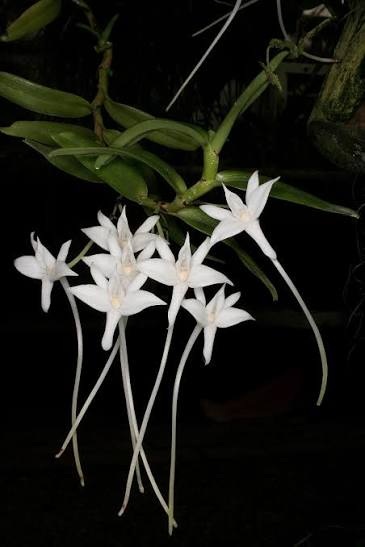
In the field the plant appears as a medium‑sized epiphytic subshrub with a woody stem bearing numerous adventitious roots near the base. Leaves are dull‑green, keeled, ligulate and flat, narrowing slightly toward the base. They are unequally bilobed at the apex and are spaced roughly 1–2 cm (0.4–0.8 in) apart along the stem【2】. Leaf length is reported as under 6 cm in the diagnostic key for the section Lemurangis【3】.
The inflorescence is a short, solitary (or occasionally paired) spike 3–4 cm (1.2–1.6 in) long, bearing one or two flowers【2】. Flowers are green, about 2 cm (0.8 in) across, and are described as “fleshy”. The floral bracts are boat‑shaped and shorter than the ovary. The plant blooms in the cooler months of the year (winter to early spring)【2】. No fragrance is documented in the available sources.
Because many Angraecum species share a similar epiphytic habit and greenish flowers, leaf size (under 6 cm) and the very short inflorescence are useful characters for separating A. floribundum from larger, more floriferous relatives such as A. eburneum.
Native Range and Habitat
The species is endemic to central Madagascar, occurring primarily in wet tropical forests at elevations of roughly 1 100–1 300 m above sea level【1】【2】. It grows as an epiphyte on tree branches in shaded, humid forest interiors, typical of the island’s mid‑elevation rainforests.
Species‑Specific Care
| Factor | Documented guidance | Source |
|---|---|---|
| Temperature | Cool‑growing; typical of mid‑elevation forest (no precise temperature range documented) | 2 |
| Light | Bright but filtered shade (inferred from shaded forest habitat; not explicitly documented) | 1 |
| Water | Consistently moist conditions; heavy rainfall environment suggests regular watering with good drainage | 1 |
| Humidity | High humidity (wet tropical biome) | 1 |
| Mounting / Potting | Epiphytic – suitable for mounting on bark or grown in a very coarse, well‑aerated medium | 2 |
| Fertilisation | Not documented for this species | — |
| Seasonal rest | Not documented | — |
Because detailed horticultural studies for A. floribundum are lacking, growers should mimic its natural mid‑elevation forest conditions: provide ample humidity, avoid direct midday sun, and maintain a cool to intermediate temperature regime. Regular watering that keeps the medium moist (but not water‑logged) is advisable, reflecting the species’ origin in a wet tropical biome.
Flowering and Pollination
Flowering occurs in the cooler months, typically winter to early spring in its native range【2】. Individual flowers last for several days, but exact longevity is not recorded. No specific pollinator has been documented for this species; the green, non‑fragrant flowers suggest possible moth pollination, a common syndrome in many Angraecum, but this remains speculative.
Conservation and Responsible Cultivation
The species is listed in the CITES Orchid Checklist as occurring in Madagascar【9】, indicating that international trade is regulated under CITES Appendix II (the standard listing for most orchids). No formal IUCN Red List assessment was found in the supplied sources.
Evidence and Limitations
Key data such as precise temperature tolerances, watering frequencies, and pollinator identity are not documented for Angraecum floribundum. Existing information derives mainly from taxonomic treatments and a horticultural description that lacks quantitative cultural parameters. Further field studies and cultivation trials would be needed to refine care recommendations.
Frequently asked questions
What is the typical flower size of Angraecum floribundum?
The flowers are about 2 cm (0.8 in) across, as reported in the IOSPE description.
When does Angraecum floribundum flower in its natural habitat?
Flowering occurs during the cooler months, generally winter to early spring.
Is Angraecum floribundum listed under CITES?
Yes, it appears in the CITES Orchid Checklist as a species native to Madagascar.
Does this species have a fragrance?
No fragrance has been documented for Angraecum floribundum in the available sources.
FOLLOW THE EVIDENCE
Sources & references
- Plants of the World Online – Angraecum floribundum Bosser, 2026, https://powo.science.kew.org/taxon/urn:lsid:ipni.org:names:616136-1
- IOSPE PHOTOS – Angraecum floribundum, 2026, http://www.orchidspecies.com/angfloribundum.htm
- Hermans, J. et al., 2021, Angraecum inflatum, a new species in Angraecinae (Orchidaceae) from Madagascar, https://link.springer.com/article/10.1007/s12225-021-09960-5
- Kew – CITES Orchid Checklist (Part II), 2026, https://www.kew.org/sites/default/files/PART_II_Names_in_current_use.pdf

