At a glance
RECORDED PROFILE DATA- Scientific name
- Angraecum didieri Baill. ex Finet Schltr.
- Name status
- Accepted
- Native region
- Madagascar
- Growth habit
- Epiphytic subshrub
- Cultivation temperature group
- Cool to intermediate
Names and Taxonomy
The accepted scientific name is Angraecum didieri Baill. ex Finet Schltr. The name was first published in Beihefte zur Botanischen Centralblatt 33: 433 (1915)【1】. Kew’s Plants of the World Online lists the species as accepted and places it in the family Orchidaceae, subfamily Epidendroideae.1 Two homotypic synonyms are recorded: Macroplectrum didieri Baill. ex Finet (1907) and Perrierangraecum didieri (Baill. ex Finet) Szlach., Mytnik & Grochocka (2013)【1】. The common name documented in horticultural sources is “Didier’s Angraecum”【5】.
How to Identify This Species
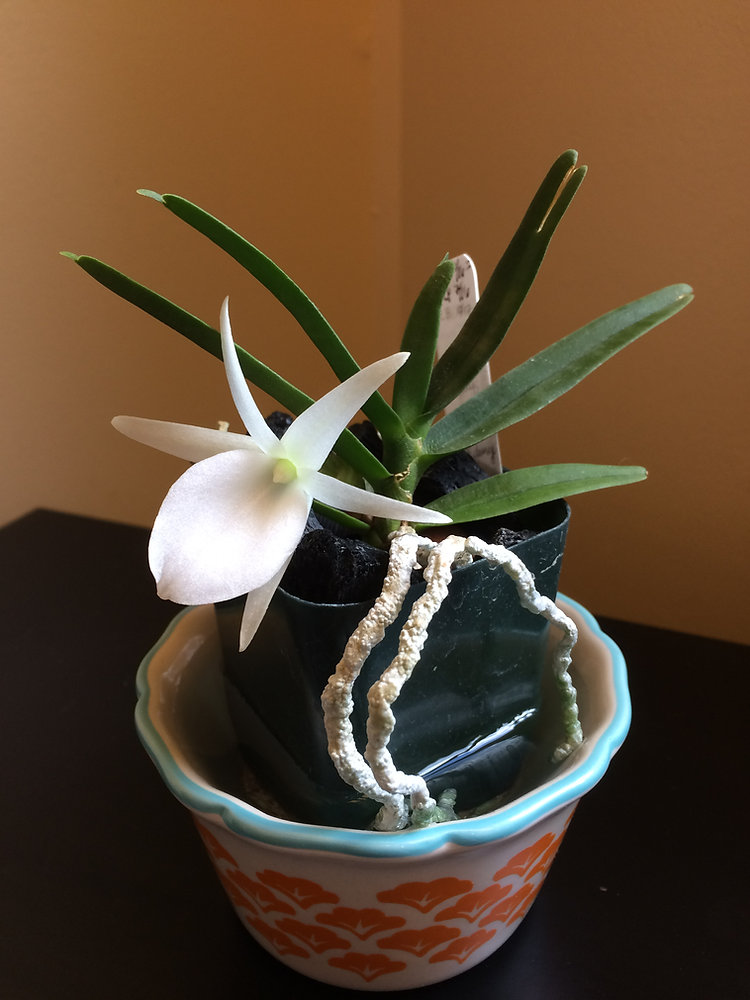
Growth habit. A miniature to small epiphytic subshrub that grows on tree branches. Stems are short, often bearing a single leaf pair per node.1
Leaves. Leaves are coriaceous, unequally bilobed at the apex, giving a “fanged” appearance noted by growers【8】. Leaf length ranges from about 6 mm to 7 cm according to orchid‑guru data【6】, though field descriptions emphasize the bilobed tip as a diagnostic trait【2】.
Roots. Thick, warty (knobby) roots are characteristic and often visible in cultivated plants【5】.
Inflorescence and flower. The plant produces a short raceme bearing a single flower, usually with two to three bracts. The flower is white, star‑shaped, measuring 2–2.5 in (5–6.3 cm) across【5】【10】. The lip is broad, opaque bright white, and the spur is long, about 5 ⅔ in (14 cm)【10】. Fragrance is described as spicy orange, strongest at dusk and into the night【5】【8】.
Comparison. Historical notes place A. didieri near A. obesum and A. elephantinum, differing mainly in the smooth roots and the presence of two prominent calli near the base of the labellum【2】. While these traits help separate the taxa, overlap in leaf shape means identification should consider the whole habit and flower morphology.
Native Range and Habitat
Angraecum didieri is endemic to Madagascar, occurring in the eastern, central and southeastern portions of the island【1】. It inhabits humid, evergreen forest zones at elevations from roughly 300 m to 1 500 m above sea level【10】 (approximately 600–1 500 m is also reported by horticultural sources【5】【6】). The species grows as an epiphyte on tree trunks and large branches, favouring moist, shaded micro‑habitats within the wet tropical biome【1】.
Seasonal climate in its native range includes a marked rainy season, with high humidity and frequent mist. No formal introduction outside Madagascar is documented in the cited sources.
Species‑Specific Care
| Factor | Documented guidance | Source |
|---|---|---|
| Temperature | Cool to intermediate; night lows around 18 °C (mid‑60 °F), daytime highs 27–30 °C (80–85 °F) | 【8】 |
| Light | Bright, filtered light; equivalent to 1 500–2 500 foot‑candles (≈8 000–22 000 lux). Avoid direct midday sun. | 【8】 |
| Humidity | Maintain 70–80 % relative humidity year‑round. | 【8】 |
| Air movement | Good airflow is essential to prevent rot of the knobby roots. | 【8】 |
| Substrate | Well‑draining bark‑based mix; growers report success with a blend of seramis (expanded clay) and charcoal, allowing the plant to remain dry between waterings. | 【8】 |
| Watering | Water regularly but allow the medium to dry out before the next watering; avoid standing water. | 【8】 |
| Fertilisation | Use a balanced orchid fertilizer; increase phosphate in the month before expected flowering, then shift to higher nitrogen during active growth. | 【8】 |
| Potting / mounting | Can be grown in small pots (2 in) or mounted on wood or cork bark to mimic its natural epiphytic habit. | 【5】【8】 |
| Seasonal changes | No documented winter rest; plants continue to grow and may rebloom in both spring and fall under suitable conditions. | 【5】【8】 |
Overall, the species tolerates a range of conditions but performs best when its natural forest parameters—cool nights, warm days, high humidity, and excellent ventilation—are reproduced. Over‑watering or excessively dry media are the most common causes of decline.
Flowering and Pollination
In cultivation, A. didieri typically flowers from April to June in the northern hemisphere, with occasional repeat blooms in the fall【5】【8】. The flower opens in the late afternoon and releases a strong spicy‑citrus scent at dusk, intensifying through the night【5】【8】. Flower longevity is not quantified in the available sources.
No specific pollinator has been documented for this species; the long nectar spur (≈14 cm) suggests adaptation to moth pollination, a pattern common in many Angraecum spp., but this remains a hypothesis without direct observation.
Conservation and Responsible Cultivation
The IUCN Red List entry for Angraecum didieri exists, but the snippet provided does not include the assessment category or criteria【12】. Consequently, the formal conservation status cannot be stated here. Given its restricted range in Madagascar’s forest fragments, growers are encouraged to source plants from reputable, legally compliant nurseries that propagate from cultivated stock rather than wild collection.
Evidence and Limitations
Most morphological and ecological data derive from herbarium descriptions (e.g., the 1938 Notulae Systematicae article) and horticultural observations from botanical gardens and experienced growers. Precise measurements of plant height, leaf dimensions, and flower longevity are limited to the ranges reported in cultivation notes; these may differ from wild populations. Pollination biology is inferred from flower morphology but lacks direct field study. The IUCN assessment details are not available in the excerpt, leaving the official threat category undocumented.
FOLLOW THE EVIDENCE
Sources & references
- Angraecum didieri (Baill. ex Finet) Schltr. | Plants of the World Online | Kew Science – https://powo.science.kew.org/taxon/urn:lsid:ipni.org:names:616080-1
- Sarcanthae nouvelles ou peu connues de Madagascar (fin) – Biodiversity Heritage Library – https://biodiversitylibrary.org/part/324457
- Angraecum didieri – Smithsonian Gardens – https://si.gardenexplorer.org/taxon-23147.aspx
- IOSPE PHOTOS – Angraecum didieri – https://www.orchidspecies.com/angdidieri.htm
- How to grow Angraecum didieri – Orchid Muse – https://www.orchidmuse.com/post/angraecum-didieri-culture
- Angraecum didieri – orchid.guru – https://www.orchid.guru/content/orchids/a/angraecum/didieri/
- Angraecum didieri – IUCN Red List of Threatened Species – https://doi.org/10.2305/iucn.uk.2025-1.rlts.t64594043a64602185.en

