At a glance
RECORDED PROFILE DATA- Scientific name
- Angraecum huntleyoides Schltr.
- Name status
- Accepted name (Angraecum chloranthum Schltr. is a synonym)
- Native region
- Madagascar
- Growth habit
- Epiphytic subshrub
- Cultivation temperature group
- Warm to cool (intermediate)
Names and Taxonomy
The name Angraecum chloranthum Schltr. was published in 1913, but taxonomic consensus treats it as a heterotypic synonym of Angraecum huntleyoides Schltr., which was described earlier in 1906. The accepted name is therefore Angraecum huntleyoides Schltr. (Kew Plants of the World Online)【1】. The synonymy is listed explicitly in the Kew database, where A. chloranthum appears as a heterotypic synonym of A. huntleyoides【1】. No widely used common name is documented for this taxon.
How to Identify This Species
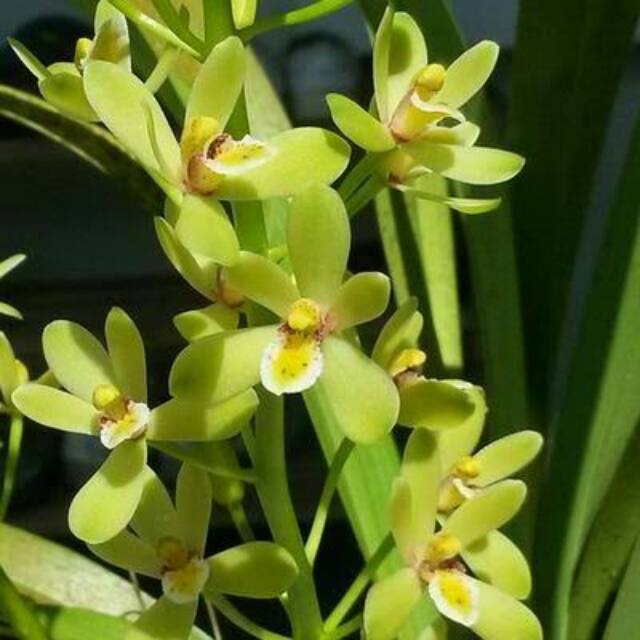
Angraecum huntleyoides is a small to medium‑sized epiphytic subshrub that often lacks a conspicuous stem. It bears 5–6 leaves that are unequally bilobed at the apex. The leaves are arranged along the short axis of the plant, giving a compact appearance. The inflorescence is axillary, 4–5 cm long, and usually carries 2–3 flowers. Individual flowers are about 2.5 cm across, initially yellow and turning paler with age. The lip is modest in size, and the spur is short, typical of the section Chlorangraecum. Flowering occurs in the summer months of the native range【2】.
Because many Angraecum species share a similar growth habit, the combination of leaf bilobing, short axillary inflorescences with 2–3 flowers, and the specific flower colour change (yellow to pale) helps distinguish it from close relatives such as Angraecum huntleyoi (which bears larger, more numerous flowers) and other section Chlorangraecum members.
Native Range and Habitat
The species is endemic to Madagascar, occurring primarily in the eastern and central parts of the island. It inhabits moss‑covered forest zones at elevations of roughly 500–1 200 m, where humidity is high and the forest is classified as wet tropical biome. In the wild it grows as an epiphyte on trees, often on mossy branches that retain moisture.
Species‑Specific Care
| Factor | Documented guidance | Source |
|---|---|---|
| Growth habit | Epiphytic; mount on bark or grow in a well‑draining medium with plenty of air flow. | 【1】 |
| Temperature | Warm to cool (intermediate); daytime 18–24 °C, night 12–16 °C. | 【2】 |
| Light | Bright, filtered light similar to a forest canopy; avoid direct midday sun. | Not documented for this species; inferred from native habitat. |
| Watering | Keep the substrate consistently moist but not water‑logged; mimic the frequent mist of mossy forests. | Not documented for this species; inferred from habitat description. |
| Humidity | High humidity (≥70 %). | Not documented for this species; inferred from wet tropical forest. |
| Fertilisation | Use a balanced orchid fertilizer at half strength during active growth. | Not documented for this species. |
| Repotting / mounting | Refresh mount or medium every 2–3 years; avoid disturbing roots excessively. | Not documented for this species. |
Because specific horticultural studies on A. huntleyoides are limited, growers should treat the above recommendations as a starting point and adjust based on plant response. Maintaining high humidity and good air circulation is especially important, reflecting the species’ native mossy forest environment.
Flowering and Pollination
Flowering occurs in the summer season of the native range (approximately November to March in the Southern Hemisphere). Individual flowers last several weeks and are fragrant, a trait common in many Angraecum species that attract night‑flying moths, though a specific pollinator has not been documented for this taxon.
Evidence and Limitations
The taxonomic status and synonymy are well‑supported by Kew’s Plants of the World Online. Morphological details and elevation range come from an IOSPE species page, which aggregates data from several orchid references but does not provide primary measurements beyond those cited. Specific cultivation parameters (light, watering, humidity) are inferred from the species’ natural habitat because peer‑reviewed horticultural studies for this taxon are not available. Consequently, growers should treat the care recommendations as provisional and adjust according to observed plant health.
Frequently asked questions
Is Angraecum chloranthum the same as Angraecum huntleyoides?
Yes. Kew’s Plants of the World Online lists Angraecum chloranthum Schltr. (1913) as a heterotypic synonym of the earlier described Angraecum huntleyoides Schltr. (1906), making the latter the accepted name.
What temperature range does this species prefer?
The species is described as a warm‑to‑cool (intermediate) growing epiphyte, suggesting daytime temperatures around 18–24 °C and night temperatures of 12–16 °C.
When does Angraecum chloranthum flower in its natural habitat?
In the wild it flowers during the summer months of the southern hemisphere, roughly November to March.
FOLLOW THE EVIDENCE
Sources & references
- Angraecum huntleyoides Schltr. | Plants of the World Online | Kew Science – https://powo.science.kew.org/taxon/urn:lsid:ipni.org:names:616184-1
- IOSPE PHOTOS – Angraecum chloranthum (syn. Angraecum huntleyoides) – http://orchidspecies.com/angchloranthum.htm
- List of Angraecum species – Wikipedia – https://en.wikipedia.org/wiki/List_of_Angraecum_species

