At a glance
RECORDED PROFILE DATA- Scientific name
- Angraecum teretifolium Ridl.
- Name status
- Accepted
- Native region
- Madagascar
- Growth habit
- Epiphytic subshrub (pendant)
- Cultivation temperature group
- Not documented
Names and Taxonomy
Angraecum teretifolium Ridl. is the accepted name for this species according to Kew’s Plants of the World Online.[1] It was first described in Journal of the Linnean Society, Botany 21: 484 (1885). The species has several homotypic synonyms that have appeared in the literature, including Angorkis teretifolia (Ridl.) Kuntze, Arachnangraecum teretifolium (Ridl.) Szlach., Mytnik & Grochocka, and Monixus teretifolius (Ridl.) Finet. All of these are regarded as taxonomic synonyms of the accepted name.[1] No vernacular (common) name is recorded in the available sources.
How to Identify This Species
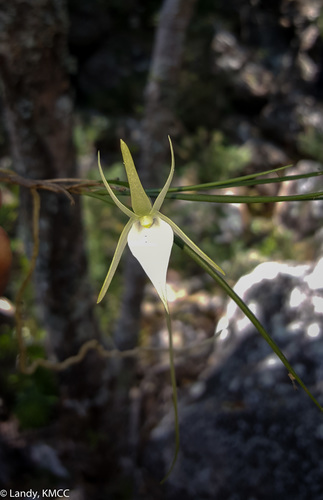
In the wild Angraecum teretifolium is a medium‑sized, pendant‑growing epiphyte that may also occur as an occasional terrestrial. The plant produces a thin, spidery stem covered with old leaf sheaths. Along the stem are 10‑15 terete (cylindrical) leaves that are dark‑green, hard, very acute and closely spaced, giving the plant a “pencil‑like” appearance.[2]
The inflorescence is short, axillary and bears a single flower. The flower measures roughly 0.7–0.9 cm (¼–⅜ in) in width, with a length of about 3.5–5 cm (1¼–2 in). The lip lacks a strong dorsal keel, a feature that helps separate it from the similar Angraecum linearifolium.[2]
Native Range and Habitat
This orchid is endemic to the eastern‑central part of Madagascar, occurring in the humid, lichen‑rich highland forests. It is typically found at elevations of 1 000–1 300 m where the climate is cool and consistently moist.[1][2] In its natural setting the species grows epiphytically on tree branches, but occasional terrestrial growth has also been reported.
Species‑Specific Care
| Factor | Documented guidance | Evidence |
|---|---|---|
| Temperature | Cool conditions, similar to highland Madagascar (approximately 15–22 °C) | [2] |
| Humidity | High, consistently humid environment | [2] |
| Light | Not documented | Not documented |
| Watering | Not documented | Not documented |
| Substrate / Mounting | Not documented | Not documented |
| Fertilisation | Not documented | Not documented |
When cultivating A. teretifolium, aim to reproduce the cool, humid conditions of its native highland forest. Provide good air circulation and avoid overheating. Because the species is a pendant epiphyte, mounting on bark or using a very well‑draining orchid mix that mimics tree bark is advisable, although specific mounting recommendations are not recorded in the cited sources.
Flowering and Pollination
Flowering occurs in the spring season of the southern hemisphere (approximately September‑November) and each stem bears a single flower. The flower’s modest size and lack of a pronounced lip keel distinguish it from related species. No pollinator observations are documented for this species in the available literature.
Conservation and Responsible Cultivation
Angraecum teretifolium is listed on the IUCN Red List of Threatened Species, although the specific threat category is not provided in the excerpted source.[3] The species occurs within protected areas such as the Andasibe‑Mantadia region, but habitat loss and pressure from human activities have been noted as concerns in regional studies.[5] Growers should source plants from reputable, legally compliant nurseries and consider ex‑situ conservation efforts.
Evidence and Limitations
Most morphological and ecological information derives from the IOSPE species page and Kew’s Plants of the World Online. Detailed horticultural data (e.g., precise temperature ranges, watering schedules, substrate preferences) are not documented in the consulted sources and therefore are presented as “Not documented.” Further field studies would be valuable to clarify pollination biology and conservation status.
Frequently asked questions
What type of habitat does Angraecum teretifolium naturally grow in?
It is native to the humid, lichen‑rich highland forests of central Madagascar, growing mainly as an epiphyte on trees at elevations of 1 000–1 300 m.
How many leaves does a typical plant have and what do they look like?
A mature plant bears about 10–15 terete (cylindrical), dark‑green, very acute leaves that are closely spaced along the thin, spidery stem.
When does this species flower?
Flowering occurs in the spring season (approximately September‑November in the southern hemisphere) and each stem produces a single flower.
FOLLOW THE EVIDENCE
Sources & references
- Angraecum teretifolium Ridl. | Plants of the World Online | Kew Science, https://powo.science.kew.org/taxon/urn:lsid:ipni.org:names:616453-1
- IOSPE PHOTOS – Angraecum teretifolium, https://www.orchidspecies.com/angteretifolium.htm
- Angraecum teretifolium – IUCN Red List of Threatened Species, https://doi.org/10.2305/iucn.uk.2021-1.rlts.t68002662a68011986.en
- « contribution a l'etude de quelques especes endemiques d'orchidee en vue de leur conservation ... », https://doi.org/10.63917/mem.2008.1046

