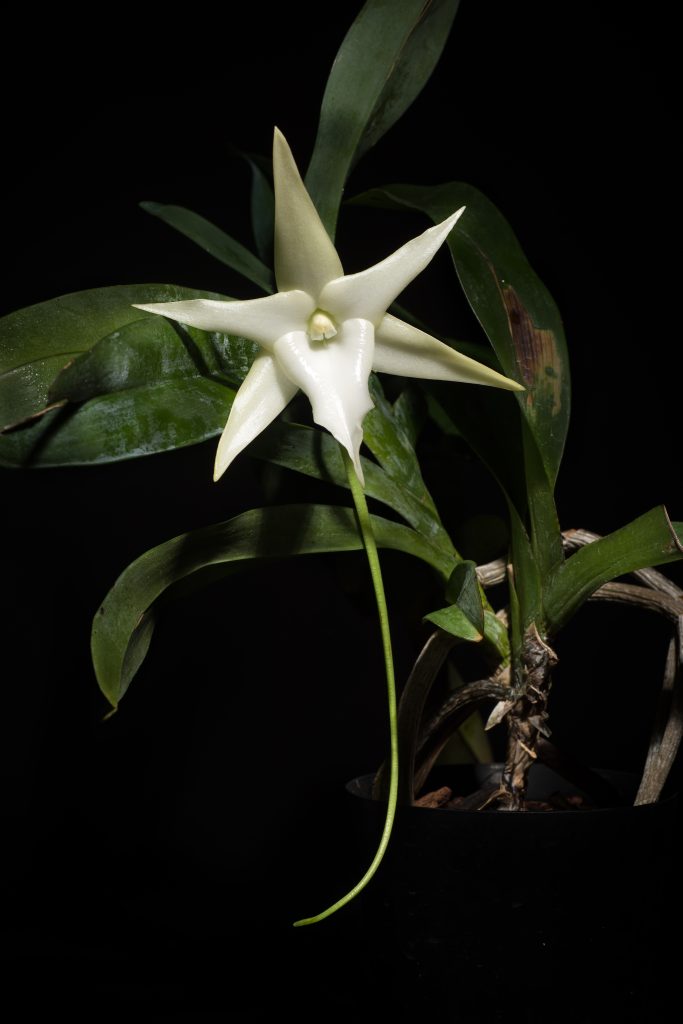
At a glance
RECORDED PROFILE DATA- Scientific name
- Angraecum tenellum (Ridl.) Schltr.
- Name status
- Accepted
- Native region
- Madagascar, Réunion
- Growth habit
- Epiphytic or lithophytic chamaephyte
- Cultivation temperature group
- Cool‑growing
Names and Taxonomy
Angraecum tenellum (Ridl.) Schltr. was first published in Beihefte zum Botanischen Centralblatt 33(2): 438 (1915) and is accepted by Kew’s Plants of the World Online.1 The epithet tenellum means “delicate” or “tender”. Numerous synonyms have been applied to the taxon, including Mystacidium tenellum Ridl., Epidorkis tenella (Ridl.) Kuntze, Angraecum microphyton Schltr., Angraecum oberonia Finet, Angraecum waterlotii H.Perrier, and the more recent horticultural combination Lesliegraecum tenellum (Ridl.) Szlach., Mytnik & Grochocka.1 All of these names are treated as synonyms of the accepted name.2
How to Identify This Species
Angraecum tenellum is among the smallest members of the genus. Plants form a very short, erect stem that is often hidden by a basal leaf rosette. The leaves are lanceolate, fleshy, and only 3–5 mm long, giving the plant a “tiny” appearance.6 From the leaf base arise one or more short, roughly horizontal inflorescences about 5 cm long, each bearing 5–10 minute flowers that open together.6
The flowers are white with faint darker longitudinal stripes on the sepals and petals. Individual flowers are extremely small – about 2 mm across (≈0.08 in). The lip is modestly shaped; the spur is present but not described in the available sources.11 Because of its diminutive size, the species can be confused with other miniature Angraecum such as A. microcharis or the South‑African A. chamaeanthus, but the combination of leaf size, very short stem, and the characteristic 5‑cm horizontal raceme helps separate it.10
Native Range and Habitat
The species is native to the islands of Madagascar and Réunion in the western Indian Ocean.1 It grows as an epiphyte or lithophyte on small branches or rock outcrops within humid evergreen forest. Field observations place it at elevations between 1 000 m and 1 740 m, where the climate is cool‑moderate and consistently moist.11 The habitat is described as “wet tropical biome”, typical of montane cloud forests on these islands.1
Species‑Specific Care
| Factor | Documented guidance | Source |
|---|---|---|
| Light | Bright, filtered light; the plant tolerates fairly bright conditions but should be protected from direct midday sun. | 6 |
| Temperature | Cool‑growing; ideal daytime temperatures 15–22 °C (59–72 °F) with cooler nights. | 11 |
| Humidity | High ambient humidity, mimicking the humid evergreen forest (≈70–80 % RH). | 11 |
| Watering | Not documented in the available sources. | — |
| Growing medium | Well‑draining orchid mix (e.g., fine bark or sphagnum) or mounted on a bark slab to replicate epiphytic habit. | 6 |
| Fertilisation | Not documented in the available sources. | — |
| Repotting / Re‑mounting | Not documented in the available sources. | — |
| Seasonal care | Maintain cool, humid conditions year‑round; avoid cold drafts. | 11 |
Because the species is a miniature, it is often cultivated on small mounts or in shallow pots to keep the root system exposed to airflow. Over‑watering can quickly lead to rot, so growers should allow the medium to dry slightly between waterings, especially in winter, even though specific watering frequencies are not documented.
Flowering and Pollination
In the wild, flowering occurs in the summer and autumn months (Southern Hemisphere), corresponding to the period of higher humidity in montane forests.11 Flowers are very short‑lived (a few days) and emit a faint fragrance that is not well described in the literature. No pollinator has been recorded for this species; the minute size and simple white morphology suggest possible small moth or fly visitation, but this remains speculative.
Evidence and Limitations
The profile relies on a limited set of published sources. Key horticultural details such as precise watering frequency, fertilizer regime, and long‑term growth rates are not documented for Angraecum tenellum. Likewise, pollination biology has not been studied in depth. Future field observations and cultivation trials would be valuable to fill these gaps.
Frequently asked questions
How large does Angraecum tenellum grow?
Plants are very small, with a short stem that is often hidden, leaves only 3–5 mm long, and inflorescences about 5 cm in length.
When does Angraecum tenellum flower?
In its native range it flowers in the summer and autumn months (Southern Hemisphere), typically at elevations of 1 000–1 740 m.
Can Angraecum tenellum be grown mounted?
Yes. Because it is an epiphytic/lithophytic chamaephyte, mounting on a fine bark slab or using a shallow, well‑draining orchid mix is recommended.
FOLLOW THE EVIDENCE
Sources & references
- Angraecum tenellum (Ridl.) Schltr. | Plants of the World Online | Kew Science – https://powo.science.kew.org/taxon/urn:lsid:ipni.org:names:616446-1
- Lesliegraecum tenellum (Ridl.) Szlach., Mytnik & Grochocka | Plants of the World Online – https://powo.science.kew.org/taxon/urn:lsid:ipni.org:names:77138901-1
- Angraecum tenellum – French orchid site (orchidees.vandes.com) – http://orchidees.vandes.com/2-Les-indigenes/Ind-Angr-tenellum.htm
- IOSPE PHOTOS – Angraecum tenellum – https://www.orchidspecies.com/angtenellum.htm
- Limodore – Angraecum tenellum – https://limodore.france-orchidees.org/angraecum/angraecum-tenellum/angraecum-tenellum.html

