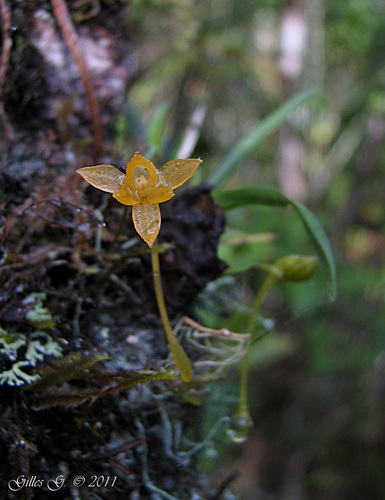
At a glance
RECORDED PROFILE DATA- Scientific name
- Angraecum ochraceum (Ridl.) Schltr.
- Name status
- Angraecum setipes Schltr. is a synonym of Angraecum ochraceum (accepted)
- Native region
- Central and eastern Madagascar
- Growth habit
- Slender epiphytic herb, up to 14 cm tall
- Cultivation temperature group
- Cool to intermediate (12–22 °C)
Names and Taxonomy
The name Angraecum setipes Schltr. was published in 1925, but recent taxonomic work treats it as a synonym of Angraecum ochraceum (Ridl.) Schltr., a name first published in 1915[2]. Authoritative sources such as Kew’s Plants of the World Online list A. setipes as a synonym of the accepted A. ochraceum[1][2]. The synonymy was formally confirmed in the 2020 Kew Bulletin, where the authors reduced A. setipes to synonymy of A. ochraceum[3].
How to Identify This Species
Angraecum ochraceum (including plants formerly known as A. setipes) is a slender epiphytic herb typically 10–14 cm tall. Roots are glabrous to slightly verrucose and 2–3 mm in diameter. The stem is short (1–3 cm long, about 1 cm thick) and is largely concealed by greenish‑brown, corrugated leaf sheaths. Leaves are ligulate, 4–11 mm long and 0.5–1 mm wide, often conduplicate and sometimes bearing three elongated lobules.
The inflorescence is a short, thin raceme bearing a single flower. Flowers are small, with a short, rounded column 1.5–2 mm long and 1.3–1.8 mm wide; the stigma is oval, about 1 mm in diameter. The spur is relatively short but noticeable, and the overall colour is a pale whitish‑cream. Detailed measurements of the lip and spur are given in the Kew description but are not reproduced here due to space constraints[2].
Because A. ochraceum is morphologically similar to several other Madagascan Angraecum species, identification should be confirmed by examining the column and leaf‑sheath characteristics described above, preferably with a herbarium specimen or clear photographs.
Native Range and Habitat
The species is native to central and eastern Madagascar, occurring in wet tropical forests and cloud‑forest habitats[2]. It is an epiphyte that grows on the branches of trees, often at elevations from sea level up to about 1 865 m, with most records concentrated between 800 and 1 500 m in high‑altitude cloud forests[8][5]. The natural environment is characterised by continuous mist, high humidity, and moderate temperatures.
Species‑Specific Care
| Factor | Documented Guidance | Source |
|---|---|---|
| Temperature | Maintain 12–22 °C; cooler nights are beneficial. | [5] |
| Light | Bright, weakly diffused light; avoid direct sun. | [5] |
| Humidity | Keep relative humidity 80–95 %; simulate cloud‑forest moisture. | [5] |
| Watering | Provide continuous moisture; roots should stay wet but not water‑logged. | [5] |
| Medium | Mount on tree bark or use a very fine, well‑aerated medium such as moss‑enriched bark. | [5] |
| Fertiliser | Apply a very dilute, balanced orchid fertilizer sparingly; over‑feeding damages the delicate roots. | [5] |
| Airflow | Ensure good air movement to prevent fungal growth while retaining humidity. | [5] |
| Seasonal changes | Do not impose a dry rest; the species is adapted to year‑round moisture. | [5] |
Because the orchid originates from high‑altitude cloud forests, growers should prioritize cool, stable temperatures and consistently high humidity. Mounting the plant on bark or a slab helps replicate its natural epiphytic habit. Over‑watering or allowing the medium to dry out can cause root desiccation, while excessive heat or direct sunlight may lead to leaf scorching.
Flowering and Pollination
Flowering has been recorded from February to April in its native range[3]. Flowers are short‑lived and emit a faint fragrance typical of many Angraecum species, but specific pollinator observations for A. ochraceum are not documented in the available sources.
Conservation and Responsible Cultivation
An IUCN Red List entry exists for Angraecum setipes, but the snippet does not provide a conservation category[6]. Consequently, the precise threat status is not documented here. Given its restricted high‑altitude habitat, the species is likely vulnerable to habitat loss and climate change; growers are encouraged to obtain material from reputable, legally compliant sources and to support in‑situ conservation efforts.
Evidence and Limitations
The taxonomy presented follows the most recent Kew Bulletin treatment, which treats A. setipes as a synonym of A. ochraceum. Morphological details are drawn from the Kew Plants of the World Online description; however, many measurements are summarized rather than quoted verbatim. Cultivation information relies on a horticultural website (Tropicals.cn) that targets specialist collectors; while detailed, it has not been peer‑reviewed, so growers should treat the recommendations as a starting point and adjust to their own conditions. Pollination biology and precise IUCN status remain undocumented in the sources provided.
FOLLOW THE EVIDENCE
Sources & references
- Angraecum setipes Schltr. | Plants of the World Online | Kew Science – https://powo.science.kew.org/taxon/urn:lsid:ipni.org:names:616418-1
- Angraecum ochraceum (Ridl.) Schltr. | Plants of the World Online | Kew Science – https://powo.science.kew.org/taxon/urn:lsid:ipni.org:names:616305-1/general-information
- New species and nomenclatural changes in Angraecum (Orchidaceae) from Madagascar | Kew Bulletin – https://link.springer.com/article/10.1007/s12225-020-09902-7
- Limodore - Auteur Angraecum ochraceum – https://limodore.france-orchidees.org/angraecum/angraecum-ochraceum/angraecum-ochraceum.html
- 刚毛风兰 Angraecum setipes | Tropicals.cn – https://tropicals.cn/species/angraecum-setipes

