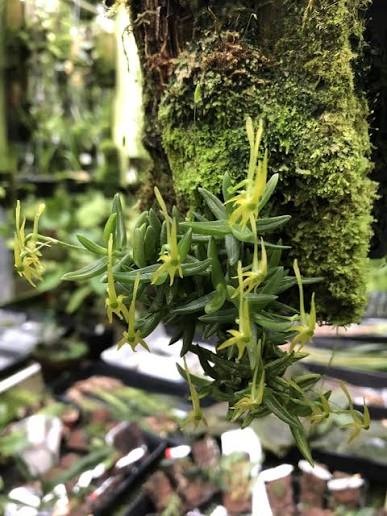
At a glance
RECORDED PROFILE DATA- Scientific name
- Angraecum sedifolium Schltr.
- Name status
- Accepted
- Native region
- Madagascar (East Central highlands)
- Growth habit
- Epiphytic subshrub, miniature to small‑sized
- Cultivation temperature group
- Cool
Names and Taxonomy
Angraecum sedifolium Schltr. was first described in 1925 in Repert. Spec. Nov. Regni Veg. Beih. The name is accepted by Kew’s Plants of the World Online[1]. A later homotypic synonym is Angraecoides sedifolia (Schltr.) Szlach., Mytnik & Grochocka (2013)[1]. No other scientific names or infraspecific taxa are documented. A horticultural common name recorded is “Sedum‑Like Leaf Angraecum,” referring to the succulent‑like leaves[2].
How to Identify This Species
The plant is a miniature to small‑sized epiphytic subshrub that grows on moss‑covered tree trunks. It has a simple, unbranched stem bearing many densely packed, narrowly linear, thick, fleshy leaves that are sub‑triquetrous and dorsally keeled[2]. Leaves are typically 2–4 cm long (measurements not given in the sources). The plant reaches about 30 cm in height in cultivation[5]. Flowering is on a short, single‑flowered inflorescence up to 10 cm long, bearing one white to greenish‑white flower about 3.1 cm across (1 ¼ in)[2]. The flower is reported as fragrant[5]. Because the species is similar in habit to other miniature Angraecum species, leaf shape (succulent, keeled) and the single, relatively large white flower are the most reliable field characters.
Native Range and Habitat
Angraecum sedifolium is endemic to Madagascar, specifically the eastern‑central highlands. It occurs in wet, moss‑rich forest fragments at elevations of roughly 1,000–2,000 m[2][6]. In the wild the orchid grows as an epiphyte on the trunks of trees within mossy forest canopies, favouring humid, cool microclimates.
Species‑Specific Care
| Factor | Documented guidance | Evidence |
|---|---|---|
| Light | Bright, filtered light; shade cloth providing ~1,000–2,000 foot‑candles (10,750–21,500 lumens) is recommended. | [4] |
| Temperature | Cool‑growing: night 55–72 °F (12–22 °C), day 70–85 °F (21–29 °C). | [4] |
| Watering | Apply a thorough watering then allow roots to begin drying (wet/dry cycle). Water in the morning; avoid standing water in the crown. | [4] |
| Humidity | Maintain 55–85 % relative humidity; higher humidity favours vigorous growth. | [4] |
| Substrate / Mounting | Use a porous bark mix for potted plants or mount on bark/fibre. Avoid soggy media; pot at a ~45° angle to encourage outward root growth. | [4] |
| Feeding | Not documented in the available sources. | Not documented |
| Repotting / Re‑mounting | Repot every 1–3 years or when the medium breaks down; re‑mount when roots outgrow the current mount. | [4] |
| Seasonal changes | Cool growing conditions are maintained year‑round; no specific rest period documented. | Not documented |
Overall, the species thrives in conditions that mimic its native cool, humid montane forest: bright but diffused light, moderate to high humidity, and a well‑draining, airy medium. Because it is a miniature epiphyte, it tolerates mounting on bark or fibre, which also helps replicate the natural airflow of tree trunks.
Flowering and Pollination
In cultivation the plant has been reported to flower in late spring and again in fall, each time producing a single white, fragrant flower[2][6]. Flower size is about 3.1 cm across. No specific pollinator has been documented for this species, and no scientific study of its pollination biology is cited in the available sources.
Conservation and Responsible Cultivation
An IUCN Red List entry for Angraecum sedifolium exists, but the snippet does not disclose its threat category[5]. Consequently, the conservation status is not documented here. Cultivators should source plants from reputable, legally compliant growers to avoid contributing to potential wild collection pressures.
Evidence and Limitations
Most morphological and ecological details come from horticultural descriptions (IOSPE, Begin With Plants) and the Kew taxonomic database. Precise measurements of leaf length, flower longevity, and pollinator observations are not available in the cited sources. The IUCN assessment’s category was not provided, so the conservation status remains unclear.
FOLLOW THE EVIDENCE
Sources & references
- Angraecum sedifolium Schltr. | Plants of the World Online | Kew Science, https://powo.science.kew.org/taxon/urn:lsid:ipni.org:names:616411-1
- IOSPE PHOTOS – Angraecum sedifolium, http://www.orchidspecies.com/angsedifolium.htm
- Angraecum sedifolium | NativePlants.info, https://www.nativeplants.info/plant/magnoliophyta-flowering-plants/orchidaceae/angraecum/angraecum_sedifolium.html
- Begin With Plants – Angraecum sedifolium product page, https://beginwithplants.com/products/angraecum-sedifolium
- Angraecum sedifolium: IUCN Red List entry, https://doi.org/10.2305/iucn.uk.2025-2.rlts.t103017338a103090447.en

