At a glance
RECORDED PROFILE DATA- Scientific name
- Angraecum scottianum Rchb.f.
- Name status
- Accepted (Kew POWO)
- Native region
- Comoros
- Growth habit
- Epiphytic subshrub
- Cultivation temperature group
- Hot to warm
Names and Taxonomy
The accepted scientific name is Angraecum scottianum Rchb.f., first published in Gardeners’ Chronicle 10: 556 (1878)【2】. Kew’s Plants of the World Online lists this name as the accepted one and records its native range as the Comoros【1】.
Synonyms documented in major databases include:
- Angorchis scottiana (Rchb.f.) Kuntze (1891)【1】
- Angraecum reichenbachianum Kraenzl. (1890)【1】
- Arachnangraecum scottianum (Rchb.f.) Szlach., Mytnik & Grochocka (2013)【1】
A common horticultural name is “Scott’s Angraecum” as recorded by IOSPE【4】.
How to Identify This Species
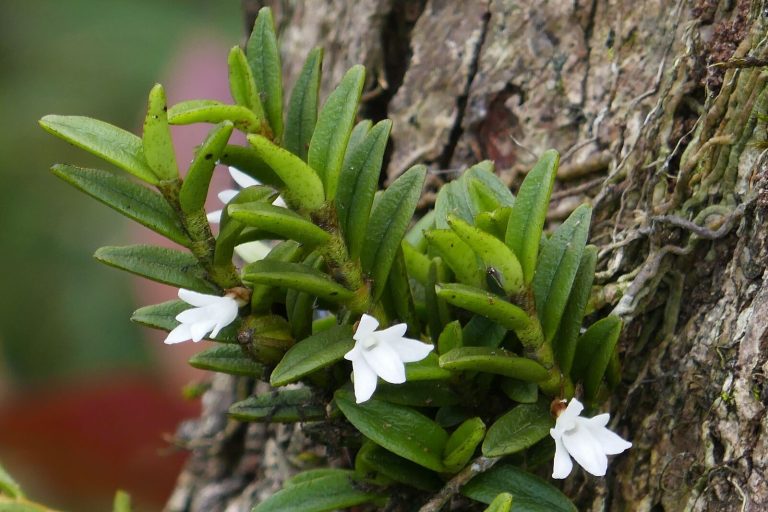
Angraecum scottianum is a small, hot‑to‑warm growing epiphytic subshrub. It has elongated, cylindrical stems bearing 6–8 subcylindrical, terete leaves that are subulate, bicarinate and canaliculate【4】. Leaves are glossy and arranged alternately along the stem.
The inflorescence is axillary, slender and usually 10 cm (≈4 in) long, bearing 5–13 cm racemes with up to eight flowers. Flowers open successively, typically one at a time, and last several days【4】【5】.
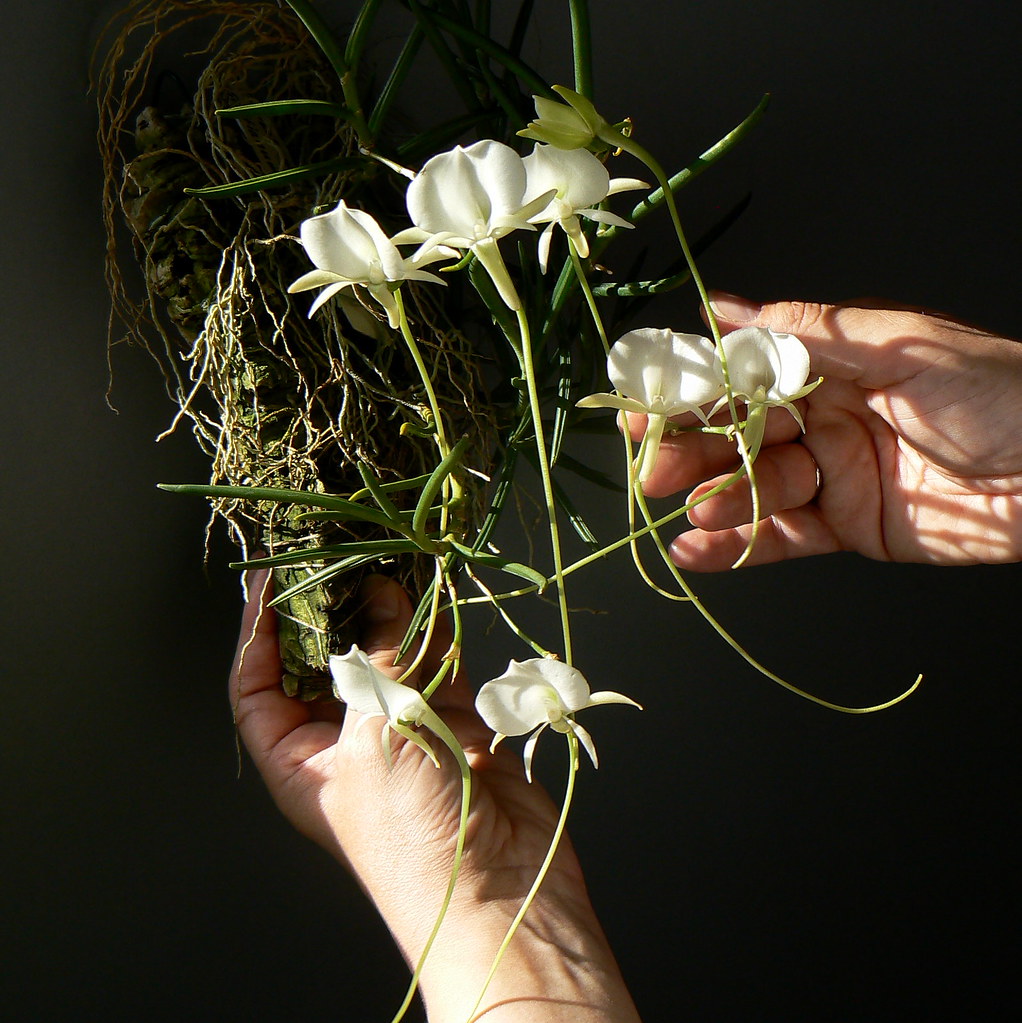
Flowers are white with a glossy perianth, star‑shaped lip, and a conspicuously long basal nectary spur. They are fragrant at night, a trait linked to moth pollination【3】【4】. The flower size is about 10 cm (4 in) in length【4】.
Native Range and Habitat
This species is endemic to the Comoro Islands, specifically recorded from Grande Comore (Ngazidja) on the western slopes of Mt Karthala at elevations of roughly 400–600 m (≈1 300–2 000 ft)【5】【6】.
In the wild it grows as an epiphyte on the trunks and lower branches of large trees, often on the western side where it receives almost full afternoon sun. The habitat is described as a seasonally dry tropical biome, typically in open, exposed forest areas【1】【3】.
Species‑Specific Care
| Factor | Documented Guidance | Evidence |
|---|---|---|
| Light | Bright light; tolerates full afternoon sun, especially when mounted on a tree‑fern plaque. | IOSPE【4】; Orchids.org observation【5】 |
| Temperature | Hot to warm conditions; typical orchid greenhouse temperatures (day 24–28 °C, night 18–22 °C) are suitable. | IOSPE describes it as “hot to warm growing”. |
| Watering | Steady, regular watering; avoid prolonged drying of the medium. | IOSPE recommends steady water【4】 |
| Humidity | Moderate to high humidity (60–80 %) mimicking its native forest environment. | Not directly documented; inferred from native humid forest habitat. |
| Mounting / Potting | Can be mounted on tree‑fern plaques or grown in small wood‑slat baskets; when potted, use a coarse, well‑draining orchid mix. | IOSPE and Orchids.org both note mounting and small basket culture【4】【5】 |
| Fertilising | Regular balanced orchid fertilizer applied every two weeks during active growth. | IOSPE mentions “steady … fertilizer”【4】 |
| Repotting / Re‑mounting | Refresh mount or repot every 2–3 years, or when the medium breaks down. | General orchid practice; not specifically documented for this species. |
| Seasonal changes | No distinct dry rest required; maintain consistent moisture and feeding year‑round. | IOSPE does not describe a rest period, implying continuous care. |
Overall, the species thrives in bright, airy conditions with reliable moisture and a warm temperature regime. Mounting replicates its natural epiphytic habit and promotes good airflow.
Flowering and Pollination
Flowers are night‑fragrant, attracting moth pollinators, a relationship noted for this species in the University of Sydney record【3】.
In cultivation the plant blooms in spring, summer and early autumn, with each flower opening successively over a period of up to two months【4】【5】. Individual flowers are long‑lasting (several days) and emit fragrance predominantly at night.
The long basal spur holds nectar and matches the proboscis length of nocturnal hawk‑moths, supporting the moth‑pollination hypothesis.
Evidence and Limitations
Key gaps remain: precise measurements of plant height and leaf dimensions, exact temperature minima, humidity preferences, and detailed phenology in the wild are not documented in the available sources. Cultivation recommendations are based on a limited number of grower observations and may need adjustment for different growing environments.
FOLLOW THE EVIDENCE
Sources & references
- Angraecum scottianum Rchb.f. | Plants of the World Online | Kew Science – https://powo.science.kew.org/taxon/urn:lsid:ipni.org:names:616408-1
- Angraecum scottianum | International Plant Names Index – https://www.ipni.org/n/616408-1
- Angraecum scottianum – University of Sydney Library – https://digital.library.sydney.edu.au/nodes/view/5976
- IOSPE PHOTOS – Angraecum scottianum – http://www.orchidspecies.com/angscottianum.htm
- Angraecum scottianum – orchids.org article by Tom Kuligowski – https://www.orchids.org/articles/angraecum-scottianum