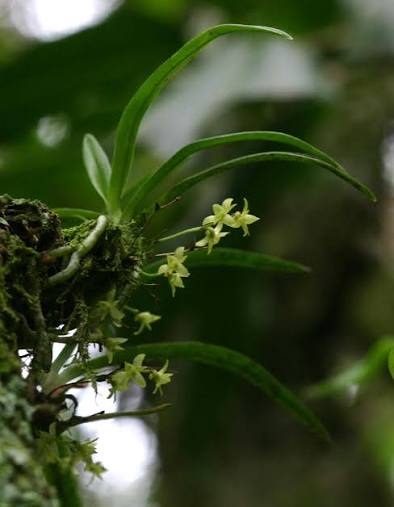
At a glance
RECORDED PROFILE DATA- Scientific name
- Angraecum sacculatum Schltr.
- Name status
- Accepted
- Native region
- Madagascar (central)
- Growth habit
- Epiphytic subshrub
- Cultivation temperature group
- Not documented
Names and Taxonomy
Angraecum sacculatum Schltr. is the accepted name for this species according to Kew’s Plants of the World Online[1]. The name was first published in Repert. Spec. Nov. Regni Veg. Beih. 33: 347 (1925). A later homotypic synonym is Gomphocentrum sacculatum (Schltr.) Szlach., Mytnik & Grochocka[1]. No common name has been documented for this taxon.
How to Identify This Species
The plant is described as an epiphytic subshrub reaching roughly 30 cm in height[4]. Leaves are arranged along a short, upright stem, typical of many Angraecum species, but detailed leaf morphology and measurements are not provided in the available sources. Flowers are reported to be white to green and fragrant[4]. Precise flower dimensions, lip shape, spur length, and other diagnostic characters are not documented in the consulted references, so identification should be confirmed with herbarium material or expert verification.
Native Range and Habitat
Angraecum sacculatum occurs naturally in central Madagascar, inhabiting the wet tropical biome[1]. It grows as an epiphyte on tree bark in humid forest environments. Elevational limits and specific forest types have not been detailed in the sources.
Species‑Specific Care
| Factor | Documented guidance | Evidence |
|---|---|---|
| Temperature | Not documented | – |
| Light | Not documented | – |
| Watering | Not documented | – |
| Humidity | Not documented | – |
| Substrate / Mounting | Epiphytic habit suggests mounting on bark or moss, but specific media are not documented. | Derived from habit[1] |
| Feeding | Not documented | – |
| Repotting / Re‑mounting | Not documented | – |
| Seasonal changes | Not documented | – |
Because detailed horticultural data are lacking, growers often apply general practices used for other wet‑tropical, epiphytic Angraecum species: moderate to warm temperatures, bright but filtered light, frequent misting to maintain high humidity, and mounting on well‑aerated bark or sphagnum. Success with A. sacculatum may vary, and observations should be recorded to refine cultivation protocols.
Flowering and Pollination
NativePlants.info records that the species can flower in any month of the year, producing fragrant white or green flowers[4]. The duration of individual blooms and the identity of natural pollinators have not been documented for this taxon.
Evidence and Limitations
The profile relies on two online sources. Morphological details, precise ecological parameters, and cultivation guidelines are largely absent from the literature consulted. Further field studies and horticultural trials are needed to fill these gaps.
Frequently asked questions
Does Angraecum sacculatum flower year‑round?
According to NativePlants.info, the species has been reported to bloom in every month of the year, although exact flowering intensity may vary.
Is Angraecum sacculatum considered threatened?
No formal conservation assessment was found in the consulted sources; its status is not documented.
FOLLOW THE EVIDENCE
Sources & references
- Angraecum sacculatum Schltr. | Plants of the World Online | Kew Science, https://powo.science.kew.org/taxon/urn:lsid:ipni.org:names:616392-1
- Angraecum sacculatum (Angraecum sacculatum) | NativePlants.info, https://www.nativeplants.info/plant/magnoliophyta-flowering-plants/orchidaceae/angraecum/angraecum_sacculatum.html

