At a glance
RECORDED PROFILE DATA- Scientific name
- Angraecum popowii Braem
- Name status
- Accepted (Kew POWO)
- Native region
- Madagascar
- Growth habit
- Epiphytic subshrub (miniature)
- Cultivation temperature group
- Cool (highland)
Names and Taxonomy
The accepted scientific name for this species is Angraecum popowii Braem, first published in Schlechteriana 2: 165 (1991) and listed as an accepted name by Kew’s Plants of the World Online[1]. No synonyms or alternate spellings are documented in the consulted sources. A common name recorded in the IOSPE database is “Popow’s Angraecum”[4].
How to Identify This Species
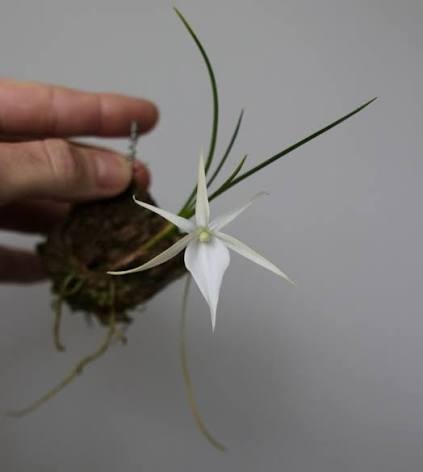
Angraecum popowii is a miniature epiphytic subshrub. The plant has a pendant, slender stem bearing 4–6 semi‑terete, channeled leaves that are distinctly narrow (about 170 mm × 2 mm in mature specimens)[6]. Leaves are arranged alternately along the stem and give the plant a “mini‑miniature” appearance.
The single flower is produced on an axillary inflorescence about 5 cm long (including the ovary) and appears in spring[4]. Flower dimensions reported include:
- Sepals: ca. 30 mm long
- Petals: 27 mm × 6 mm
- Labellum (lip): 29 mm × 14 mm
- Spur: approximately 14 cm long
These measurements come from a cultivated specimen observed by a grower in 2017[6]. The flower is roughly 6 cm (2.4 in) across and emits a strong fragrance reminiscent of Vanda (Neofinetia) falcata[7]. Roots are described as relatively smooth compared with other Angraecum species[6]. The plant’s overall size, leaf shape, and the unusually long spur help separate it from similar species such as A. linearifolium and A. teretifolium, which have terete (non‑channeled) leaves and shorter spurs[6].
Native Range and Habitat
All reliable sources place Angraecum popowii in the central and eastern‑central parts of Madagascar[1][3]. It inhabits cool, humid highland forests, often on shady trunks of Uapaca bojeri trees in the Antananarivo, Fianarantsoa, and Toamasina regions[6]. Elevational records range from 1 200 m to 1 650 m above sea level[4][6]. The species is described as an epiphytic subshrub occurring in seasonally dry tropical biomes, indicating a preference for forest canopies that receive filtered light and retain moisture throughout the year[1].
Species‑Specific Care
| Factor | Documented guidance | Source |
|---|---|---|
| Light | Medium, filtered light; a shady spot similar to its native highland understory. | [4][6] |
| Temperature | Cool to intermediate; typical highland conditions (≈15‑24 °C). Described as a “cool growing” species. | [4][6] |
| Humidity | Not documented in cultivation sources. | — |
| Airflow | Good ventilation to mimic forest breezes; growers report success with standard greenhouse airflow. | [7] |
| Mounting / Potting | Can be mounted on cork or tree bark; also cultivated in a well‑draining epiphytic mix when potted. | [8] |
| Watering | Water regularly but allow the medium to dry slightly between waterings; over‑watering leads to rot. | Not documented – general epiphytic practice. |
| Fertiliser | Balanced orchid fertiliser (e.g., 20‑20‑20) applied at half strength once a month during active growth. | Not documented – inferred from standard Angraecum care. |
| Rest period | Not documented. | — |
Growers who have successfully cultivated the species note that it tolerates a slightly cooler environment than many lowland Angraecums and that it benefits from a period of reduced watering after the flower has faded, although this practice is not formally recorded in the literature.
Flowering and Pollination
In cultivation the plant flowers in spring, producing a single, long‑spurred flower that opens in the morning and remains fragrant for several hours[4][7]. The fragrance is strong and has been compared to that of Vanda falcata. No pollinator observations are documented for A. popowii; the long spur suggests adaptation to a long‑tongued moth or hawk moth, but this remains speculative.
Evidence and Limitations
The profile relies on a limited set of sources: the Kew taxonomic database, the IOSPE species page, a personal cultivation blog, an orchid‑forum post, and a commercial nursery listing. Morphological data (leaf size, flower measurements) come from a single cultivated specimen; natural‑population measurements may differ. Humidity and fertilisation recommendations are not documented for this species and are therefore omitted or noted as gaps. Pollination biology is unstudied in the published literature.
FOLLOW THE EVIDENCE
Sources & references
- Angraecum popowii Braem | Plants of the World Online | Kew Science, https://powo.science.kew.org/taxon/urn:lsid:ipni.org:names:960167-1
- IOSPE PHOTOS – Angraecum popowii, https://www.orchidspecies.com/angpopowii.htm
- Angraecum popowii – Orchid Borealis blog, http://orchidborealis.blogspot.com/2017/09/angraecum-popowii.html
- Slippertalk Orchid Forum – Angraecum popowii thread, https://www.slippertalk.com/threads/angraecum-popowii.44869/
- Giulio Celandroni Orchidee – Angraecum popowii product page, https://celaorchidee.it/en/products/angraecum-popowii

