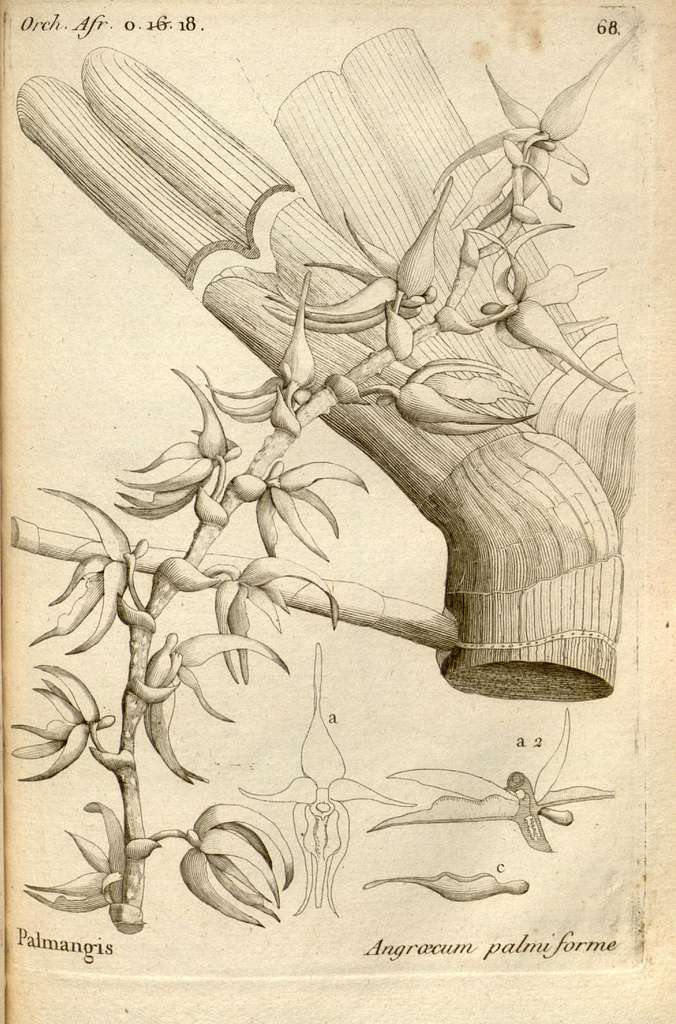
At a glance
RECORDED PROFILE DATA- Scientific name
- Angraecum palmiforme Thouars
- Name status
- Accepted
- Native region
- Réunion (Mascarene Islands)
- Growth habit
- Epiphytic or lithophytic chamaephyte
- Cultivation temperature group
- Not documented
Names and Taxonomy
Angraecum palmiforme Thouars is the accepted scientific name for this species. The name is accepted by Kew’s Plants of the World Online and by World Flora Online [1][3]. It was first published by Thouars in 1809 in the Nouveau Bulletin des Sciences, publié par la Société Philomathique de Paris.[2]
Synonyms recorded in Kew’s database include:
- Aerobion palmiforme (Thouars) Spreng.
- Angorkis palmangis Thouars
- Angorkis palmiformis (Thouars) Kuntze
- Listrostachys palmiformis (Thouars) T. Durand & Schinz
- Angraecum palmatum Thouars (nom. illeg.)
No common name is documented in the available sources.
How to Identify This Species
The species is described as an epiphytic or lithophytic chamaephyte growing in wet tropical habitats [1]. Detailed morphological descriptions (leaf size, flower dimensions, colour, fragrance, etc.) are not provided in the cited references, so identification must rely on expert verification of herbarium material or photographs linked to a reliable source.
Native Range and Habitat
Angraecum palmiforme is native to the island of Réunion in the Mascarene Islands [1]. It was formerly present on Mauritius but is now considered extinct there [1][8]. The orchid occurs as an epiphyte or lithophyte in the wet tropical biome, typically on tree trunks or rocks at low to mid elevations (specific altitude range not documented).
Species-Specific Care
| Factor | Documented guidance | Source |
|---|---|---|
| Growth habit | Epiphytic or lithophytic; treat as a chamaephyte. | [1] |
| Light | Not documented. | Not documented |
| Temperature | Not documented. | Not documented |
| Watering & humidity | Not documented. | Not documented |
| Medium / mounting | Not documented. | Not documented |
| Fertilisation | Not documented. | Not documented |
| Seasonal rest | Not documented. | Not documented |
Because specific horticultural information for this species is lacking, growers should apply general practices for wet‑tropical epiphytic orchids and monitor the plant closely for signs of stress.
Flowering and Pollination
No published data on flowering time, flower morphology, fragrance, nectar spur length, or pollinators for Angraecum palmiforme were found in the consulted sources.
Evidence and Limitations
The profile relies on taxonomic databases (Kew POWO, IPNI, World Flora Online) and a regional protected‑species list. Detailed morphological, ecological, phenological, and horticultural information is not documented in the available sources, limiting the completeness of identification keys, care recommendations, and pollination biology.
Frequently asked questions
What is the conservation status of Angraecum palmiforme?
The species is listed as protected in Réunion and is considered extinct on Mauritius. No IUCN Red List assessment was found in the consulted sources.
Can Angraecum palmiforme be cultivated by orchid enthusiasts?
Specific cultivation guidelines are not documented. Growers should treat it as a wet‑tropical epiphytic orchid and seek expert advice.
FOLLOW THE EVIDENCE
Sources & references
- Angraecum palmiforme Thouars | Plants of the World Online | Kew Science. https://powo.science.kew.org/taxon/urn:lsid:ipni.org:names:616316-1
- Angraecum palmiforme | International Plant Names Index. https://ipni.org/n/616316-1
- Snapshots of the taxonomy – World Flora Online entry for Angraecum palmiforme. https://wfoplantlist.org/taxon/wfo-0000978957-2023-12
- Espèces protégées – Mascarine Cadetiana (listing Angraecum palmiforme). https://mascarine.cbnm.org/index.php/flore/listes-d-especes/especes-protegees