At a glance
RECORDED PROFILE DATA- Scientific name
- Angraecum eichlerianum var. eichlerianum
- Name status
- Accepted variety (POWO)
- Native region
- Nigeria to Angola; Angola, Cameroon, Central African Republic, Congo, DR Congo, Gabon, Nigeria
- Growth habit
- Epiphytic subshrub; also described as a large to giant vining epiphyte
- Cultivation temperature group
- Hot-growing descriptor from Orchids.org; no numeric thresholds documented
- Species authorship
- Angraecum eichlerianum Kraenzl., first published 1882
- Common name
- Eichler's Angraecum (Smithsonian Gardens)
- Flower size
- About 3 inches across (Smithsonian Gardens)
- Inflorescence
- 4–8 inches long, 1–2 flowers (Smithsonian Gardens)
- Flowering context
- July–December, peaking October, in a Northern Hemisphere collection (Smithsonian Gardens)
- Habitat elevation
- About 150 m in humid forest (Smithsonian Gardens; Orchids.org)
Angraecum eichlerianum var. eichlerianum is an accepted infraspecific taxon in the orchid family, native from Nigeria to Angola according to Plants of the World Online [1]. It is an epiphytic orchid of humid forest, and the available horticultural record describes it as a large to giant plant with pale green flowers and a white lip [4][5]. The name is taxonomically stable in POWO, but species-specific cultivation data are sparse: the sources support a hot-growing descriptor and a humid-forest origin, not numeric temperature, light, or watering schedules [5].
Names and Taxonomy
POWO treats Angraecum eichlerianum var. eichlerianum as an accepted variety [1]. The species was published as Angraecum eichlerianum Kraenzl. in Gart.-Zeitung (Berlin) 1: 434 (1882), and POWO accepts that species name [2]. The variety is the autonym of the species: when the species is divided into infraspecific taxa, the variety that repeats the species epithet is automatically established. The available POWO snippet does not give a separate variety author citation, so the autonym should be cited through the species authorship and the infraspecific rank rather than with an invented variety author.
The variety page lists Angraecum arnoldianum De Wild. in Miss. Ém. Laurent 1: 224 (1906) as a heterotypic synonym [1]. At species level, POWO also records the homotypic synonym Eichlerangraecum eichlerianum (Kraenzl.) Szlach., Mytnik & Grochocka, published in Biodivers. Res. Conservation 29: 13 (2013) [2]. IPNI confirms that later combination and its basionym [3]. These names refer to the same species-level taxon; they should not be treated as separate species in a collection database.
POWO lists two accepted infraspecific taxa under the species: Angraecum eichlerianum var. curvicalcaratum Szlach. & Olszewski and Angraecum eichlerianum var. eichlerianum [2]. The requested profile is specifically the autonymic variety, not var. curvicalcaratum. The Smithsonian Gardens record gives the common name Eichler’s Angraecum [4]; no other common names are documented in the supplied evidence.
How to Identify This Species
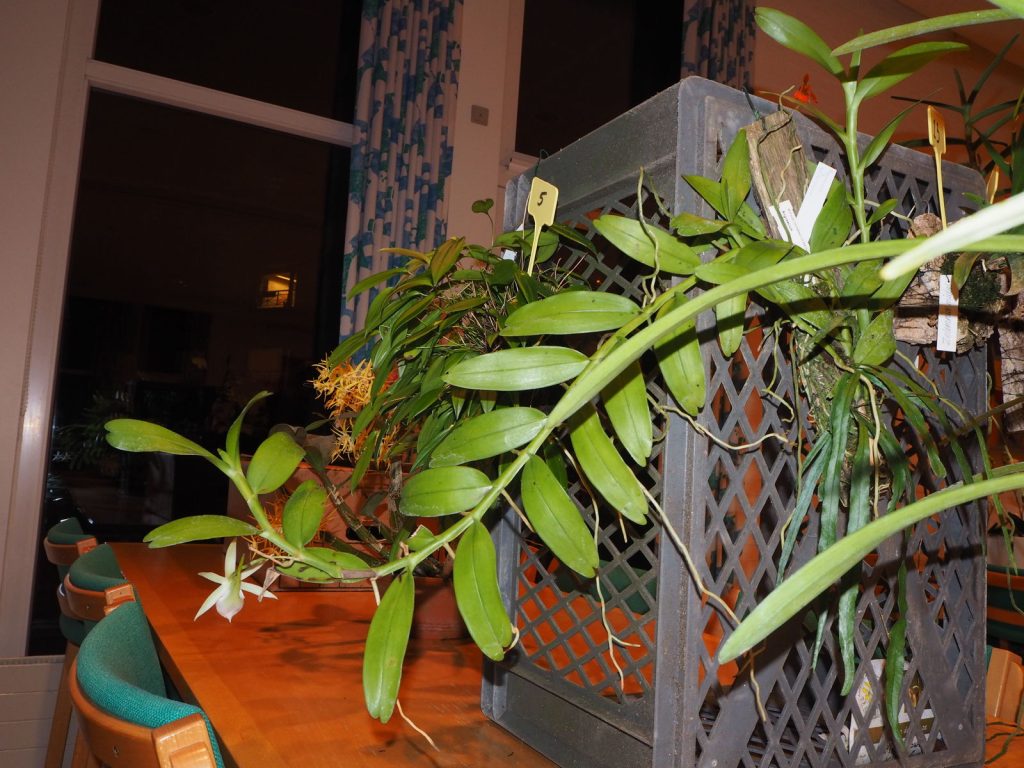
POWO describes the variety as an epiphytic subshrub [1]. Orchids.org describes the species as a large to giant, vining, hot-growing epiphyte from humid forests [5], while Smithsonian Gardens describes it as a large to giant African orchid [4]. These are qualitative size statements; no mature stem length, leaf length, leaf width, or root measurement is documented in the supplied sources. At genus level, Angraecum are described as monopodial epiphytes, lithophytes, or terrestrials that root at the base or along the stems [6]; this species is specifically documented as epiphytic [1][4].
The most useful diagnostic evidence in the available sources concerns the flowers. Smithsonian Gardens records pale green flowers with a white lip, an inflorescence 4–8 inches long bearing one or two heavily textured, long-lasting flowers, each about 3 inches across, with a jasmine and lily fragrance [4]. The same record gives a Northern Hemisphere bloom period of July to December, peaking in October [4]. These measurements refer to cultivated flowers in that collection, not to a formal taxonomic description, and they should not be generalized to every population without confirmation.
Several identification details are not documented in the supplied evidence: spur length and curvature, leaf shape and arrangement, root thickness, and the exact difference between var. eichlerianum and var. curvicalcaratum. A label bearing the species name alone cannot establish the variety. Photographs can show flower color and general habit, but they do not replace examination of the spur, inflorescence, and vegetative parts, or comparison with the accepted infraspecific taxonomy [1][2].
Native Range and Habitat
POWO gives the native range of Angraecum eichlerianum var. eichlerianum as Nigeria to Angola [1]. The variety-level native country list in the supplied POWO snippet is Angola, Cameroon, Central African Republic, Congo, DR Congo, Gabon, and Nigeria [1]. The POWO species page lists Equatorial Guinea for the species as a whole [2], but the variety page’s list does not include it. That is a country-level discrepancy between the species and variety pages; for variety-level mapping, the narrower list should be used unless a more detailed source confirms Equatorial Guinea for the autonym.
Smithsonian Gardens describes the habitat as dense, undisturbed, humid forests at about 150 m elevation [4]. Orchids.org likewise places the species in humid forests at elevations around 150 m [5]. The sources do not document host-tree preferences, forest seasonality, or a full elevation range. The native range and habitat are separate from cultivation: the fact that the plant grows in humid forest at about 150 m does not by itself establish a greenhouse temperature, humidity target, or watering schedule.
Species-Specific Care
The supplied evidence does not contain a detailed cultivation account for this variety. The table below separates what is actually documented from what is missing. The only cultivation descriptor found is “hot-growing” from Orchids.org [5]; that is a source descriptor, not a measured day/night temperature threshold.
| Factor | Documented guidance | Evidence or context |
|---|---|---|
| Temperature | Described as hot-growing; no numeric day or night ranges documented. | Orchids.org calls the species hot-growing [5]. No thresholds are given, so a specific temperature group cannot be quantified from the evidence. |
| Light | Not documented. | No species-specific light measurement or cultivation observation was found in the supplied sources. |
| Watering | Not documented. | The habitat is humid forest [4][5], but habitat moisture is not a cultivation watering schedule. |
| Humidity and airflow | No species-specific humidity or airflow target documented. | Humid forest is habitat context [4][5]; it should not be converted into an arbitrary greenhouse humidity percentage. |
| Potting or mounting | Epiphytic; specific pot, basket, or mount guidance not documented. | POWO describes it as epiphytic [1]; Smithsonian Gardens lists it as epiphytic [4]. Those facts support an epiphytic habit, not a particular culture method. |
| Feeding | Not documented. | No species-specific fertilizer rate or timing was found. |
| Repotting | Not documented. | No species-specific repotting interval or root-disturbance guidance was found. |
| Seasonal changes | No dry rest documented. Bloom recorded July–December, peaking October, in a Northern Hemisphere collection. | The bloom window is from Smithsonian Gardens [4]. The sources do not document a rest period, so one should not be inferred from habitat or from other Angraecum species. |
In practical terms, the safest supported reading is that this is a large, vining epiphyte from hot humid forest, and that the available sources do not justify precise temperature, light, watering, feeding, or repotting prescriptions. A grower should treat “hot-growing” as a broad descriptor only [5]. Because the plant is described as large to giant and vining [4][5], space and sturdy support are reasonable planning considerations, but that is a practical inference from growth habit rather than a documented cultivation protocol. No source in this evidence set recommends a dry rest, a specific potting medium, or a flowering-inducing treatment.
Flowering and Pollination
Smithsonian Gardens records an inflorescence 4–8 inches long with one or two flowers, each about 3 inches across, pale green with a white lip, heavily textured and long-lasting, and fragrant of jasmine and lily [4]. The same collection records flowering from July to December, with a peak in October, in the Northern Hemisphere [4]. Those months are a cultivation record from one garden, not a universal flowering calendar; flowering in another hemisphere or under different conditions may differ.
No species-specific pollinator is documented in the supplied evidence. At genus level, older fragrance literature notes that Old World Angraecum species produce species-specific fragrances and that their pollinators are night-flying moths rather than euglossine bees [7]. That is genus-level context, not a confirmed pollinator record for Angraecum eichlerianum var. eichlerianum. The nectar spur is part of the genus description, but the spur dimensions and pollination mechanism for this variety are not documented here. Flower shape and fragrance can suggest moth pollination, but the available evidence does not establish it for this taxon.
Conservation and Responsible Cultivation
No formal conservation assessment for Angraecum eichlerianum var. eichlerianum was found in the supplied evidence. A conservation status should therefore be marked Not documented rather than inferred from the plant’s native range or from its presence in cultivation. Smithsonian Gardens records one accession as collected directly from the wild with known origin [4]. That provenance note describes a single garden accession; it does not establish population status, trade legality, or the sustainability of any particular purchase. Responsible cultivation decisions should rely on verified provenance and applicable local regulations, none of which are assessed by this profile.
Evidence and Limitations
This profile is based on search snippets and a public garden collection record, not on a full taxonomic revision or a complete cultivation article. POWO supports the accepted variety name and the native country list [1]; POWO and IPNI support the species authorship and synonymy [2][3]; Smithsonian Gardens supplies the flower measurements, fragrance, bloom window, and habitat note [4]; Orchids.org supplies the large, vining, hot-growing descriptor and a similar habitat elevation [5]; the American Orchid Society supplies genus-level habit context [6]; and Murrell et al. (1981) supplies genus-level fragrance and moth-pollination context [7]. The evidence does not document leaf, root, stem, or spur measurements, a species-specific pollinator, a formal conservation assessment, or numeric cultivation thresholds. The retrieval dates of the sources are not publication dates or botanical review dates.
Frequently asked questions
Is Angraecum eichlerianum var. eichlerianum an accepted name?
Yes. POWO treats the variety as accepted, with Angraecum eichlerianum Kraenzl. as the accepted species. The species has two accepted infraspecific taxa: var. eichlerianum and var. curvicalcaratum [1][2].
Where is this variety native?
POWO gives Nigeria to Angola and lists Angola, Cameroon, Central African Republic, Congo, DR Congo, Gabon, and Nigeria for the variety. The species page also lists Equatorial Guinea; that country is not in the variety-level list supplied here [1][2].
What temperature should I use?
No numeric temperature thresholds are documented. Orchids.org describes the species as hot-growing, which is a broad descriptor rather than a measured day/night range [5].
What do the flowers look like?
Smithsonian Gardens records pale green flowers with a white lip, about 3 inches across, one or two per inflorescence, heavily textured, long-lasting, and fragrant of jasmine and lily [4].
When does it bloom?
In a Northern Hemisphere Smithsonian Gardens collection, flowering is recorded from July to December, peaking in October. This is a cultivation record, not a universal calendar [4].
Is a pollinator known?
No species-specific pollinator is documented in the supplied evidence. Older genus-level literature discusses night-flying moth pollination in Old World Angraecum, but that is not a confirmed record for this variety [7].
Related terminology
- Autonym
- The automatically established infraspecific name that repeats the species epithet, such as Angraecum eichlerianum var. eichlerianum.
- Heterotypic synonym
- A synonym based on a different type specimen from the accepted name; POWO lists Angraecum arnoldianum as a heterotypic synonym of this variety.
- Epiphyte
- A plant that grows on another plant for support without parasitizing it; this variety is documented as epiphytic.
- Infraspecific taxon
- A taxon below the rank of species, such as a variety or subspecies; var. eichlerianum and var. curvicalcaratum are accepted infraspecific taxa under Angraecum eichlerianum.
FOLLOW THE EVIDENCE
Sources & references
- Royal Botanic Gardens, Kew. Angraecum eichlerianum var. eichlerianum. Plants of the World Online. https://powo.science.kew.org/taxon/urn:lsid:ipni.org:names:77167563-1
- Royal Botanic Gardens, Kew. Angraecum eichlerianum Kraenzl. Plants of the World Online. https://powo.science.kew.org/taxon/616100-1
- International Plant Names Index. Eichlerangraecum eichlerianum (Kraenzl.) Szlach., Mytnik & Grochocka. https://www.ipni.org/n/77138574-1
- Smithsonian Gardens. Angraecum eichlerianum. https://gardens.si.edu/collections/explore/object/ofeo-sg_2014-0954A
- Orchids.org. Orchid Species: Angraecum eichlerianum. https://www.orchids.org/grexes/angraecum-eichlerianum
- American Orchid Society. Angraecum. https://www.aos.org/explore/angraecum
- Murrell, J.T., Williams, N.H., Pridgeon, A.M., & Dodson, C.H. (1981). Floral Fragrances in Angraecum (Orchidaceae). Selbyana 5(3-4). https://journals.flvc.org/selbyana/article/download/119741/117650/

