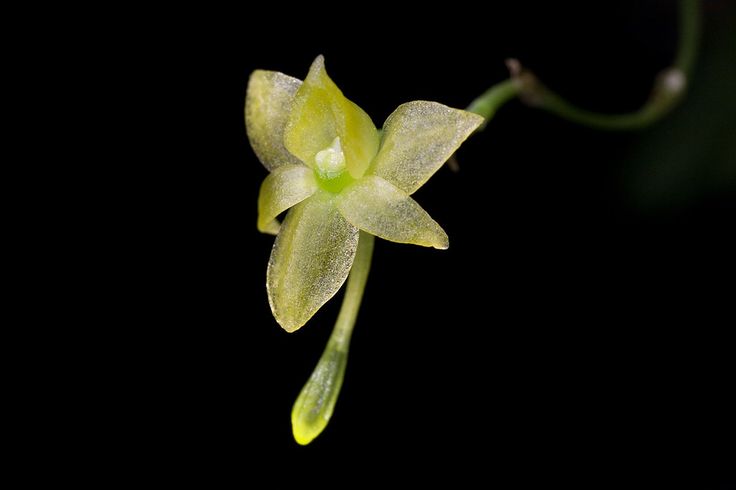
At a glance
RECORDED PROFILE DATA- Scientific name
- Angraecum ochraceum (Ridl.) Schltr.
- Name status
- Accepted
- Native region
- Madagascar (central & eastern)
- Growth habit
- Epiphytic herb/subshrub, 8–14 cm tall
- Cultivation temperature group
- Warm / hot‑growing
Names and Taxonomy
The accepted scientific name is Angraecum ochraceum (Ridl.) Schltr. [1]. The name was first published in Beih. Bot. Centralbl. 33:436 (1915) and is listed as an accepted species by Kew’s Plants of the World Online [1].
Synonyms recorded for this taxon include:
- Mystacidium ochraceum Ridl. [3]
- Macroplectrum ochraceum (Ridl.) Finet [9]
- Epidorkis ochracea (Ridl.) Kuntze [9]
- Angraecum setipes Schltr. (heterotypic synonym) [9]
- Boryangraecum ochraceum (Ridl.) Szlach., Mytnik & Grochocka [9]
No vernacular name other than the descriptive “Ochre Yellow Angraecum” appears in the horticultural source IOSPE [4].
How to Identify This Species
Angraecum ochraceum is a miniature epiphytic herb, typically 8–14 cm tall [2][4]. The stem is short (1–3 cm) and densely covered by corrugated leaf sheaths. Leaves are ligulate, 4–11 mm long and 0.5–1 mm wide, often conduplicate and sometimes bearing three elongate lobules [2]. Roots are glabrous to slightly verrucose, 2–3 mm in diameter, and attach the plant to tree bark.
The single flower emerges on an erect, thin inflorescence 7 cm long, bearing one flower [4]. Flowers are ochre‑yellow, about 10 mm long and 15 mm wide [4]. The column is short (1.5–2 mm long) with a rounded shape, bearing two subglobose pollinia ≈0.5 mm in diameter [2]. The lip is concave, and the spur is relatively short compared with many other Angraecum species, but exact length is not detailed in the available sources.
Because several Angraecum species share a small, single‑flowered habit, the combination of leaf size, the very short stem, and the ochre‑yellow coloration helps separate A. ochraceum from close relatives such as A. setipes, which has been synonymised under this name [9].
Native Range and Habitat
The species is endemic to Madagascar, recorded from the central and eastern parts of the island [1]. It occurs in wet tropical forests, primarily as an epiphyte on tree trunks and branches. Reported elevation ranges from sea level up to about 1 860 m, with most collections from lowland forests below 100 m [4][9].
Species‑Specific Care
| Factor | Documented guidance | Evidence |
|---|---|---|
| Growth substrate | Mounted on bark or grown in a coarse, well‑draining epiphytic medium. | [2] |
| Temperature | Warm to hot conditions; typical lowland tropical temperatures (≥20 °C). | [4] |
| Light | Bright, filtered light; direct midday sun should be avoided. | Not documented |
| Watering | Keep the medium moist but not water‑logged; allow brief drying between waterings. | Not documented |
| Humidity | High ambient humidity, reflecting the wet forest habitat. | Not documented |
| Fertilisation | Apply a balanced, water‑soluble orchid fertilizer at half strength during active growth. | Not documented |
| Seasonal rest | No specific rest period reported. | Not documented |
Because the species is a lowland, warm‑growing orchid, growers should aim to maintain temperatures above 20 °C and provide ample humidity. Mounting on bark mimics its natural epiphytic habit and helps prevent rot. Detailed watering schedules, fertilisation regimes, and rest periods have not been published for this taxon and should be adjusted based on plant response.
Flowering and Pollination
Flowering occurs in the warmer months of the southern hemisphere, reported as spanning from January through July in Madagascar [4]. Flowers are short‑lived, lasting a few days, and emit a faint fragrance typical of many Angraecum species, though the scent profile is not described in the sources.
No specific pollinator has been documented for A. ochraceum. Many Angraecum orchids are pollinated by hawk‑moths, but without direct observations this remains speculative for this species.
Conservation and Responsible Cultivation
Predictive extinction‑risk modelling classifies A. ochraceum as “Threatened” with high confidence [2]. Habitat loss in eastern Madagascar’s lowland forests is a primary driver of risk. Collectors should ensure that any material obtained for cultivation originates from legal, sustainably sourced propagation rather than wild collection.
Evidence and Limitations
The profile relies on taxonomic and distribution data from Kew’s Plants of the World Online, synonymy from the same database, and horticultural observations from IOSPE and the Limodore site. Detailed physiological or cultivation studies are lacking; consequently many care parameters are marked “Not documented.” Future field observations and ex‑situ trials would be valuable to refine temperature, humidity, and watering recommendations, as well as to identify pollinators.
Frequently asked questions
What temperature range is suitable for Angraecum ochraceum?
The species is described as a hot‑growing epiphyte from lowland Madagascar, so temperatures of 20 °C or higher are recommended. Specific upper limits are not documented.
Can Angraecum ochraceum be grown mounted on bark?
Yes. In its natural habitat it grows on tree bark, and mounting on bark or a coarse epiphytic medium is advised.
When does this orchid flower in cultivation?
Flowering has been reported from January to July in its native range. Exact timing in cultivation may vary and is not fully documented.
FOLLOW THE EVIDENCE
Sources & references
- Angraecum ochraceum (Ridl.) Schltr. – Plants of the World Online, Kew Science. https://powo.science.kew.org/taxon/urn:lsid:ipni.org:names:616305-1
- Angraecum ochraceum – Plants of the World Online general information. https://powo.science.kew.org/taxon/urn:lsid:ipni.org:names:616305-1
- Mystacidium ochraceum Ridl. – Plants of the World Online synonym record. https://powo.science.kew.org/taxon/urn:lsid:ipni.org:names:645144-1
- IOSPE Photos – Angraecum ochraceum (Ridl.) Schltr. 1915. https://www.orchidspecies.com/angochraceum.htm
- Limodore – Angraecum ochraceum page. https://limodore.france-orchidees.org/angraecum/angraecum-ochraceum/angraecum-ochraceum.html

