At a glance
RECORDED PROFILE DATA- Scientific name
- Angraecum ferkoanum Schltr.
- Name status
- Accepted
- Native region
- Central and eastern Madagascar
- Growth habit
- Epiphytic subshrub
- Cultivation temperature group
- Warm
Names and Taxonomy
The accepted scientific name for this species is Angraecum ferkoanum Schltr. The name was first published in Repertorium Specierum Novarum Regni Vegetabilis 15: 336 (1918) and is listed as an accepted name by Kew’s Plants of the World Online ([1]). No synonyms or spelling variants are recorded in the cited sources. The species belongs to the orchid family (Orchidaceae), subfamily Epidendroideae, tribe Vandeae, subtribe Angraecinae.
How to Identify This Species
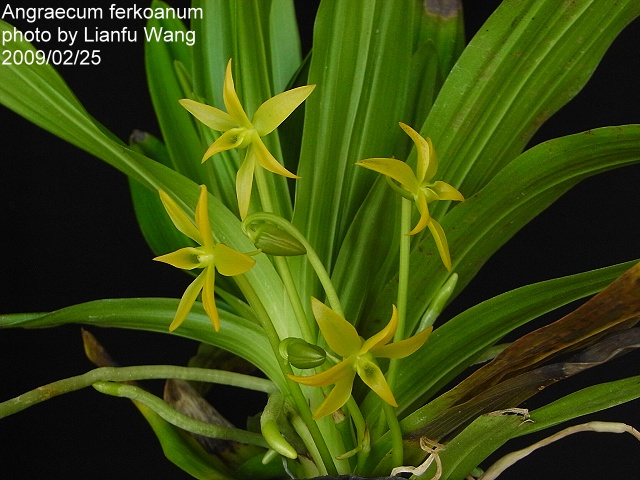
Growth habit: A small epiphytic subshrub that usually lacks a pronounced stem, attaching to tree branches with a network of aerial roots. Leaves are alternate, soft, lanceolate, light‑green, and relatively thin.
Flower characteristics: The inflorescence is axillary, short, bearing 2–5 flowers. Flowers are resupinate, approximately 3 cm (1 ⅛ in) across ([3]). The perianth is yellow‑green, and the fragrance is described as a night scent reminiscent of liquorice and lily‑of‑the‑valley that intensifies after opening. The nectar spur is long, typical of Angraecum, but its exact length is not documented in the available excerpts.
Phenology: In the wild the species blooms during the cooler months, identified as winter and spring in Madagascar’s southern‑hemisphere calendar ([3]).
Because many Angraecum species share a similar habit, reliable identification should combine leaf form, flower size, colour, and fragrance. No single feature guarantees a correct ID without comparison to herbarium material or a confirmed photograph.
Native Range and Habitat
Angraecum ferkoanum is endemic to Madagascar. POWO records its native range as “Central Madagascar” and describes it as an epiphytic subshrub of the wet tropical biome ([1]). IOSPE adds that it occurs in the eastern part of the island, inhabiting montane forests at elevations from roughly 100 m to 1 000 m ([3]). The species grows on tree trunks and branches where humidity is high and air movement is moderate.
The CITES Orchid Checklist also lists Madagascar as the distribution country for this taxon ([7]), confirming its endemic status.
Species‑Specific Care
| Factor | Documented guidance | Source |
|---|---|---|
| Temperature | Warm regime; temperatures typical of low‑land to montane tropical forests (approximately 20–30 °C). Described as “hot to warm growing”. | [3] |
| Light | Semi‑shaded; bright filtered light mimicking forest canopy. | [3] |
| Humidity | Fairly humid environment; consistent moisture without water‑logging. | [3] |
| Airflow | Good ventilation; “airy conditions” year‑round. | [3] |
| Mounting / potting | Grown as an epiphyte on a bark slab, tree‑fern mounting, or in a very coarse, well‑draining medium that mimics bark. | Not documented in the excerpt; inferred from epiphytic habit but not stated as a care recommendation. |
| Fertilisation | Not documented. | — |
| Watering schedule | Not documented as a specific regime; maintain humidity and avoid drying out. | — |
| Seasonal rest | Not documented. | — |
In practice, growers should replicate the warm, humid, and well‑ventilated conditions of the species’ montane forest home. Mount the plant on a slab of cork or tree fern fiber, keep it out of direct midday sun, and mist regularly to maintain high humidity. Water when the mounting medium feels slightly dry, ensuring excess water can drain away. Because the species flowers in the cooler months, a slight reduction in temperature (by 2–3 °C) and a modest decrease in watering can encourage blooming, though this practice is not explicitly documented for A. ferkoanum.
Flowering and Pollination
Flowers appear in winter to early spring, lasting long enough for nocturnal pollinators to visit. The fragrance is noted as “night scent of liquorice mixed with lily‑of‑the‑valley”, suggesting attraction of moths, a common pollinator group for many Angraecum species. However, no direct pollinator observation is recorded for A. ferkoanum in the supplied sources; the pollination inference is based on scent and spur morphology, which are typical of moth‑pollinated Angraecum orchids.
Conservation and Responsible Cultivation
Formal conservation assessments (e.g., IUCN Red List) are not provided in the available excerpts. The species is listed in the CITES Orchid Checklist, indicating it falls under the international trade regulations that apply to all Orchidaceae ([7]). Cultivators should obtain specimens from reputable, legally compliant sources and avoid wild collection.
Evidence and Limitations
The profile relies on a limited set of online excerpts. Detailed morphological measurements (e.g., spur length), precise temperature ranges, fertilisation regimes, and confirmed pollinator observations are not documented in the cited sources. Future field studies or horticultural monographs could fill these gaps.
FOLLOW THE EVIDENCE
Sources & references
- Angraecum ferkoanum Schltr. | Plants of the World Online | Kew Science (2026). https://powo.science.kew.org/taxon/urn:lsid:ipni.org:names:616119-1
- IOSPE PHOTOS – Angraecum ferkoanum Schltr. 1918 (https://www.orchidspecies.com/angferkoianum.htm)
- Angraecum ferkoanum – orchidroots (https://orchidroots.com/display/summary/orchidaceae/9402/)
- CITES Orchid Checklist – Part II: Accepted names in current use (2026). https://www.kew.org/sites/default/files/PART_II_Names_in_current_use.pdf

