At a glance
RECORDED PROFILE DATA- Scientific name
- Angraecum danguyanum H.Perrier
- Name status
- Accepted
- Native region
- Madagascar
- Growth habit
- Epiphytic subshrub with pendent stem
- Cultivation temperature group
- Intermediate to cool
Names and Taxonomy
Angraecum danguyanum H.Perrier was first described in Notulae Systematicae 7:107 (1938) and is accepted by Kew’s Plants of the World Online as the current name for this species[1]. The species has several later‑published synonyms, including Angraecum nasutum Schltr. (1925) and the recombination Arachnangraecum danguyanum (H.Perrier) Szlach., Mytnik & Grochocka (2013)[2]. No other competing names are recorded in the cited sources.
How to Identify This Species
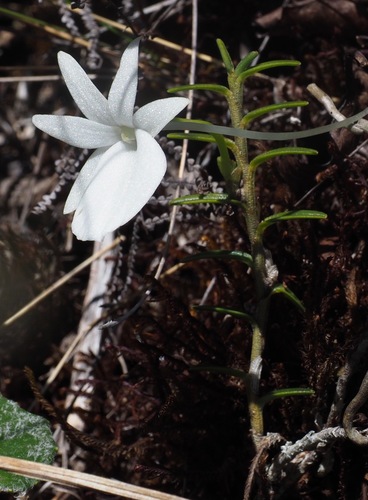
This orchid is a small epiphytic subshrub. The stem is pendulous, typically 15–20 cm long and about 1 mm in diameter, often slightly sinuate[3]. Leaves are linear, semi‑cylindrical and recurved, measuring roughly 35–38 mm long by 1.3–2.2 mm wide, arranged in 14–21 alternating leaves along the stem[2]. Roots are fine, grayish, and attach directly to the bark or lichen‑covered trunks of host trees.
The single flower is borne on an axillary peduncle only 0.4–0.6 in (1–1.5 cm) long, sometimes with one or two basal sheaths. The flower is white, fragrant, and about 5 cm across (2 in)[2]. It lacks a documented spur length in the available sources, though a nectar spur is typical of the genus. The bloom is solitary per stem and appears in the local summer months.
While the overall habit is distinctive, the species can be confused with other small, white‑flowered Angraecum such as A. nasutum, its own synonym. Careful examination of leaf size, stem length, and the presence of basal sheaths helps separate them.
Native Range and Habitat
Angraecum danguyanum is endemic to Madagascar, recorded from the central and eastern parts of the island[1]. It grows in humid evergreen or moss forests, frequently on the trunks of small trees and shrubs that are covered with lichens. Reported elevation ranges span 700–1 150 m according to horticultural observations[2], and 1 000–2 100 m in a French orchid database[3]. The species prefers the consistently moist, shaded micro‑habitat provided by these forest canopies.
Species‑Specific Care
| Factor | Documented guidance | Source |
|---|---|---|
| Light | Medium, bright but filtered light; avoid direct midday sun. | [3] |
| Temperature | Intermediate to cool; comfortable in warm‑to‑cool range typical of montane forest (≈18–24 °C day, 12–18 °C night). | [2][3] |
| Humidity | High (70–85 %); replicate misty forest air. | [2] |
| Substrate / Mounting | Mount on bark or tree‑fern slab; if potted, use a very coarse, well‑draining epiphytic mix (bark, sphagnum, perlite). | [2][3] |
| Watering | Keep medium moist but not water‑logged; water thoroughly when the surface begins to dry. | [2] |
| Fertilisation | Apply a balanced orchid fertilizer (20‑20‑20) at half strength once a month during active growth. | [2] |
| Repotting / Re‑mounting | Every 2–3 years, or when roots outgrow the mount; prune dead roots and refresh the medium. | [2] |
| Seasonal cues | Provide slightly cooler nights in the winter months to mimic natural elevation climate; no strict rest period is required. | [3] |
Overall, the most critical needs are high humidity, good air movement, and avoidance of prolonged dryness. Because the species originates from cool‑mountain forest, it tolerates lower night temperatures better than many lowland Angraecum.
Flowering and Pollination
In the wild the plant flowers in the local summer, roughly October to March[3], while cultivated plants are reported to bloom from summer through early autumn[2]. Flowers are fragrant, especially in the evening, a trait common in Angraecum that usually indicates moth pollination. However, no specific pollinator has been documented for A. danguyanum in the cited literature; the pollination ecology remains unverified[4].
Conservation and Responsible Cultivation
The species appears on the CITES Orchid Checklist as a Madagascar‑native taxon[5]. No IUCN Red List assessment is provided in the available sources, so its formal conservation status is not documented here. Growers are encouraged to source plants from reputable, legally compliant nurseries and to support in‑situ conservation programs when possible.
Evidence and Limitations
Key aspects such as spur length, exact pollinator identity, and detailed temperature minima are not documented in the consulted sources. Information on fruiting, seed biology, and long‑term population trends is also absent. Future field studies or horticultural observations would help fill these gaps.
FOLLOW THE EVIDENCE
Sources & references
- Angraecum danguyanum H.Perrier | Plants of the World Online | Kew Science, https://powo.science.kew.org/taxon/urn:lsid:ipni.org:names:616069-1
- IOSPE PHOTOS – Angraecum danguyanum, https://www.orchidspecies.com/angdanguyanum.htm
- page A4 – French orchid site (les orchidées de Madagascar), http://madaorchidee.free.fr/lesorchideesdemadagascar/pagesalphabetiques/pageA4.htm
- Angraecum danguyanum – NativePlants.info, https://www.nativeplants.info/plant/magnoliophyta-flowering-plants/orchidaceae/angraecum/angraecum_danguyanum.html
- CITES Orchid Checklist – Part II (Accepted names in current use), https://cites.org/sites/default/files/common/com/nc/tax_ref/PART_II_Names_incurrentuse.pdf

