At a glance
RECORDED PROFILE DATA- Scientific name
- Jumellea triquetra (Thouars) Schltr.
- Name status
- Accepted; Angraecum triquetrum is a synonym
- Native region
- Réunion (Mascarene Islands)
- Growth habit
- Epiphytic, monopodial orchid
- Cultivation temperature group
- Not documented
Names and Taxonomy
The accepted scientific name for the species is Jumellea triquetra (Thouars) Schltr. This name was first published by Schlechter in 1915 (Beih. Bot. Centralbl. 33: 430) and is recognized by Kew’s Plants of the World Online as the current accepted name [1]. The earlier name Angraecum triquetrum Thouars (1822) is treated as a synonym of Jumellea triquetra [2]. Additional synonymy, including Aerobion triquetrum and Angorkis triquetra, is recorded in the same sources. The name change was confirmed by Summerhayes (1951) and later authors [7].
How to Identify This Species
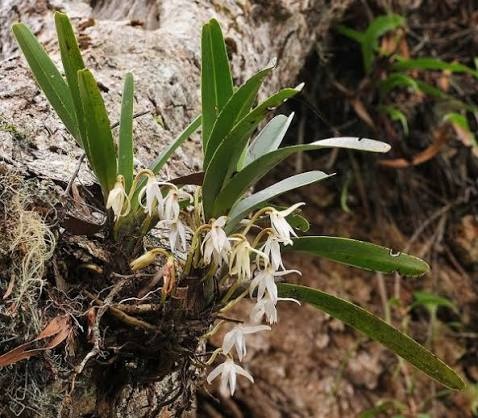
Jumellea triquetra is a small, monopodial epiphyte. The stem is short or virtually absent, bearing a rosette of 4–6 leaves that are ligulate, folded in the lower third, and clasping the stem. Leaves are unequally bilobed at the apex and rounded in outline. The plant produces a single flower on a short, leaf‑bearing inflorescence (approximately 2 cm long) with three small green bracts. The flower itself is about 2.5 cm across, white‑green with a modest spur, and lacks the large, fragrant spur typical of many Angraecum species. These traits are described on the IOSPE orchid page [9]. The combination of a short monopodial habit, few clasping leaves, and a solitary small flower distinguishes it from related Jumellea species that often have larger, more fragrant flowers.
Native Range and Habitat
The species is native to the island of Réunion in the Mascarenes, where it occurs throughout the island’s evergreen forest zones [1]. Historical records also list Mauritius, but the plant is now considered extinct there. In the wild it grows as an epiphyte on tree trunks and branches, typically at elevations between 700 m and 1500 m in humid, montane forest [9]. The habitat is characterized by high rainfall, frequent cloud cover, and a warm‑to‑cool temperature regime due to altitude.
Species‑Specific Care
| Factor | Documented guidance | Evidence |
|---|---|---|
| Growth medium | Not documented | — |
| Mounting vs. potting | Not documented | — |
| Light level | Not documented | — |
| Temperature | Not documented | — |
| Watering | Not documented | — |
| Humidity | Not documented | — |
| Fertilisation | Not documented | — |
| Repotting / re‑mounting | Not documented | — |
Because the species is rarely cultivated and no horticultural literature specifically addresses its requirements, growers should base care on the conditions of its native habitat: bright, filtered light; high humidity; and regular moisture without waterlogging. However, these suggestions are inferred rather than documented and should be applied cautiously.
Flowering and Pollination
In the wild the plant blooms in the later spring to early summer months (approximately October to December in the Southern Hemisphere) [9]. Flowers are short‑lived, lasting only a few days, and no specific pollinator has been recorded for this species in the literature. The modest spur and lack of strong fragrance suggest pollination by small moths or flies, but this remains speculative.
Evidence and Limitations
The taxonomic treatment is well supported by Kew’s POWO and by the historical revision of Bosser (1988). Morphological description and habitat details come from the IOSPE species page, which compiles data from several orchid references. No peer‑reviewed cultivation studies or pollination observations were found for Jumellea triquetra. Consequently, the care table and pollination section contain many “Not documented” entries, reflecting genuine gaps in the current knowledge base.
Frequently asked questions
Is Angraecum triquetrum the correct name for this orchid?
No. The current accepted name is Jumellea triquetra (Thouars) Schltr.; Angraecum triquetrum is a historical synonym.
Can I grow this species in a typical home orchid setup?
Specific cultivation guidelines are not documented. Growers should aim to mimic its native mid‑elevation forest conditions—high humidity, good air movement, and filtered light—but success cannot be guaranteed without further research.
What is the conservation status of Jumellea triquetra?
The available sources do not provide an official conservation assessment for this species.
FOLLOW THE EVIDENCE
Sources & references
- Jumellea triquetra (Thouars) Schltr. – Plants of the World Online, Kew Science, 2026, https://powo.science.kew.org/taxon/urn:lsid:ipni.org:names:639413-1
- Angraecum triquetrum Thouars – Plants of the World Online, Kew Science, 2026, http://powo.science.kew.org/taxon/urn:lsid:ipni.org:names:616464-1
- Bosser, J. (1988). Contribution à l'étude des Orchidaceae de Madagascar et des Mascareignes. XXIII. Bulletin du Muséum national d'histoire naturelle, Section B, Adansonia. https://doi.org/10.5962/p.276369
- IOSPE PHOTOS – Jumellea triquetra (Thouars) Schltr., 1915. Orchid Species Photos. 2026, https://orchidspecies.com/jumtriquetra.htm