At a glance
RECORDED PROFILE DATA- Scientific name
- Angraecum moandense De Wild.
- Name status
- Accepted (Plants of the World Online)
- Native region
- West Tropical Africa; West‑Central Tropical Africa; East Tropical Africa
- Growth habit
- Epiphytic subshrub
- Cultivation temperature group
- Not documented
Names and Taxonomy
Angraecum moandense De Wild. is the accepted name for this species according to Plants of the World Online (POWO) [1]. The name was first published in Bulletin du Jardin Botanique de l’État Bruxelles 5:188 (1916). Several later combinations are regarded as synonyms: Aerangis moandensis (Schltr.) [2]; Angraecoides moandensis (E.M.Pessoa & M.Alves) [2]; Conchograecum moandense (Szlach. et al.) [2]; and Angraecum chevalieri Summerh. (1936) [2]. A horticultural common name recorded in the IOSPE database is “Moande Angraecum” [5].
How to Identify This Species
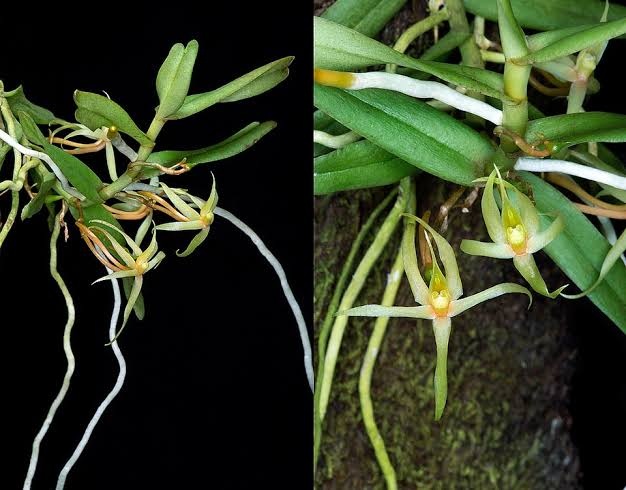
The plant is a small epiphytic subshrub with thin, often branched stems 6–15 cm long. Leaves are narrowly strap‑shaped, 0.8–1.5 cm long and 1.5–3 mm wide, arranged distichously and clasping the stem at the base. Inflorescences are up to 5 cm long, bearing 1–4 non‑resupinate flowers. Flowers are yellow‑white, about 2.5 cm (1 in.) across, with lanceolate sepals 0.8–1.5 cm long, linear‑lanceolate petals 0.9–1.2 cm long, and an ovate‑elliptic labellum 0.8–1 cm long, 2–3.5 mm wide. The labellum bears a thin spur 1.5–2 cm long at its base [3][5]. The species is miniature and may be confused with other small Angraecum species such as A. affine, but the combination of a relatively long spur (≈ 1.8 cm) and the yellow‑white colour helps separate it.
Native Range and Habitat
In the wild Angraecum moandense is distributed across West Tropical Africa, West‑Central Tropical Africa and East Tropical Africa, being recorded from Cameroon, Central African Republic, Congo, Democratic Republic of the Congo, Equatorial Guinea, Gabon, Ghana, Guinea, Gulf of Guinea Islands, Ivory Coast, Liberia, Nigeria, Rwanda, Tanzania, Togo and Uganda [1]. It grows as an epiphyte on the upper branches of trees in dense, humid lowland to submontane forests, typically between 1 000 and 2 000 m elevation [3][4]. The species prefers the wet tropical biome and is found in primary forest canopies where moisture is abundant.
Species‑Specific Care
| Factor | Documented guidance | Source |
|---|---|---|
| Growth medium | Mount on cork bark or grow in a well‑draining orchid mix; avoid frequent disturbance of the plant. | [3] |
| Light | Not documented. | Not documented |
| Watering | Not documented. | Not documented |
| Humidity | Not documented. | Not documented |
| Temperature | Not documented. | Not documented |
| Fertilisation | Not documented. | Not documented |
The only cultivation note explicitly recorded is that the species “does not love to be frequently disturbed” and therefore should be repotted or divided only when necessary [3]. Growers typically keep it mounted or in a small pot to mimic its natural epiphytic habit.
Flowering and Pollination
In cultivation the plant flowers in the fall and winter months, producing 1–2 flowers per short inflorescence [5]. Flowers are non‑resupinate and emit a faint fragrance, though specific pollinator observations are not documented. The relatively long nectar spur (≈ 1.8 cm) suggests adaptation to moth pollination, a common trend in the Angraecum alliance, but no direct evidence is available for this species.
Conservation and Responsible Cultivation
Angraecum moandense is listed in CITES Appendix II, meaning international trade is regulated to prevent over‑exploitation [3]. Its forest habitat is subject to deforestation pressures, but a formal IUCN Red List assessment has not been located in the supplied sources.
Evidence and Limitations
Most morphological and distribution data come from the Monaco Nature Encyclopedia and Kew’s Plants of the World Online. Detailed horticultural parameters such as optimal light intensity, watering frequency, humidity range, and temperature group are not documented in the available sources, so growers should treat the provided care notes as preliminary and adapt them based on general Angraecum cultivation practices. Pollination ecology remains unstudied for this species.
Frequently asked questions
What is the common name of Angraecum moandense?
The horticultural common name recorded for this species is “Moande Angraecum”.
Is Angraecum moandense regulated under CITES?
Yes, it is listed in CITES Appendix II, so international trade requires appropriate permits.
FOLLOW THE EVIDENCE
Sources & references
- Angraecum moandense De Wild. | Plants of the World Online | Kew Science, https://powo.science.kew.org/taxon/616272-1
- Angraecoides moandensis (De Wild.) E.M.Pessoa & M.Alves | Plants of the World Online | Kew Science, https://powo.science.kew.org/taxon/urn:lsid:ipni.org:names:77156989-1
- Angraecum moandense - Monaco Nature Encyclopedia (English), https://www.monaconatureencyclopedia.com/angraecum-moandense-2/?lang=en
- Angraecum moandense - Monaco Nature Encyclopedia (Italian), https://www.monaconatureencyclopedia.com/angraecum-moandense/
- IOSPE PHOTOS – Angraecum moandense, http://www.orchidspecies.com/angmoandense.htm
