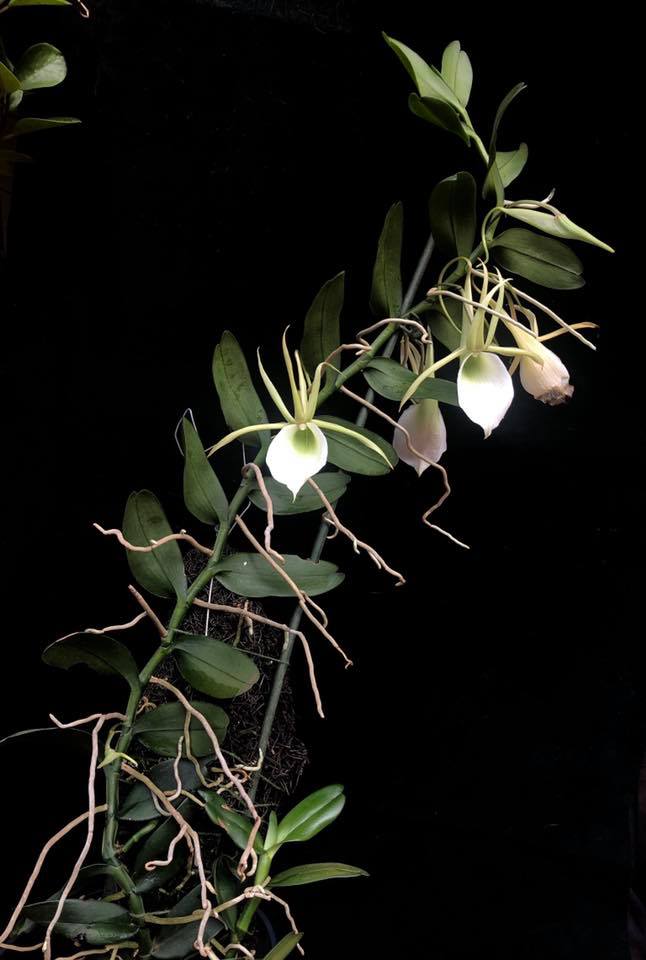
At a glance
RECORDED PROFILE DATA- Scientific name
- Angraecum infundibulare Lindl.
- Name status
- Accepted
- Native region
- Nigeria, Cameroon, Central African Republic, Congo, DR Congo, Ethiopia, Gulf of Guinea Islands, Kenya, Rwanda, Uganda
- Growth habit
- Epiphytic herb/subshrub, monopodial
- Cultivation temperature group
- Not documented
Names and Taxonomy
Angraecum infundibulare Lindl. is the accepted name for this species according to Kew’s Plants of the World Online.[1] The name was first published in Journal of the Proceedings of the Linnean Society, Botany 6:136 (1862).[2] Several homotypic synonyms have been recorded:
- Angorkis infundibularis (Lindl.) Kuntze (1891)
- Mystacidium infundibulare (Lindl.) Rolfe (1897)
- Eichlerangraecum infundibulare (Lindl.) Szlach., Mytnik & Grochocka (2013)
No vernacular common name was found in the cited sources.
How to Identify This Species
The plant grows as an epiphytic herb forming clumps. Stems are 30–60 cm long (occasionally up to 100 cm) and may be pendent with the apex upturned. Leaves are numerous, narrowly elliptic to oblanceolate, 10–22 mm long and 1.5–4 mm wide, with a shallowly two‑lobed apex.[3]
Flowers are produced singly on a short peduncle (3–7 cm). The perianth is white with a pale green or yellow tinge; tepals are linear‑lanceolate, 6–8.5 mm long and <1 mm wide, margins recurved.[3] The lip is snow‑white, ovate, 5–8.5 mm long and 4–6.5 mm wide, terminating in a long apiculate tip. The most striking feature is the funnel‑shaped, S‑shaped spur, 14–21 cm long (approximately 4–8 in).[3][5] The flower measures about 8.75 cm across the lip and 15–20 cm from lip tip to spur tip, making it the largest‑flowered Angraecum on mainland Africa.[4][5] A strong, sweet jasmine‑like fragrance is emitted at night.[11]
Because several Angraecum species have large white flowers, identification should rely on the combination of stem length, leaf shape, single‑flowered inflorescences, and especially the exceptionally long curved spur.
Native Range and Habitat
The species is native to a broad stretch of tropical Africa, recorded from Nigeria eastward through Cameroon, Central African Republic, the Republic of Congo, the Democratic Republic of the Congo, Rwanda, Uganda, Kenya, Ethiopia, and the Gulf of Guinea Islands (including Principe).[1][3][6] It inhabits warm, humid forests, often in deep valleys, rainforest patches, forest galleries, and secondary forest. It is typically epiphytic on tree branches (e.g., on Polyscias ferruginea with tree ferns) but can be semi‑terrestrial in dense undergrowth. Elevational records range from sea level up to about 1,400 m, with many observations clustered between 1,150 and 1,400 m.[3]
Species-Specific Care
| Factor | Documented guidance | Evidence |
|---|---|---|
| Growth habit | Epiphytic or semi‑terrestrial; can be mounted on bark or grown in a very large, well‑draining pot. | [3] |
| Light | Bright, filtered light mimicking forest canopy; direct sun should be avoided. | Not documented; inferred from native forest shade. |
| Temperature | Not documented for cultivation. | — |
| Watering | Maintain high humidity; water regularly to keep the medium moist but not water‑logged. | Native habitat described as warm forest with high humidity.[3] |
| Humidity | Preferably 70 % + relative humidity. | Derived from forest habitat description.[3] |
| Fertiliser | Not documented; standard orchid balanced fertilizer at reduced strength during active growth is commonly used. | — |
| Seasonal change | Not documented; growers report flowering in summer to fall. | [7][10] |
| Repotting | Not documented; typical practice is to repot every 2–3 years after flowering. | — |
Because the species originates from humid montane forests, providing good air movement and avoiding prolonged dryness are critical. Mounting on a slab of cork bark or tree fern fiber can simulate its natural epiphytic habit. When grown in a pot, use a coarse orchid mix containing bark, perlite, and charcoal to ensure rapid drainage.
Flowering and Pollination
Flowering has been observed from the summer into the fall in cultivation.[7][10] Individual flowers are long‑lasting, persisting for several weeks. The nocturnal release of a sweet jasmine‑like fragrance attracts moth pollinators; the long, curved spur is adapted for a moth with a correspondingly long proboscis.[11] Specific pollinator species have not been documented, but sphingid moths are the typical pollinators of Angraecum orchids with similar spur morphology.
Evidence and Limitations
Most morphological data come from herbarium descriptions and a few cultivated observations. Detailed horticultural parameters such as exact temperature ranges, light intensity values, and precise watering schedules are not available in the referenced literature. Pollination has only been inferred from flower shape and fragrance; no field study has identified the exact pollinator species for Angraecum infundibulare. Conservation status was not found in the supplied sources.
FOLLOW THE EVIDENCE
Sources & references
- Angraecum infundibulare Lindl. | Plants of the World Online | Kew Science, https://powo.science.kew.org/taxon/urn:lsid:ipni.org:names:616194-1
- Angraecum infundibulare | International Plant Names Index, https://ipni.org/n/616195-1
- African Plant Database – Angraecum infundibulare Lindl., https://africanplantdatabase.ch/fr/nomen/specie/43511/angraecum-infundibulare-lindl
- Orchid Species: Angraecum infundibulare – Internet Orchid Species Encyclopedia, https://www.orchids.org/grexes/1128
- Collector’s item Angraecum infundibulare – AOS article, https://botanicaltd.com/wp-content/uploads/2022/12/aos-angraecum-infundibulare-dec2016-oviatt-nerison-1.pdf
- Angraecum infundibulare – OrchidWeb description, https://www.orchidweb.com/p/angraecum-infundibulare
