At a glance
RECORDED PROFILE DATA- Scientific name
- Angraecum florulentum Rchb.f.
- Name status
- Accepted
- Native region
- Comoros (Njazidja)
- Growth habit
- Epiphytic, monopodial subshrub
- Cultivation temperature group
- Warm (day 21–27 °C, night 18–22 °C)
Names and Taxonomy
Angraecum florulentum Rchb.f. is the accepted name for this species according to Kew’s Plants of the World Online (POWO)[1]. The name was first published in Gardeners’ Chronicle 23:787 (1885) (IPNI) [4]. A homotypic synonym is Pseudojumellea florulenta (Rchb.f.) Szlach., Mytnik & Grochocka (2013) [1]. The species is sometimes called the “Easy Blooming Angraecum” or “Freely Flowering Angraecum” in horticultural literature ([5],[7]).
How to Identify This Species
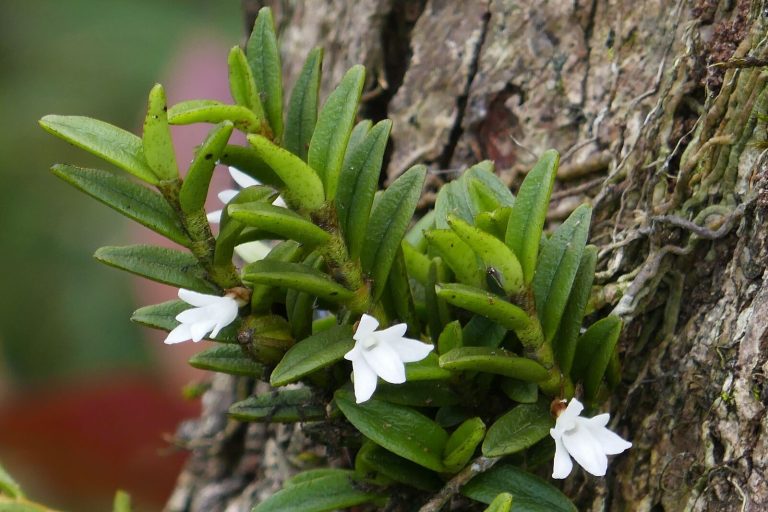
The plant is a small, monopodial epiphyte with short, flattened, sinuous stems bearing numerous narrow, lanceolate leaves. In the wild it reaches about 5–15 cm in height; cultivated specimens are similar (Growli)[7].
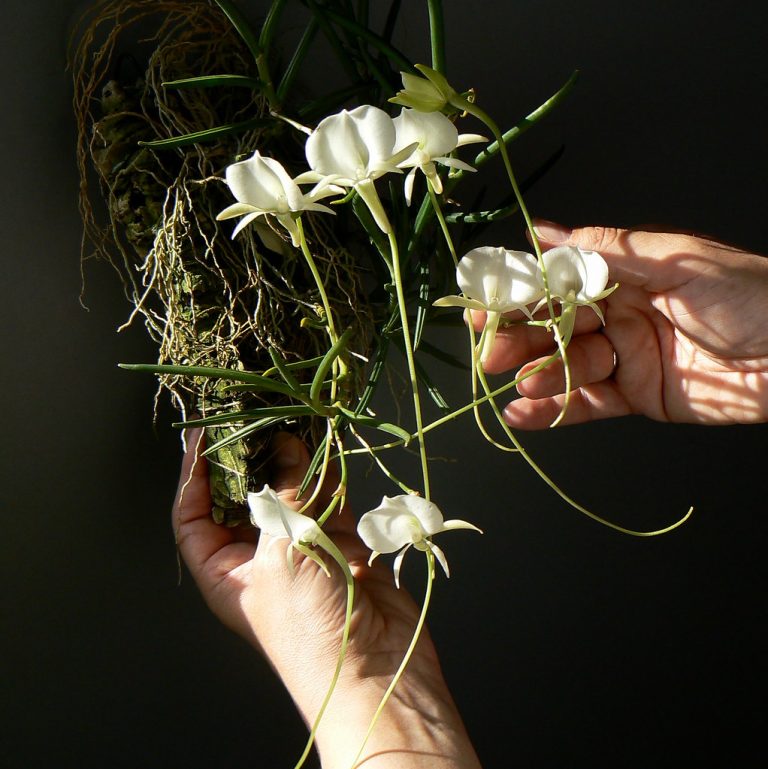
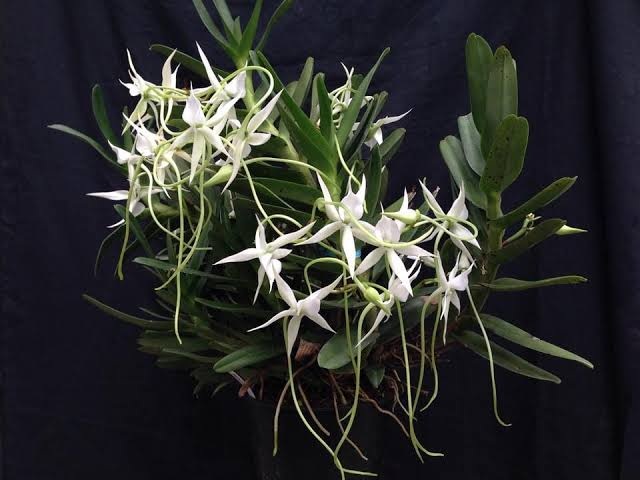
Flowers are produced on short axillary spikes (2–4 flowers per inflorescence). Each flower is white, star‑shaped, approximately 20–24 mm long (2–2.4 cm) according to a grower description ([10]), and about 2 in (5 cm) across in a Smithsonian specimen ([5]). The lip is shallow with a long nectar spur (≈ 4 in in length reported by a hobbyist, not formally measured). Flowers emit a sweet fragrance at night.
Because several Angraecum species have small white flowers, identification should be confirmed by the combination of growth habit (compact monopodial epiphyte), elevation range (600–1000 m), and the relatively long spur.
Native Range and Habitat
According to POWO, the species is native to the Comoro Islands, specifically the island of Njazidja (also known as Anjouan) ([1],[2]). It is listed as “doubtfully present” in Madagascar, but no confirmed records exist ([1]).
In its natural environment the orchid grows epiphytically on tree trunks and in moist scrub forest, typically between 600 and 1000 m elevation ([5],[10]). The habitat is described as a seasonally dry tropical biome with a pronounced wet season, and the plants are found in relatively bright, but not exposed, light conditions.
Species‑Specific Care
| Factor | Documented guidance | Evidence |
|---|---|---|
| Light | Bright, indirect light; a spot a few metres from a window works well. | Growli (medium indirect light) [7]; Travaldo (fairly bright light) [10] |
| Temperature | Warm day temperatures 21–27 °C (70–80 °F); night temperatures 18–22 °C (65–72 °F). | Travaldo care guide [10]; Ecuagenera product page (21–27 °C day, 18–22 °C night) [12] |
| Watering | Water when the growing medium begins to dry; in practice this is every 3–5 days under moderate humidity. | Growli (watering every 3–5 days) [7]; Travaldo (tolerates dry‑out, water when substrate dries) [10] |
| Humidity | High humidity, ideally around 80 % (acceptable range 60–85 %). | Travaldo (80–85 %) [10]; Ecuagenera (60–80 %) [12] |
| Substrate / Mounting | Well‑drained orchid mix in a pot, or mounted on a tree‑fern slab; fine bark mix works well. | Travaldo (well‑drained containers or mounts) [10]; Marniturkel grower notes (fine bark mix) [11] |
| Airflow | Good air movement is recommended, but specific guidance is not documented. | Not documented |
| Fertilizer | Use a balanced, diluted fertilizer at each watering (e.g., ¼‑½ strength). Specific regimen not documented for this species. | Not documented (general orchid practice only) |
| Repotting | Repot when the medium breaks down, typically every 2–3 years. | Not documented for this species |
In cultivation the most critical factors are maintaining warm temperatures, high humidity, and allowing the medium to dry slightly between waterings. The orchid tolerates a brief dry period but should not be allowed to become completely desiccated. Mounting on bark or a slab mimics its natural epiphytic habit and can improve airflow.
Flowering and Pollination
Flowering in the wild occurs in the spring months of the Southern Hemisphere, but precise phenology is not documented in the sources provided. Cultivated plants often flower from late winter to early spring under appropriate light and temperature regimes (Growli) [7].
Flowers are fragrant at night, suggesting moth pollination, a common syndrome in Angraecum. No specific pollinator has been recorded for A. florulentum; the nocturnal scent and long spur are consistent with hawk‑moth pollination, but this remains a hypothesis.
Conservation and Responsible Cultivation
The Angiosperm Extinction Risk Predictions (2024) list Angraecum florulentum as “Threatened” with high confidence ([2]). This assessment is a predictive model, not an IUCN Red List category, but it indicates potential vulnerability. Collectors should source plants from reputable growers who propagate from cultivated stock rather than wild collection.
Evidence and Limitations
Most ecological and morphological details derive from horticultural observations (Smithsonian, Growli, Travaldo, Marniturkel). Formal peer‑reviewed studies on this species are lacking, so measurements such as flower size and elevation range are based on limited field reports. Pollination biology is inferred from flower morphology; no direct observations are available. Conservation status is based on a predictive model rather than an official assessment.
Frequently asked questions
Is Angraecum florulentum toxic to cats or dogs?
The species is listed as non‑toxic to cats and dogs by the ASPCA; no specific toxic compounds have been reported for this orchid.
What light conditions does this orchid need?
It prefers bright, indirect light – a spot a few metres from a window or under filtered sunlight.
When does Angraecum florulentum usually flower?
Flowering time is not precisely documented; cultivated plants often bloom from late winter to early spring when provided with appropriate light and temperature.
Related terminology
- Epiphytic
- Plants that grow on other plants (usually trees) but are not parasitic, obtaining moisture and nutrients from the air and rain.
- Monopodial
- A growth form in orchids where a single main stem grows continuously, producing leaves and flowers along its length.
FOLLOW THE EVIDENCE
Sources & references
- Angraecum florulentum Rchb.f. | Plants of the World Online | Kew Science, https://powo.science.kew.org/taxon/616137-1
- Angraecum florulentum Rchb.f. | Plants of the World Online – General information, https://powo.science.kew.org/taxon/urn:lsid:ipni.org:names:616137-1/general-information
- Angiosperm Extinction Risk Predictions v1 (2024) – predicted threat status for Angraecum florulentum, cited via POWO, https://powo.science.kew.org/taxon/616137-1
- International Plant Names Index (IPNI) entry for Angraecum florulentum, https://www.ipni.org/n/616137-1
- Angraecum florulentum – Smithsonian Gardens collection, https://gardens.si.edu/collections/explore/object/ofeo-sg_2009-2020A
- Angraecum florulentum orchid plant care and culture | Travaldo's blog, https://travaldo.blogspot.com/2018/09/angraecum-florulentum-orchid-plant-care-and-culture.html
- Freely Flowering Angraecum care — full guide | Growli, https://www.getgrowli.app/plant-care/freely-flowering-angraecum
- Angraecum florulentum – Ecuagenera product page, https://ecuagenera.com/products/angraecum-florulentum
- Angraecum florulentum – Mostly Species grower notes, http://marniturkel.com/mostlyspecies/f.ang.flor.749.html