At a glance
RECORDED PROFILE DATA- Scientific name
- Angraecum eburneum Bory
- Name status
- Accepted (Kew POWO)
- Native region
- SE Kenya to E Tanzania (incl. Pemba, Zanzibar), W Indian Ocean; also Aldabra, Comoros, Madagascar, Mauritius, Réunion, Seychelles, Tanzania, Kenya
- Growth habit
- Epiphyte or lithophyte (FTEA); Smithsonian Gardens lists lithophytic
- Cultivation temperature group
- Not documented
- Common names
- Comet Orchid; Ivory-Colored Angraecum (Smithsonian Gardens)
- Plant size
- Stem 60–100 cm long, 1.5–2 cm diameter (FTEA)
- Flower size
- 3 in across (Smithsonian Gardens)
- Habitat elevation
- 0–750 m (Smithsonian Gardens)
- Flowering context
- Oct–Feb in Northern Hemisphere, peak Jan (Smithsonian Gardens collection context)
Names and Taxonomy
Angraecum eburneum Bory is the accepted scientific name for this orchid in Kew Plants of the World Online (POWO) [1]. The name was first published in Voy. îles Afrique 1: 359 (1804) [1]. POWO treats the species as accepted and lists four accepted infraspecific taxa: A. eburneum subsp. eburneum, subsp. giryamae (Rendle) Senghas & P.J.Cribb, subsp. superbum (Thouars) H.Perrier, and subsp. xerophilum H.Perrier [1]. The requested phrase SE Kenya to E Tanzania, Pemba, Zanzibar, W Indian Ocean matches POWO’s summary native range, not a separate species name [1].
POWO lists three homotypic synonyms: Limodorum eburneum (Bory) Willd., Angorkis eburnea (Bory) Kuntze, and Angorkis eburnangis Thouars, the last marked nom. illeg. superfl. [1]. These are nomenclatural synonyms, not separate accepted species. Smithsonian Gardens uses the common names Comet Orchid and Ivory-Colored Angraecum and describes the plant as the type species of Angraecum [3]. The available sources do not document a formal common-name standard, so common names should be treated as horticultural labels rather than taxonomic evidence.
How to Identify This Species
The Flora of Tropical East Africa account, reproduced in POWO’s general-information page, describes A. eburneum as a large, robust epiphyte or lithophyte [2]. The erect stem is reported as 60–100 cm long and 1.5–2 cm in diameter, with thick, fleshy, boot-lace-like roots 3.5–5 mm in diameter [2]. Leaves are 6–10 or more, distichous, fleshy-coriaceous, obovate-ligulate, and unequally roundly bilobed at the apex; the account gives leaf dimensions of 16–50(–70) cm long and 2.9–7 cm wide [2].
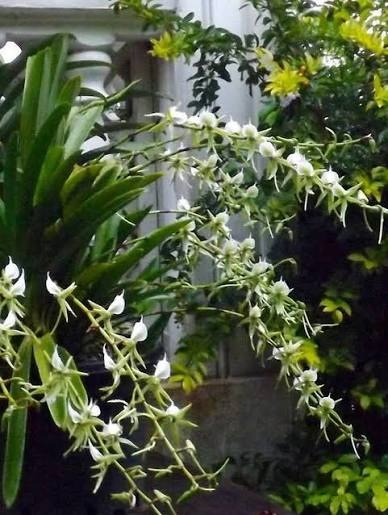
Inflorescences are described as suberect or ascending, 8–20-flowered, and 30–75 cm long, with a stout peduncle 12–29 cm long bearing 1–3 well-spaced sheaths [2]. The floral account notes a white lip, yellow-green at the mouth of the spur, green sepals, petals, and column, and a pleasant scent at night [2]. Smithsonian Gardens adds that the flowers are held upside down, with the white lip pointing upward and the green petals hanging beneath; it describes the horizontal inflorescence as up to 4 ft long, the flowers as long-lived, very waxy, and 3 in across, and the fragrance as Gardenia-like [3].
Identification from a photograph or nursery label should be cautious. The combination of large size, distichous fleshy leaves, long many-flowered inflorescences, green sepals and petals, and a white lip is diagnostic within the evidence available, but the sources do not provide a full comparative key to all four accepted subspecies. Subspecies identity should not be assigned from a single flower photo without documented provenance and, ideally, taxonomic review.
Native Range and Habitat
POWO gives the native range as southeastern Kenya to eastern Tanzania, including Pemba and Zanzibar, and the western Indian Ocean [1]. Its native-to list includes Aldabra, Comoros, Kenya, Madagascar, Mauritius, Réunion, Seychelles, and Tanzania [1]. This is a native distribution, not evidence of introduced occurrence or cultivation escape. The same source describes the species as an epiphyte growing primarily in the wet tropical biome [1].
The Flora of Tropical East Africa account calls it an epiphyte or lithophyte [2], and Smithsonian Gardens lists its life form as lithophytic and gives a habitat elevation of 0–750 m [3]. A paper on the reproductive biology of A. eburneum subsp. superbum notes in the available excerpt that A. eburneum is rather frequent in coastal forests [4]; this is habitat context, not a cultivation prescription. The supplied sources do not give a detailed host-tree list, microhabitat measurements, or a full seasonal climate profile for the species across its range.
The sources differ in emphasis: POWO calls it an epiphyte, while the Flora of Tropical East Africa and Smithsonian Gardens also record lithophytic growth [1][2][3]. This is best treated as a facultative habit rather than a contradiction.
Species-Specific Care
The supplied sources do not provide species-specific cultivation protocols for A. eburneum. They document growth habit, native range, habitat elevation, and flowering context, but not greenhouse or indoor setpoints. The table therefore marks unsupported care factors as Not documented rather than borrowing values from other Angraecum species.
| Factor | Documented guidance | Evidence or context |
|---|---|---|
| Temperature | Not documented | No species-specific temperature regime in the available sources; native elevation (0–750 m) is habitat context only [3]. |
| Light | Not documented | No species-specific light level supplied. |
| Watering | Not documented | No species-specific watering schedule supplied. |
| Humidity and airflow | Not documented | No species-specific humidity target or airflow requirement supplied. |
| Potting or mounting | Not documented | Documented as epiphytic or lithophytic [2][3], but exact cultivation method is not specified. |
| Feeding | Not documented | No species-specific fertilizer regime supplied. |
| Repotting | Not documented | No species-specific repotting interval supplied. |
| Seasonal changes | Not documented | No dry rest or seasonal temperature change is documented for this species in the supplied sources. |
What can be said from the evidence is limited. The plant is documented as a large, robust epiphyte or lithophyte [2], and its cultivation context would need to be checked against that documented habit. The sources do not state a preferred medium, mount, pot size, light intensity, or watering frequency. Smithsonian Gardens records bloom time in the Northern Hemisphere as October to February, peaking in January, in its collection context [3]; that is a flowering observation, not a care schedule. No cultivation temperature group is documented, and none should be inferred solely from the native elevation range.
Flowering and Pollination
Smithsonian Gardens records bloom time in the Northern Hemisphere as October to February, with a peak in January, for its collection [3]. This is a cultivated/garden record and should not be assumed to apply to every wild population or to the Southern Hemisphere without local evidence. The Flora of Tropical East Africa account describes the flowers as pleasantly scented at night [2], while Smithsonian Gardens describes the fragrance as Gardenia-like [3].
Smithsonian Gardens lists a moth pollination syndrome for A. eburneum [3]. The available sources do not name a specific moth pollinator for this species, nor do they document a pollination experiment on the nominate subspecies. The floral morphology includes a spur, as the Flora of Tropical East Africa account refers to the mouth of the spur [2], and Smithsonian Gardens lists a moth pollination syndrome [3]. A syndrome is not the same as a confirmed pollinator record. Flower longevity is described as long-lived and very waxy by Smithsonian Gardens [3]; the exact number of days is not documented in the supplied excerpts.
Conservation and Responsible Cultivation
POWO’s general-information page includes an Angiosperm Extinction Risk Prediction (AERP) of not threatened with confident confidence [2]. This is a predicted extinction-risk result, not a formal IUCN Red List assessment in the supplied excerpt. No formal conservation status, legal trade status, or population trend for A. eburneum is documented in the available sources. Cultivation claims should therefore be separated from conservation claims; a nursery purchase is not evidence of legal compliance or of wild-source status.
Evidence and Limitations
This profile is based on Kew POWO taxonomy and distribution, the Flora of Tropical East Africa morphology account reproduced by POWO, Smithsonian Gardens collection data, and a short excerpt from a paper on A. eburneum subsp. superbum [1][2][3][4]. The sources are search snippets or selected page excerpts, not full taxonomic revisions or complete cultivation trials. Material gaps include species-specific temperature, light, watering, humidity, airflow, potting, feeding, repotting, and seasonal-rest data; a named pollinator; flower longevity in days; and a formal conservation assessment. Subspecies delimitation and the application of common names also need taxonomic and horticultural review. No claim here should be read as a botanical review or as verified cultivation advice for every collection.
Frequently asked questions
What is the accepted scientific name of Angraecum eburneum?
Kew Plants of the World Online treats Angraecum eburneum Bory as the accepted name. It was first published in Voy. îles Afrique 1: 359 (1804).
Where is Angraecum eburneum native?
POWO gives the native range as southeastern Kenya to eastern Tanzania, including Pemba and Zanzibar, and the western Indian Ocean. Its native-to list includes Aldabra, Comoros, Kenya, Madagascar, Mauritius, Réunion, Seychelles, and Tanzania.
Is Angraecum eburneum epiphytic or lithophytic?
The Flora of Tropical East Africa describes it as an epiphyte or lithophyte. POWO calls it an epiphyte, while Smithsonian Gardens lists a lithophytic life form; the evidence supports treating the habit as facultative.
What are the common names of Angraecum eburneum?
Smithsonian Gardens uses Comet Orchid and Ivory-Colored Angraecum. The available sources do not document a formal common-name standard.
What cultivation temperature group does Angraecum eburneum need?
Not documented in the supplied sources. The native elevation range is habitat context and should not be used to infer a cultivation temperature group.
When does Angraecum eburneum bloom?
Smithsonian Gardens records bloom time in the Northern Hemisphere as October to February, peaking in January, in its collection context. This should not be assumed for every wild population or for the Southern Hemisphere.
What pollinates Angraecum eburneum?
Smithsonian Gardens lists a moth pollination syndrome. The available sources do not name a specific moth pollinator for this species.
Is Angraecum eburneum threatened?
POWO’s general-information page includes an Angiosperm Extinction Risk Prediction of not threatened with confident confidence. This is a predicted extinction-risk result, not a formal IUCN Red List assessment in the supplied excerpt.
Related terminology
- Angraecum
- A genus of epiphytic or lithophytic orchids in the tribe Vandeae, family Orchidaceae; the supplied sources treat Angraecum eburneum as an accepted species in this genus.
- Epiphyte
- A plant that grows on another plant for support without deriving sustenance from it; POWO describes A. eburneum as an epiphyte.
- Lithophyte
- A plant that grows on rocks; the Flora of Tropical East Africa and Smithsonian Gardens record a lithophytic habit for A. eburneum.
- Moth pollination syndrome
- A suite of floral traits associated with moth pollination; Smithsonian Gardens lists this syndrome for A. eburneum, but the available sources do not name a pollinator species.
- Infraspecific taxon
- A taxonomic rank below species, such as a subspecies; POWO lists four accepted subspecies of A. eburneum.
FOLLOW THE EVIDENCE
Sources & references
- Angraecum eburneum Bory. Plants of the World Online, Kew Science. https://powo.science.kew.org/taxon/616096-1
- Angraecum eburneum Bory — General information. Plants of the World Online, Kew Science (includes Flora of Tropical East Africa account and Angiosperm Extinction Risk Prediction). https://powo.science.kew.org/taxon/urn:lsid:ipni.org:names:616096-1/general-information
- Angraecum eburneum. Smithsonian Gardens Orchid Collection. https://gardens.si.edu/collections/explore/object/ofeo-sg_1978-0021A
- Buyun, L.I., Cherevchenko, T.M., Kovalska, L.A., and Ivannikov, R.V. Reproductive biology of Angraecum eburneum subsp. superbum (Orchidaceae) under glasshouse conditions. https://eeb.lu.lv/EEB/201503/EEB_XII_1_Buyun.pdf

