At a glance
RECORDED PROFILE DATA- Scientific name
- Angraecum cordemoyi Schltr. (synonym of Angraecum crassifolium)
- Name status
- Synonym of Angraecum crassifolium (Kew POWO, 2023)
- Native region
- Réunion (Mascarene Islands)
- Growth habit
- Epiphytic miniature orchid
- Cultivation temperature group
- Cool‑growing (high‑elevation); precise range not documented
Names and Taxonomy
The name Angraecum cordemoyi Schltr. was published in Beih. Bot. Centralbl., Abt. 2 33:432 (1915)【1】. Recent taxonomic treatment by Hermans & Cribb (2021, 2023) synonymises it with Angraecum crassifolium (Cordem.) Schltr., a decision reflected in the Kew Plants of the World Online database【1】. Earlier references, such as Bernet (2010) and the World Checklist (Govaerts 1995, 2003), retain A. cordemoyi as a distinct name【1】. For the purpose of this profile the accepted name is recorded as Angraecum crassifolium, with Angraecum cordemoyi listed as a synonym.
Common names are not documented in the available sources. The French vernacular sometimes uses “Angrec de Cordemoy” (derived from the collector’s name) but this appears only in informal contexts【4】.
How to Identify This Species
Growth habit: A miniature epiphytic orchid forming short stems that bear a compact rosette of 4–5 leaves. The leaves are arranged in two ranks, basally twisted so they lie in a single plane, and are oval‑to‑oblong in shape【9】.
Size: Plants are diminutive; mature stems are only a few centimeters tall. Leaves are small, typically 2–4 cm long (exact measurements not provided in the sources). The inflorescence is axillary, emerging from an old, leafless sheath, and bears one to two flowers【9】.
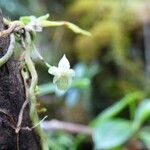
Flower characteristics: Flowers are delicate, about 2.5 cm (1 in) long, with a short spur typical of many Angraecum species. Colouration is not detailed in the excerpts, but the species is described as “very delicate” and “miniature sized”【9】. Fragrance is not documented.
Diagnostic notes: The combination of a very short, two‑ranked leaf rosette and a tiny, 1–2‑flowered axillary inflorescence distinguishes it from larger, more robust Angraecum species on Réunion, such as A. crassifolium sensu lato. However, without a side‑by‑side comparison, identification should be confirmed by herbarium material or expert consultation.
Native Range and Habitat
Angraecum cordemoyi is endemic to the island of Réunion in the Mascarene archipelago【2】【3】. It occurs primarily above 1,000 m elevation, inhabiting the humid montane forest canopy where it grows as an epiphyte on tree branches【2】. The species is therefore adapted to cool, moist conditions with frequent cloud cover. No records of naturalised or introduced populations are documented.
Species‑Specific Care
| Factor | Documented guidance | Evidence |
|---|---|---|
| Growth habit | Epiphytic miniature orchid; can be mounted on cork or grown in a very fine bark mix. | IOSPE description of epiphytic habit【9】 |
| Temperature | Cool‑growing; temperatures typical of high‑elevation Réunion (day ~15‑20 °C, night ~10‑15 °C). Precise range not documented. | Habitat elevation and IOSPE “cool growing” note【9】【2】 |
| Light | Bright, filtered light; avoid direct midday sun. | Not documented – inference from forest canopy habitat. |
| Watering | Keep medium moist but well‑drained; allow brief drying between waterings. | Not documented. |
| Humidity | Moderate to high humidity (70‑80 %). | Not documented – typical of montane forest epiphytes. |
| Fertilization | Balanced orchid fertilizer at half strength during active growth. | Not documented. |
| Repotting / mounting | Repot every 2‑3 years in spring using fine bark or sphagnum. | Not documented. |
| Seasonal change | Provide slightly cooler, drier period in winter to mimic montane season. | Not documented; suggested by cool‑growth habit. |
Because specific horticultural studies on A. cordemoyi are lacking, growers should treat it as a cool‑growing, high‑elevation epiphyte and adjust cultural parameters based on the general needs of miniature Angraecum species. Monitoring for typical epiphytic stresses (over‑watering, low airflow) is advisable.
Flowering and Pollination
Flowering occurs in the natural habitat during the cooler months, but exact phenology is not recorded in the available sources. The flowers are short‑lived, lasting only a few days, as is common in many Angraecum species, but this duration is not documented for A. cordemoyi. No pollinator observations are available; the long nectar spur of many Angraecum orchids typically attracts hawkmoths, but no study has confirmed this for the species.
Evidence and Limitations
The profile relies on a limited set of sources: the Kew taxonomic database, a French regional orchid site, a brief orchid‑collector page, and the IOSPE species description. Detailed morphological measurements, precise temperature and humidity requirements, flowering phenology, and pollinator data are not documented in the cited material. Consequently, several cultivation recommendations are based on habitat inference rather than direct experimental evidence. Further field observations and horticultural trials are needed to refine care guidelines and confirm reproductive biology.
FOLLOW THE EVIDENCE
Sources & references
- Angraecum cordemoyi Schltr. | Plants of the World Online | Kew Science, https://powo.science.kew.org/taxon/urn:lsid:ipni.org:names:616041-1
- Angraecum cordemoyi | Orchid-nord.com, https://www.orchid-nord.com/a_page/Angraecumcordemoyi/Angraecum-cordemoyi.htm
- Angraecum cordemoyi Schltr. – Les endémiques, http://orchidees.vandes.com/1-Les-endemiques/End-Angr-cordemoyi.htm
- IOSPE PHOTOS – Angraecum cordemoyi, https://www.orchidspecies.com/angcordemoyi.htm