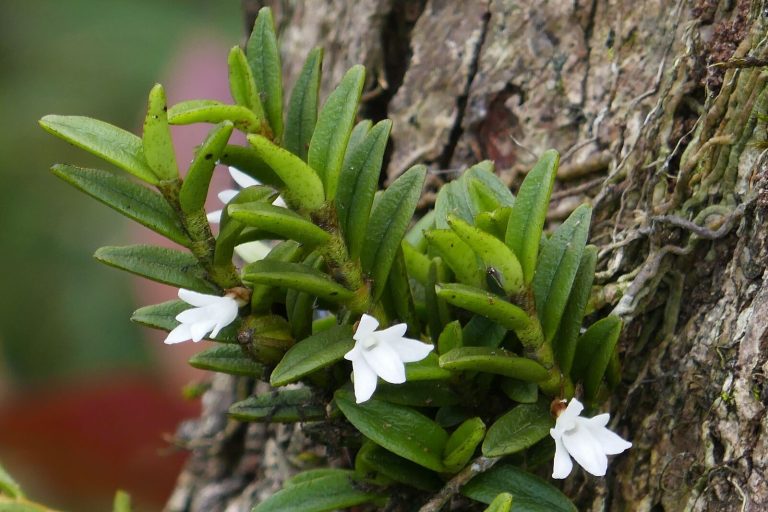
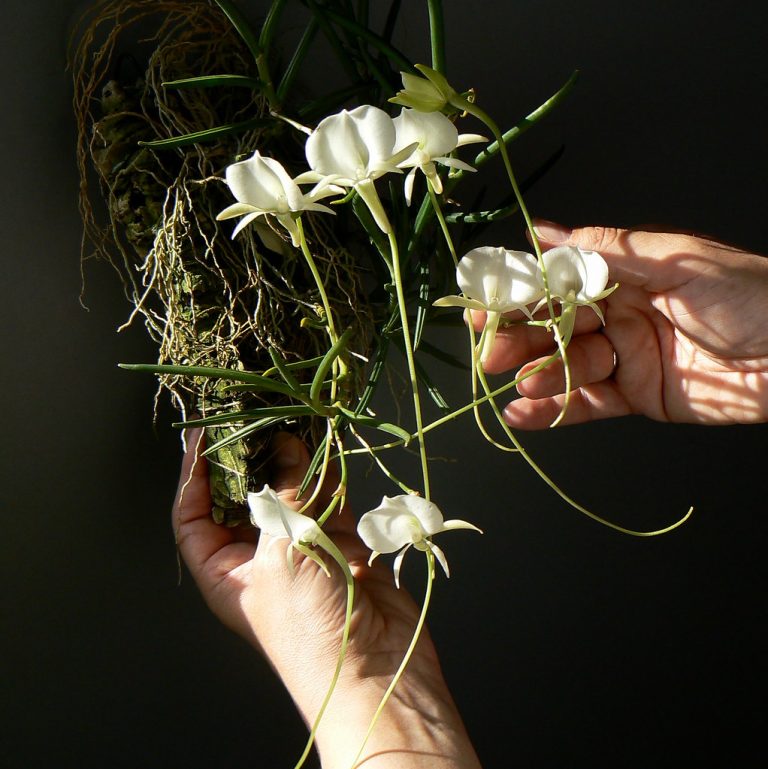
At a glance
RECORDED PROFILE DATA- Scientific name
- Angraecum xylopus Rchb.f.
- Name status
- Accepted
- Native region
- Comoros
- Growth habit
- Epiphytic subshrub
- Cultivation temperature group
- Not documented
Names and Taxonomy
The accepted scientific name for this orchid is Angraecum xylopus Rchb.f. The name was first published in Flora 68: 538 (1885) and is listed as an accepted species by Kew’s Plants of the World Online.[1] Documented synonyms include Macroplectrum xylopus (Rchb.f.) Finet and Boryangraecum xylopus (Rchb.f.) Szlach., Mytnik & Grochocka.[1][2] No common names or infraspecific taxa are recorded in the consulted sources.
How to Identify This Species
Field descriptions are sparse. The species is reported as an epiphytic subshrub, indicating a relatively compact growth form that attaches to tree bark or branches. Leaves are typical of the genus – leathery, opposite, and arranged along a short stem, but specific leaf dimensions for A. xylopus are not documented.[1][2] Flower morphology is not detailed in the available literature; consequently, diagnostic characters such as lip shape, spur length, or fragrance remain unknown.[2] Identification therefore relies primarily on locality (Comoros) and the combination of an epiphytic habit with the generic Angraecum flower structure when specimens are examined by a specialist.
Native Range and Habitat
Angraecum xylopus is endemic to the Comoros archipelago in the western Indian Ocean.[1][2][3] It occurs in the seasonally dry tropical biome, growing as an epiphyte on trees within forested areas that experience a marked dry season. The precise elevation range is not reported, nor are specific host tree species documented.
Species-Specific Care
| Factor | Documented guidance | Evidence |
|---|---|---|
| Growth medium | Not documented | — |
| Mounting vs. potting | Not documented | — |
| Light | Not documented | — |
| Temperature | Not documented | — |
| Watering | Not documented | — |
| Humidity | Not documented | — |
| Fertilisation | Not documented | — |
| Seasonal rest | Not documented | — |
Because no species‑specific horticultural data are available, growers should treat A. xylopus as a typical Angraecum epiphyte: mount on bark or use a well‑draining orchid mix, provide bright filtered light, maintain high humidity, and avoid waterlogging. However, these recommendations are extrapolated from related species and are not confirmed for A. xylopus itself.
Flowering and Pollination
Information on flowering time, flower longevity, scent, spur length, or pollinator identity for Angraecum xylopus is not recorded in the consulted sources.[2] The genus commonly exhibits night‑fragrant, long‑spurred flowers pollinated by hawk‑moths, but this cannot be assumed for this species without direct observation.
Conservation and Responsible Cultivation
The conservation status of Angraecum xylopus has not been evaluated in the sources consulted. Its restriction to the Comoros suggests a potentially limited distribution, and habitat loss on the islands could be a concern, but formal assessments (e.g., IUCN Red List) are not cited.
Evidence and Limitations
This profile is based on three publicly available sources. Critical data such as detailed morphology, precise habitat parameters, flowering phenology, pollination biology, and cultivation requirements are absent. Consequently, many sections contain “Not documented” statements. Further field studies and horticultural trials are needed to fill these gaps.
Frequently asked questions
Is Angraecum xylopus commonly cultivated?
There are no published cultivation notes for this species; it is not known to be in regular trade.
What is the conservation status of Angraecum xylopus?
A formal conservation assessment has not been found in the available literature.
FOLLOW THE EVIDENCE
Sources & references
- Angraecum xylopus Rchb.f. – Plants of the World Online, Kew Science, 2026, https://powo.science.kew.org/taxon/urn:lsid:ipni.org:names:616494-1
- Angraecum xylopus – Swedish Wikipedia, 2014, https://sv.wikipedia.org/wiki/Angraecum_xylopus
- Contribution to the ecological study of orchids in the Comoros archipelago: floristic diversity, biogeography, ecological status, and conservation challenges, 2026, https://gjournals.org/GJAS/Publication/2026/3/HTML/062426095Abdillahietal.htm