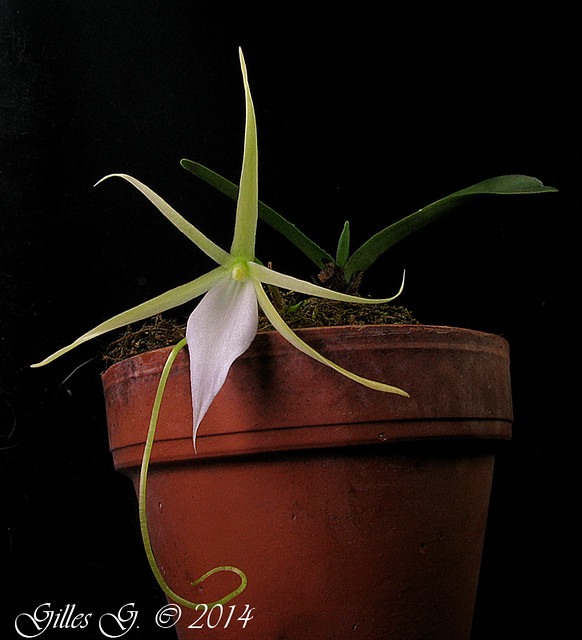
At a glance
RECORDED PROFILE DATA- Scientific name
- Angraecum humbertii H.Perrier
- Name status
- Accepted by POWO
- Native region
- Madagascar; POWO gives SE Madagascar, IOSPE reports SW Madagascar
- Growth habit
- Lithophytic subshrub
- Cultivation temperature group
- Warm-growing descriptor from IOSPE; numeric thresholds not documented
- Flower size
- 5 in (12.5 cm), as reported by IOSPE
- Inflorescence
- About 8 in (20 cm), 4–8 successively flowered, as reported by IOSPE
- Habitat elevation
- About 800 m, as reported by IOSPE
- Common name
- Humbert's Angraecum, as reported by IOSPE
- Homotypic synonym
- Arachnangraecum humbertii (H.Perrier) Szlach., Mytnik & Grochocka
Angraecum humbertii H.Perrier is an accepted Madagascan orchid in the family Orchidaceae. Kew Plants of the World Online treats it as a lithophytic subshrub of seasonally dry tropical biome and gives its native range as SE Madagascar [1]. A horticultural habitat account in IOSPE instead places it in southwestern Madagascar, growing on rocks in dry deciduous forests on western mountain slopes at about 800 m [2]. The name is not in dispute in the supplied sources, but the regional distribution conflict should be kept visible rather than smoothed over.
Names and Taxonomy
Angraecum humbertii H.Perrier was first published in Notulae Systematicae (Paris) 8: 46 (1939), according to POWO [1]. POWO accepts the name and lists one homotypic synonym: Arachnangraecum humbertii (H.Perrier) Szlach., Mytnik & Grochocka, published in Biodiversity Research and Conservation 29: 11 (2013) [1]. Because the synonym is homotypic, it is based on the same type as A. humbertii; it should not be treated as a separate species in a species profile.
IOSPE gives the common name Humbert’s Angraecum and lists the species under section Arachnangraecum [2]. The POWO excerpt supplied here does not provide a sectional placement, so the section note is best treated as source-specific rather than as a full modern classification. No varieties or subspecies are documented in the supplied excerpts. The requested phrase “SW Madagascar” is a geographic qualifier, not part of the scientific name.
How to Identify This Species
The available species description is brief but diagnostic in habit. IOSPE describes A. humbertii as a small-sized, warm-growing lithophyte with a short, thick, slightly compressed stem [2]. The leaves are two-ranked, broadly linear to loriform, often conduplicate, leathery, slightly glossy, and very unequally bilobed at the apex, with rounded lobes and clasping bases [2]. The root system is not described in the supplied excerpts.
IOSPE reports a flower size of 5 in (12.5 cm) and a robust inflorescence about 8 in (20 cm) long, bearing four to eight successively flowered blooms, two to three acute sheaths, and a very thin floral bract [2]. Those measurements are from a single horticultural source and were not independently checked here. The supplied excerpts do not document flower color, lip shape, spur length, fragrance, or pollinator, so identification should not be based on a name label or a single photograph. A plant matching the leaf arrangement and reported flower dimensions is a candidate, but confirmation should rely on verified botanical material and, ideally, the original description or a flora treatment.
Native Range and Habitat
POWO gives the native range as SE Madagascar and describes the species as a lithophytic subshrub growing primarily in the seasonally dry tropical biome [1]. IOSPE separately reports southwestern Madagascar, with plants growing on rocks in dry deciduous forests on the western slopes of mountains, on rocky outcrops, at elevations around 800 m [2]. The CITES Orchid Checklist also lists the species for Madagascar [3], which supports the country-level distribution but does not resolve the regional disagreement.
The conflict between “SE Madagascar” in POWO and “southwestern Madagascar” in IOSPE is material and should not be averaged into a vague “southern Madagascar” statement. The two sources may reflect different data sets, different circumscriptions of regional terms, or a distribution that spans more than one area; the supplied excerpts do not allow a conclusion. The documented habitat is lithophytic, not epiphytic or terrestrial: plants are reported on rocks and rocky outcrops in dry deciduous forest [1][2]. No introduced or cultivated occurrence is treated here as part of the native range. Seasonality is indicated by the seasonally dry tropical biome and dry deciduous forest descriptors [1][2], but the excerpts do not give a month-by-month rainfall pattern or a microhabitat temperature record.
Species-Specific Care
Species-specific cultivation evidence is limited. The table below separates what is documented from what is absent; it does not convert habitat data into greenhouse setpoints.
| Factor | Documented guidance | Evidence or context |
|---|---|---|
| Temperature | Described as warm-growing; numeric day/night thresholds are not documented. | IOSPE uses the descriptor “warm growing” for this species [2]. No temperature range is supplied, and the ~800 m habitat elevation is not a cultivation setpoint. |
| Light | Not documented in the available sources. | No species-specific light measurement or grower trial was supplied. |
| Watering | Not documented; no dry rest is documented. | The habitat is seasonally dry, but the excerpts do not specify watering frequency, seasonal reduction, or a rest period for cultivation [1][2]. |
| Humidity and airflow | Not documented in the available sources. | No species-specific humidity or airflow values were supplied. |
| Potting or mounting | Lithophytic in habitat; a species-specific pot, mount, or medium protocol is not documented. | POWO calls it a lithophytic subshrub [1]; IOSPE reports growth on rocks in dry deciduous forest [2]. A well-drained, open root environment is a reasonable inference from the lithophytic habit, not a tested prescription. |
| Feeding | Not documented in the available sources. | No species-specific fertilizer rate or timing was supplied. |
| Repotting | Not documented in the available sources. | No repotting interval or root-disturbance guidance was supplied. |
| Seasonal changes | Flowering is reported in late spring and early summer; a cultivation rest period is not documented. | IOSPE records the flowering period but does not specify hemisphere or growing context in the excerpt [2]. |
The most defensible care statement is therefore narrow: A. humbertii is documented as a warm-growing lithophyte, and its habitat is rocky and seasonally dry [1][2]. Growers should not assume that every Angraecum requires the same watering, humidity, or resting regime. Where no species-specific trial is available, any culture recommendation should be labeled as an inference and adjusted cautiously. The absence of a documented dry rest is especially important: the seasonally dry habitat does not by itself prove that cultivated plants should be kept dry for a fixed period.
Flowering and Pollination
IOSPE reports that A. humbertii blooms in late spring and early summer on a robust inflorescence about 20 cm long, with four to eight successively opening flowers [2]. The same source gives a flower size of 12.5 cm [2]. Because the excerpt does not state whether those months refer to the Southern or Northern Hemisphere, or to a particular greenhouse, the flowering period should be treated as source-specific rather than universal. “Successively flowered” indicates that the blooms open over a period rather than all at once, but the supplied excerpt does not give flower longevity.
No species-specific pollinator, nectar spur measurement, fragrance timing, or pollination mechanism is documented in the supplied sources. The genus Angraecum includes long-spurred species with specialized moth associations, but that general context must not be transferred to A. humbertii without evidence. For this profile, pollination is best recorded as not documented in the available sources.
Conservation and Responsible Cultivation
No formal conservation assessment for A. humbertii is documented in the supplied excerpts. The CITES Orchid Checklist lists the name and a Madagascar distribution [3], but that checklist is a nomenclatural reference, not a conservation status or a determination of legal trade status. Habitat loss and collection pressure are general concerns for Madagascan orchids, but the supplied sources do not quantify them for this species. Cultivation should be based on verified provenance; this profile makes no claim about the legality or sustainability of any particular nursery stock.
Evidence and Limitations
This profile relies on search snippets from POWO, IOSPE, and the CITES Orchid Checklist, not on full-page or full-paper verification [1][2][3]. The principal unresolved point is distribution: POWO says SE Madagascar, while IOSPE says southwestern Madagascar. The flower size, inflorescence length, flower count, and flowering months come from IOSPE and were not independently verified here. Root description, flower color, lip and spur morphology, fragrance, pollinator, flower longevity, and numerical cultivation thresholds are not documented in the supplied evidence. No formal conservation assessment was supplied. Identification of cultivated plants should be checked against verified botanical descriptions and photographs with known identity and rights; no image is requested or supplied in this profile.
Frequently asked questions
Is Angraecum humbertii an accepted species?
Yes. POWO accepts Angraecum humbertii H.Perrier and lists Arachnangraecum humbertii as a homotypic synonym [1].
Where does Angraecum humbertii grow natively?
It is native to Madagascar. POWO gives SE Madagascar, while IOSPE reports southwestern Madagascar; the supplied sources conflict on the regional distribution [1][2].
What is the growth habit of Angraecum humbertii?
POWO describes it as a lithophytic subshrub, and IOSPE reports it growing on rocks in dry deciduous forest [1][2].
How large are the flowers of Angraecum humbertii?
IOSPE reports a flower size of 5 in (12.5 cm); this measurement was not independently verified in the supplied evidence [2].
What temperature should Angraecum humbertii be grown at?
IOSPE calls it warm-growing, but no numeric day/night temperature thresholds are documented in the supplied sources [2]. The ~800 m habitat elevation should not be treated as a greenhouse setpoint.
Related terminology
- Lithophyte
- A plant that grows on rocks. POWO describes Angraecum humbertii as a lithophytic subshrub, and IOSPE reports it on rocks and rocky outcrops.
- Homotypic synonym
- A synonym based on the same nomenclatural type. POWO lists Arachnangraecum humbertii as a homotypic synonym of Angraecum humbertii.
- Seasonally dry tropical biome
- A biome descriptor used by POWO for the native range of Angraecum humbertii; it does not by itself specify a cultivation watering or resting regime.
FOLLOW THE EVIDENCE
Sources & references
- Royal Botanic Gardens Kew. Angraecum humbertii H.Perrier. Plants of the World Online. https://powo.science.kew.org/taxon/urn:lsid:ipni.org:names:616178-1
- IOSPE PHOTOS. Angraecum humbertii H.Perrier 1939. http://www.orchidspecies.com/anghumbertii.htm
- CITES Orchid Checklist, Volumes 1, 2 & 3 Combined. https://cites.org/sites/default/files/common/com/nc/tax_ref/PART_II_Names_incurrentuse.pdf

